7. The SDI or PADI Underwater Navigator course: is it worth it?
Short answer: yes, absolutely. Longer answer: here’s why.
The SDI or PADI Underwater Navigator Specialty course is designed to turn underwater navigation from something you do by guesswork into a solid, repeatable skill you can rely on.
What will you learn?
Over three guided dives with a certified instructor, you’ll practice:
- Distance estimation techniques (by time, kick cycles, and air consumption).
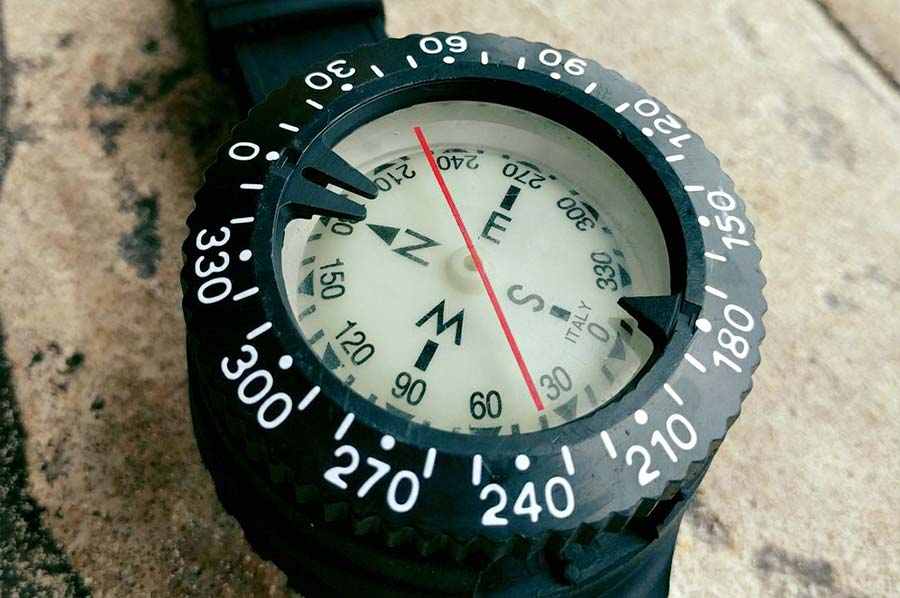
- Compass navigation making at least five different turns.
- Marking and relocating submerged objects from the surface.
- Creating underwater maps of the dive environment.
- Navigating in geometric patterns (square, triangle, rectangle).
Who can take it?
You only need an Open Water Diver certification (or PADI-recognized equivalent). It’s accessible from the recreational diver level — you don’t need advanced experience.
How long does it take and how much does it cost?
It’s typically completed in 1-2 days depending on the dive center. The price varies by location and center, but it’s one of the most affordable specialties in both the SDI and PADI catalog. Ask at your local dive center or book directly with Dressel Divers.
Is it required for the Advanced Open Water?
It’s not mandatory, but it’s one of the most recommended specialty options because the skills you gain apply to absolutely every future dive, regardless of the type of diving you do. Learning it early pays dividends for years.
8. FAQs about underwater navigation
How do divers navigate underwater without GPS?
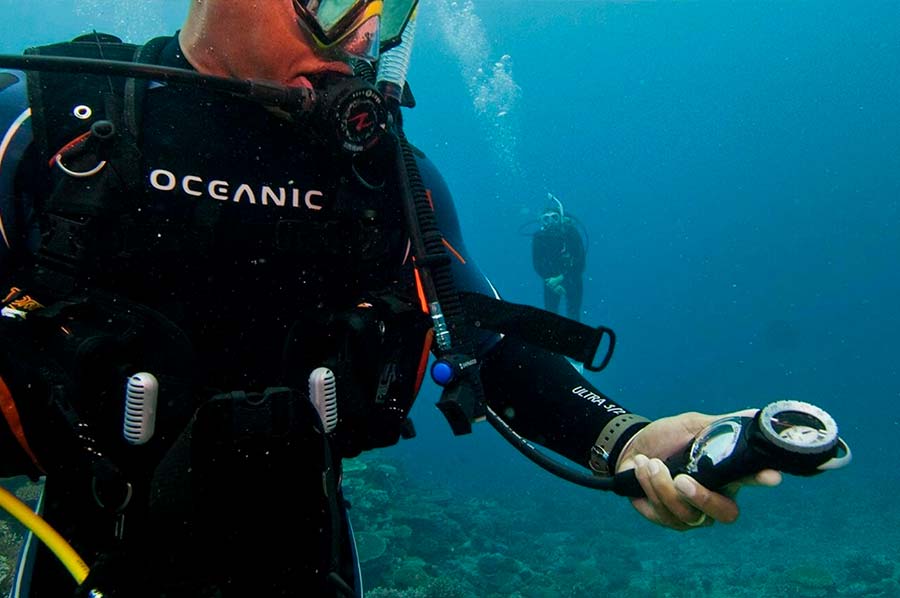
By combining three tools: natural environmental references (reef, light, sand), a diving compass to maintain precise headings, and continuous depth and time tracking with a dive computer. With practice, the system works remarkably well.
What is the best underwater navigation system?
The one that combines all three methods: natural navigation as the foundation, compass as the backup, and geometric patterns for systematic exploration. None of them works particularly well in isolation — the combination is what makes the difference.
Is underwater navigation difficult to learn?
No, though it does require practice. Most divers notice significant improvement after just two or three dives focused specifically on navigation practice. The SDI or the PADI course accelerates this considerably because the learning is guided and structured.
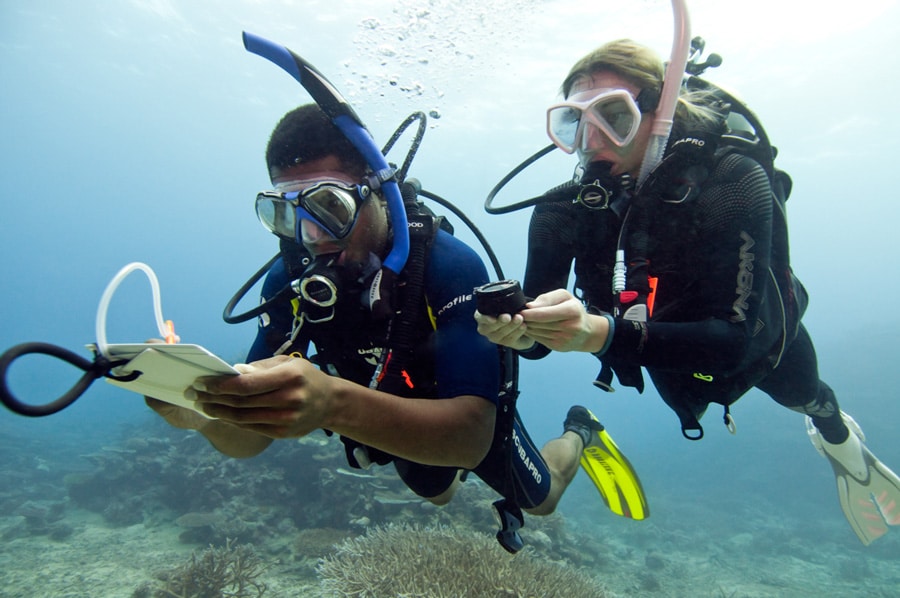
What is an underwater navigation board?
It’s a waterproof slate you can write on underwater to record headings, sketch the dive site, or share information with your buddy. It’s especially useful during exploration dives or when diving in unfamiliar locations.
What are the most effective navigation patterns for returning to the boat?
To return to the starting point (such as a boat or the shore), divers use geometric swimming patterns:
- Out-and-back navigation (Reciprocal): You travel a certain distance in one direction (e.g., north) and return in the opposite direction (south) after a 180-degree turn.
- Square or rectangular pattern: Ideal for searching for lost objects or exploring an area without losing orientation. It involves making 90-degree turns at predetermined time or distance intervals.
- Triangular pattern: Useful when you need to cover a wide area and return precisely to the original starting point.
What technological equipment exists for professional underwater navigation?
In addition to conventional compasses, professionals use:
- DVL (Doppler Velocity Log): Measures velocity relative to the seafloor.
- Acoustic Positioning Systems (USBL/LBL): Use transponders to triangulate the exact position of a diver or an ROV (Remotely Operated Vehicle).
- Underwater GPS: Although GPS does not work underwater, hybrid systems exist that transmit coordinates from surface buoys connected acoustically.
What are the biggest challenges of underwater navigation?
The aquatic environment presents unique obstacles:
- Lack of visual references: In murky water or monotonous sandy bottoms, it’s easy to lose orientation.
- Currents: They can drift a diver off course without them noticing.
- Depth effects: Stress and nitrogen narcosis can impair the cognitive ability needed to maintain a heading.
What advice would you give to improve diving navigation skills?
- Practice out-and-back navigation: It’s the fundamental exercise for learning to use a compass.
- Observe the environment before diving: Identify clear reference points on the surface.
- Maintain a steady pace: Counting your fin kicks is an effective way to measure distance without advanced technology.
- Trust your instruments: Your sense of direction underwater is often unreliable—always rely on your compass.
Is navigating in open water the same as in caves or wrecks?
No, these are very different environments. In open water, navigation relies on compasses and light references. In caves or wrecks, navigation is far more technical and restrictive; it requires the use of guideline systems (permanent lines or dive reels) to ensure a safe, unobstructed exit to the surface, following strict safety protocols.
Ready to become a true underwater navigator?
Underwater navigation isn’t a luxury reserved for advanced divers. It’s a fundamental skill that makes every single dive safer, more efficient, and — honestly — much more enjoyable.
When you know where you are underwater, you relax. When you relax, you use less air. When you use less air, you dive longer. And when you dive longer with confidence and control, the whole experience transforms.
If you want to accelerate your learning, the SDI or PADI Underwater Navigator course is one of the best investments you can make as a diver. Three dives can genuinely change your relationship with the underwater navigation.