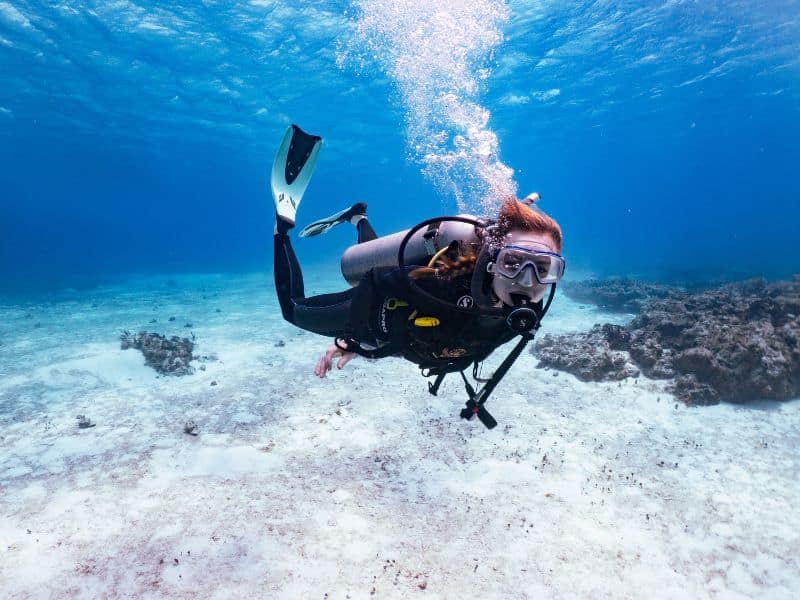

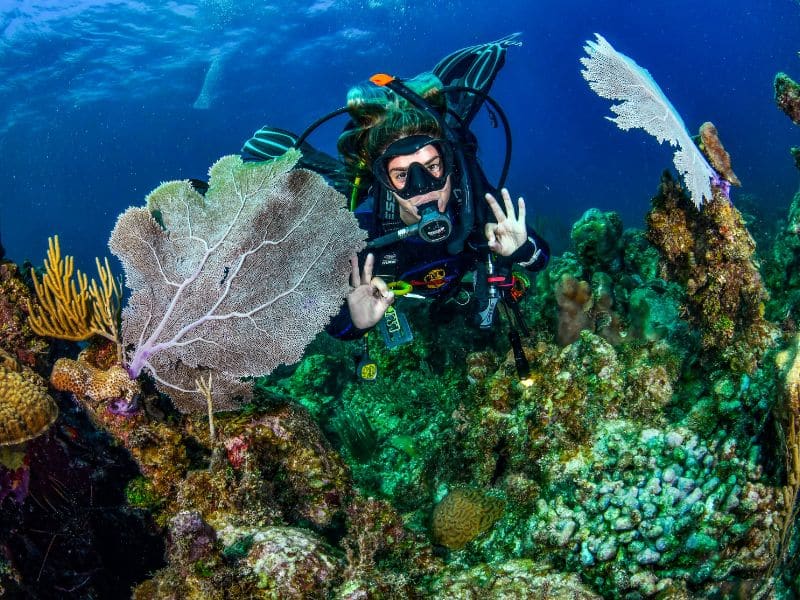
Short answer: how does SCUBA work? A tank on your back holds compressed air. A regulator, the piece of gear that does all the magic, steps that pressure down in two stages until it matches the water around you. You breathe in, air flows. You breathe out, bubbles escape through a one-way valve. No hoses to the surface, no holding your breath, everything smooth. Just you, a tank, and a very clever valve system.

Reef Lizardfish: Identification, Habitat & Behavior
22/07/2026
Scuba Diving Apparel: Much More Than Scuba Clothing
26/08/2026Table of Contents
2. How Does SCUBA Work? The Big Picture
3. How Does SCUBA Diving Work?
4. How Does a SCUBA Tank Work?
5. How Do SCUBA Tanks Work Together With the Regulator?
6. How Does a SCUBA Regulator Work?
8. How Do Divers Know How Much Air They Have Left?
9. Why Can You Breathe Normally Underwater?
10. Common Myths About How SCUBA Works

1. What Does SCUBA Mean?
SCUBA stands for Self-Contained Underwater Breathing Apparatus
Quite a mouthful, right? It is. But the concept is simple.
It’s a system that lets you breathe underwater while carrying your own air supply. No hose to the surface. No boat with a compressor. And definitely no holding your breath.
Just a scuba tank on your back and the freedom to swim wherever you want.
There are only three ways humans can stay underwater:
- Free diving (breath-hold diving): No breathing underwater. You hold your breath for as long as you can. That’s it. No gear. No air supply. Just your lungs and determination.
- Surface-supplied diving: Air comes through a hose connected to a compressor or support vessel on the surface. It’s perfect for commercial diving—but you’re always tethered.
- SCUBA diving: You carry your own breathing gas with you. Total independence. Total freedom.
A little history—because it’s worth telling.
In 1943, French naval officer Jacques-Yves Cousteau teamed up with engineer Émile Gagnan. They took an industrial demand valve—originally designed to regulate gas for automobile engines—and transformed it into the first reliable underwater breathing regulator: the Aqua-Lung.
Before that, divers either held their breath or dragged an air hose behind them.
After that, scuba diving as we know it was born.
2. How Does SCUBA Work? The Big Picture
Think of it as a relay race for pressure. The air starts out highly compressed inside the tank, then gets released in stages until it reaches exactly the right pressure for you to breathe comfortably—no matter how deep you are.
Here’s the journey your air takes, from the tank to the bubbles:
Tank → First Stage → Low-Pressure Hose → Second Stage → Your Lungs → Exhaust Bubbles
Broken down into six simple steps:
- Storage: Compressed air is stored inside a strong metal scuba tank at 200–232 bar (2,900–3,365 psi). That’s an enormous amount of air packed into a relatively small cylinder.
- First Pressure Reduction: The first stage regulator connects to the tank valve and reduces that extremely high pressure to an intermediate pressure—about 9–10 bar (130–145 psi) above the surrounding water pressure.
- Air Delivery Through the Hose: The air travels through a flexible low-pressure hose, over your shoulder, to the mouthpiece.
- Second Pressure Reduction: The second stage (the part you breathe from) reduces the pressure one last time, matching it exactly to the water pressure around you.
- Inhalation: You breathe normally. No sucking hard. No fighting the regulator. It simply… works.
- Exhalation: Breathe out, and the used air escapes through one-way exhaust valves as a stream of bubbles. Nothing comes back in.
| Stage | Component | Working Pressure | What It Does |
| 1. Storage | Scuba Tank | 200–232 bar (2,900–3,365 psi) | Stores a large volume of compressed air in a compact cylinder. |
| 2. First Pressure Reduction | First Stage Regulator | ~9–10 bar (130–145 psi) above ambient pressure | Reduces the tank pressure to a stable intermediate pressure. |
| 3. Air Delivery | Low-Pressure Hose | ~9–10 bar (130–145 psi) above ambient pressure | Safely carries the air to the second stage. |
| 4. Final Pressure Reduction | Second Stage Regulator | Ambient water pressure | Reduces the air to exactly match the surrounding pressure, on demand. |
| 5. Air Delivery | Mouthpiece | Ambient water pressure | Delivers air only when you inhale. |
| 6. Exhaust | Exhaust Valve | Ambient water pressure | Releases exhaled air as bubbles while preventing water from entering. |
3. How Does SCUBA Diving Work?
Breathing is only one piece of the puzzle. How does SCUBA work as a complete system? Four things have to happen at the same time:
- Breathing: The regulator delivers air at exactly the pressure your body needs at that depth. You just breathe. Slowly. Naturally.
- Moving: Water is about 800 times denser than air, so swimming with your arms alone would be exhausting—and inefficient. Fins turn small kicks into real propulsion.
- Controlling Buoyancy: The Buoyancy Control Device (BCD) is basically an adjustable air bladder. Add a little air, and you rise. Release a little air, and you descend. Get it just right, and you’ll hover effortlessly in the water, almost like an astronaut in space.
- Equalizing Pressure: As you descend, the increasing pressure squeezes the air spaces in your body—your ears, sinuses, and mask. Divers gently add small amounts of air to those spaces to stay comfortable.

4. How Does a SCUBA Tank Work?
How does a scuba tank actually work? It’s really just a way of packing a huge amount of air into a very small space.
At rest, the average person breathes about 6 liters (1.6 gallons) of air per minute.
To provide enough air for about an hour underwater, roughly 2,200 liters (78 cubic feet) of air are compressed into a 12-liter (80 cu ft) scuba tank at around 200 bar (2,900 psi).
Think of it like a spray can—or a bicycle tire inflated far beyond normal pressure. Same principle: pack more gas into a rigid container, and the pressure inside rises dramatically.
Why scuba tanks don’t contain pure oxygen
Here’s one of the biggest myths in diving: scuba tanks are not filled with pure oxygen.
They’re filled with clean, filtered air that’s approximately 21% oxygen, 78% nitrogen, and about 1% other gases—exactly the same air you’re breathing right now, just compressed.
The truth is that breathing pure oxygen underwater would actually be dangerous. As you descend, the amount of oxygen your body absorbs increases because of the surrounding pressure. Recreational divers stay well below safe oxygen exposure limits. But if you were breathing pure oxygen, you’d exceed those limits at a depth of just 6 meters (20 feet), creating a risk of oxygen toxicity. If you’d like to learn more, check out our article on hyperoxia.
This is why technical divers, who dive to much greater depths, often reduce the percentage of oxygen in their breathing gas by adding helium. It’s also why Enriched Air Nitrox (EANx)—which contains 32% to 40% oxygen—is only used within specific depth limits and with proper training.
5. How Do SCUBA Tanks Work Together with the Regulator?
Let’s tackle one of the most searched questions: how do the scuba tank and regulator work together without air leaking out under such extreme pressure?
It all comes down to two connection systems:
- Yoke (INT / Clamp) System: The regulator’s first stage fits over the tank valve and is secured with a hand-tightened yoke screw. A rubber O-ring creates an airtight seal between the regulator and the valve.
- DIN System: The first stage screws directly into the tank valve, with the O-ring safely protected inside the connection. DIN regulators are rated for higher pressures and are the preferred choice for cold-water diving and technical diving.
When you open the tank valve, the high-pressure air rushes into the regulator’s first stage. From there, it’s reduced to an intermediate pressure and sent through the hoses to your second stage (the part you breathe from) and to your BCD inflator.
A simple connection on the outside. A remarkable piece of engineering on the inside.
6. How Does a SCUBA Regulator Work?
Here’s the real heart of the system. How does a scuba regulator work? Two stages, working together: the first stage on the tank and the second stage in your mouth.
How the first stage works
The first stage reduces the tank pressure—from around 200 bar (2,900 psi)—to a much lower intermediate pressure, while automatically adjusting as your depth changes.
- Piston First Stages: A metal piston is exposed to the surrounding water. As the ambient water pressure increases, it pushes on the piston, allowing more high-pressure air to enter until the intermediate pressure is restored.
- Diaphragm First Stages: A flexible rubber diaphragm keeps water completely away from the internal moving parts. That’s why they’re the preferred choice for cold-water diving or silty environments—nothing inside can freeze or corrode.
- Balanced vs. Unbalanced Regulators: A balanced regulator delivers the same easy breathing whether the tank is full or nearly empty. With an unbalanced regulator, breathing gradually becomes harder as the tank pressure drops.
How the second stage works (the demand valve)
This is the part you breathe from. It only delivers air when you actually ask for it.
- You inhale, lowering the pressure inside the second stage.
- The surrounding water pressure pushes a flexible diaphragm inward.
- The diaphragm moves a small internal lever.
- The lever opens the valve, allowing air to flow in at exactly the right pressure.
- As soon as you’ve inhaled enough air, the pressure equalizes and the valve snaps shut. No wasted air.
Here’s a clever safety feature: scuba regulators are designed to fail open, not closed. If something goes wrong, the regulator is far more likely to go into a free flow—delivering a continuous stream of air—than to stop supplying air altogether. Divers are trained to stay calm, breathe from a free-flowing regulator if necessary, and make a controlled ascent to the surface. You can learn more about that in our dedicated article.
| Feature | First Stage | Second Stage |
| Inlet Pressure | 200–232 bar (2,900–3,365 psi) | ~9–10 bar (130–145 psi) above ambient pressure |
| Outlet Pressure | ~9–10 bar (130–145 psi) above ambient pressure | Matches the surrounding water pressure |
| Valve Type | Piston or diaphragm | Downstream demand valve |
| Contact with Water | Direct or environmentally sealed | Diaphragm is in direct contact with the surrounding water |
Comfort controls: The Pre-Dive/Dive switch and the Venturi effect
Beginners often notice a regulator releasing a steady stream of bubbles at the surface and assume something is broken. In reality, the demand valve is tuned to make breathing as effortless as possible underwater.
To prevent unwanted free flows at the surface, most modern second stages include a Pre-Dive/Dive switch that controls the internal airflow using the Venturi effect.
- Pre-Dive Mode: Adds a little extra breathing resistance to reduce the chance of an accidental free flow while entering the water or floating at the surface.
- Dive Mode: Redirects the airflow inside the regulator so the Venturi effect helps pull air toward your mouth, making each breath feel smoother and requiring very little effort once you’re underwater.
The backup regulator: The octopus and the buddy system
One of the most common questions from new divers is, “What happens if my regulator stops working or I run out of air?”
Scuba equipment is designed with redundancy to handle exactly that kind of situation.
Every standard regulator setup includes a second stage, commonly called an octopus or alternate air source. It’s bright yellow and attached to a longer hose, making it easy to spot and easy to reach in an emergency.
In recreational diving, divers always follow the buddy system, diving in pairs. If one diver has a problem or runs low on gas, their buddy immediately shares the alternate air source, allowing both divers to make a calm, controlled ascent together.

7. How Does SCUBA Gear Work?
Zoom out, and how does SCUBA gear work as a whole system? Every single piece has one job, and together they cover everything a human body needs to survive and move comfortably underwater.
| Gear | What It Does |
| SCUBA Tank | Stores your compressed air supply |
| Regulator Set | Steps that pressure down to something breathable |
| BCD | Inflatable vest that controls your buoyancy |
| Pressure Gauge (SPG) | Shows exactly how much air you’ve got left |
| Dive Computer | Tracks depth, time, and nitrogen absorption in real time |
| Mask | Creates an air pocket so you can actually see |
| Fins | Turn leg kicks into real underwater propulsion |
| Exposure Suit | Keeps you warm (wetsuit or drysuit) |
| Weight System | Offsets extra buoyancy from your suit so you can sink |
8. How Do Divers Know How Much Air They Have Left?
There’s no guessing game here. Divers keep a close eye on their air supply at all times using two essential tools:
- Submersible Pressure Gauge (SPG): An analog gauge connected directly to the scuba tank that displays the remaining pressure in bar or psi. Simple. Time-tested. Highly reliable.
- Air-Integrated Dive Computers: A wireless transmitter sends real-time tank pressure data to a wrist-mounted dive computer. Many models can even track your personal breathing rate and estimate your remaining gas time based on your current air consumption.
But experienced divers don’t just watch the numbers—they follow simple gas management rules:
- The Rule of Thirds: Use one-third of your gas supply for the outbound dive, one-third for the return, and keep the final third in reserve for unexpected situations.
- Reserve Pressure: Begin your ascent with at least 50 bar (725 psi) remaining in your tank. It’s not optional. It’s standard diving practice.
9. Why Can You Breathe Normally Underwater?
Here’s the part that sounds like magic—but it’s really just brilliant engineering.
Without a regulator, the muscles in your chest simply aren’t strong enough to overcome the increasing water pressure as you descend. Try breathing through a long tube at any meaningful depth, and you’ll quickly discover that your lungs can’t expand against the surrounding pressure.
The solution is elegant. The regulator’s second stage is in direct contact with the surrounding water, so it “feels” the same pressure you do. It delivers air at exactly the ambient pressure, keeping the pressure inside your lungs perfectly balanced with the pressure outside your body.
The result? Breathing underwater feels surprisingly natural—whether you’re floating at the surface or diving at 20 meters (66 feet).
What does it feel like to breathe underwater?
For first-time divers, breathing underwater feels different from breathing on land in a few noticeable ways.
- Dry air: Scuba tanks contain highly filtered air with moisture, oil, and dust removed. As a result, every breath feels much drier than the air you normally breathe.
- Relaxed breathing: Regulators automatically deliver air at the surrounding water pressure, so there’s no need to force each breath. Slow, deep breaths using your diaphragm make breathing feel effortless and help reduce fatigue.
- The feeling of weightlessness: As you add or release air from your BCD, your buoyancy changes. Every inhale slightly increases your lung volume, making you rise almost imperceptibly. Every exhale makes you sink just a little. Together, these tiny movements create the incredible sensation of floating freely in three-dimensional space.
What happens when you exhale?
Exhaling underwater has one important challenge: letting used air out without allowing any water back in.
That’s the job of the small silicone exhaust valve located at the bottom of the regulator’s second stage.
- As you exhale, the pressure inside the regulator increases, opening a thin silicone valve that lets the air escape as bubbles.
- The instant you stop exhaling, the valve snaps shut again. The surrounding water pressure keeps it tightly sealed until your next breath.
Simple.
Reliable.
And it happens every single time you breathe.

10. Common Myths About How SCUBA Works
- Myth: Tanks are full of pure oxygen. Fact: It’s regular filtered air, about 21% oxygen — pure oxygen would actually be dangerous below just a few meters.
- Myth: The regulator constantly pushes air at you. Fact: It’s demand-based. Air only flows when you inhale.
- Myth: You can run out of air with zero warning. Fact: Gauges and computers track your supply the whole time, and breathing gets noticeably harder as the tank empties, well before you’d actually run dry.
- Myth: You need huge lungs or serious strength. Fact: The regulator does the hard work. You just breathe slowly and normally.
- Myth: SCUBA air is some special synthesized gas. Fact: It’s just normal outdoor air, filtered and compressed by oil-free compressors.
11. Frequently Asked Questions
Is scuba air just compressed air?
Yes. Standard scuba tanks are filled with normal atmospheric air that has been carefully filtered to remove moisture, oil, and dust before being compressed to around 200 bar (2,900 psi).
How long does the air in a scuba tank last?
A typical 12-liter (80 cu ft) scuba tank lasts about 45 to 60 minutes at a depth of 10 meters (33 feet). Actual dive time depends on your depth, breathing rate, level of exertion, and body size.
Does breathing underwater feel natural?
Yes. Because the regulator delivers air at exactly the same pressure as the surrounding water, breathing feels remarkably natural—just like it does on land.
What happens if a scuba regulator fails?
Scuba regulators are designed to fail open, meaning they’re far more likely to go into a continuous free flow than stop supplying air altogether. Divers are trained to handle this situation, so it’s treated as a standard emergency procedure—not a reason to panic.
Is scuba diving difficult to learn?
Not at all. Beginner scuba courses focus on the essentials: assembling your equipment, clearing your mask, controlling your buoyancy, and learning basic safety skills—usually starting in a swimming pool or other confined water.
Why don’t divers get water in their lungs?
The regulator’s mouthpiece forms a seal with your lips, while a one-way exhaust valve lets exhaled air escape but prevents water from entering.
Do scuba tanks contain oxygen?
They contain about 21% oxygen, just like the air you breathe every day. Enriched Air Nitrox (EANx) increases that oxygen content to 32%–40%, allowing longer no-decompression limits within its recommended depth range.
How deep can scuba divers go?
For recreational diving, the maximum recommended depth is 40 meters (130 feet). Divers earn certifications that gradually qualify them to dive deeper as their training and experience increase.
Can beginners use scuba equipment?
Absolutely. Discover Scuba Diving and other introductory experiences let complete beginners try scuba diving in shallow, controlled water with a professional instructor by their side every step of the way.
12. Ready to Experience How SCUBA Works?
Reading about scuba diving is one thing.
Experiencing it is something else entirely.
There’s an easy way to get started:
- Open Water Diver Course: Earn the world’s most recognized scuba certification and unlock dive sites around the globe, allowing you to dive independently with a buddy.
One way or another, the first time you take a breath underwater and realize that it simply… works, you’ll understand why so many people fall in love with scuba diving for life.
Ready to learn how SCUBA works? Contact us—we’ll teach you everything you need to know.
CONTACT US FOR
PERSONALIZED ASSISTANCE
Ready to improve your dive skills?
Need more information about the next certification level?
WE ARE HERE TO HELP