12. FAQs
- What is a free-flowing regulator?
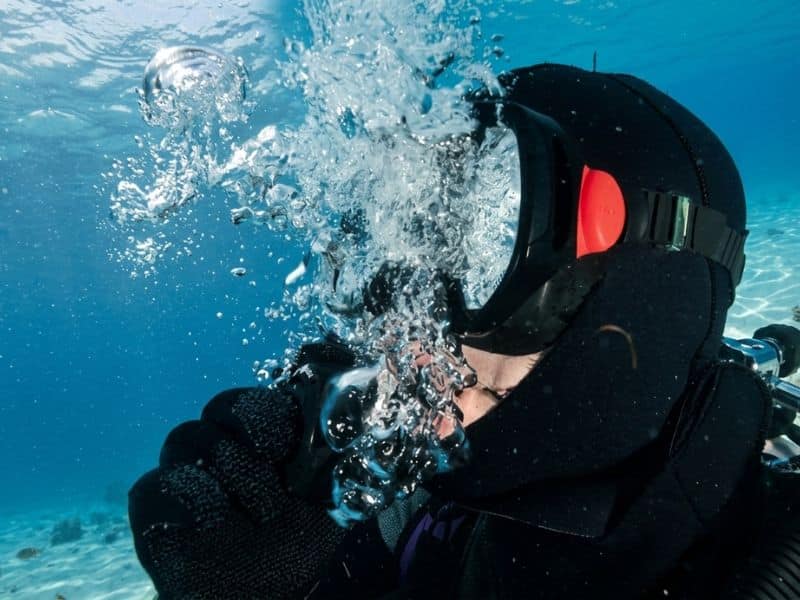
A free-flowing regulator is a scuba second stage whose demand valve is stuck open, releasing gas continuously without the diver inhaling. It is a fail-safe design feature, but it drains a cylinder in 2–5 minutes and requires an immediate controlled ascent.
- How long does it take a cylinder to empty during a free flow?
A standard 12-litre cylinder at 200 bar (approximately a 200 cu ft tank at ~3,000 psi) can empty in 2 to 5 minutes under a full free flow.
The exact duration depends on depth—at greater depths, the higher ambient pressure makes the gas denser, so more mass of air escapes per second, and on the initial cylinder pressure.
- Is a free flow regulator dangerous?
The danger is not a cut-off of air supply but the rapid depletion of your gas reserve, combined with the psychological stress of noise and zero visibility. Panic triggers uncontrolled ascents. With correct technique, a free flow is a manageable equipment failure.
- What is “feathering” or manual valve breathing?
“Feathering” is an advanced technique commonly used in technical diving or sidemount configurations, where the diver manually opens and closes the cylinder valve for each inhalation.
Instead of relying on a fully functioning regulator, the diver briefly cracks the valve open to allow a controlled amount of gas to flow, then closes it again to stop the leak. This can significantly reduce gas loss when a regulator is stuck in free flow.
However, it is only practical when the cylinder valve is easily accessible to the diver
- Can a regulator freeze in 12–15°C water?
Yes. Due to the Joule-Thomson expansion effect, internal components can reach below 0°C even when surrounding water is at 12–15°C. Heavy breathing or prolonged purging in relatively warm water can still cause internal icing.
- Why is fresh water more dangerous than salt water for regulator freezing?
Fresh water freezes at 0°C (32°F) versus approximately −2°C (28°F) for salt water. In lakes and rivers, ice forms inside the regulator at higher ambient temperatures, making free flow significantly more likely in freshwater cold environments.
- How do you clean sand out of a regulator without triggering a free flow?
If a regulator has been dragged through sand, do not immediately press the purge button, as this can force grains into the valve seat and potentially cause a blockage or malfunction.
Instead, gently rinse or “swish” the regulator underwater to dislodge sediment before attempting to breathe from it or pressurize it. The goal is to let water carry away particles rather than driving them deeper into the mechanism.
- Why shouldn’t you breathe from a regulator out of the water in cold climates?
Breathing from a wet regulator in freezing air before a dive can cause the second stage to freeze almost instantly.
It is recommended to perform the first breathing checks only once the regulator is submerged. Water, even when cold, provides a far more stable thermal environment than sub-zero air, reducing the risk of rapid icing in the second stage.
- Is it dangerous to use Nitrox if the regulator goes into free flow?
A free-flow event with Nitrox does not change the mechanical nature of the failure, but it introduces additional considerations.
Because Nitrox contains an elevated oxygen fraction, there is an increased risk of oxygen toxicity (CNS toxicity) if the diver descends below the Maximum Operating Depth (MOD) of the mix while trying to manage the situation.
In addition, a large uncontrolled release of oxygen-enriched gas, particularly at the surface, requires appropriate safety awareness due to elevated flammability risks in certain conditions and environments.
A free-flowing regulator is unlikely, but if it happens, you need to be prepared.
That’s why responsible divers don’t rely on the assumption that equipment will never fail. They rely on:
knowing what to do when it does,
maintaining and checking their regulator,
understanding why it behaves the way it does, and
practicing emergency procedures until they become automatic.
That’s what separates someone who can handle a free-flow situation from someone who can’t. Who would you rather dive with?
Get in touch with us to train.