Dive Theory Explained Simply
03/06/2026
Show all

Triggerfish Species: A Complete Guide to Caribbean Triggerfish

About the Author

This triggerfish species guide was written and reviewed by PADI and SDI Divemaster and Instructors with 500+ logged dives across Caribbean reef systems including Cozumel, Bayahibe, and Jamaica.

Quick Answer: What are the main Caribbean triggerfish species?

The five Caribbean triggerfish species divers most commonly encounter are the Queen Triggerfish (Balistes vetula), Ocean Triggerfish (Canthidermis sufflamen), Gray Triggerfish (Balistes capriscus), Black Durgon (Melichthys niger), and Sargassum Triggerfish (Xanthichthys ringens). The Queen Triggerfish and Black Durgon are the most frequently sighted on Caribbean reef dives.

You’re 50 feet / 15 meters underwater.

The reef is buzzing with life.

And suddenly, a flash of electric blue and yellow rockets past you like a bolt of lightning.

That’s a specie of triggerfish. And once you see one for the first time, you never forget it.

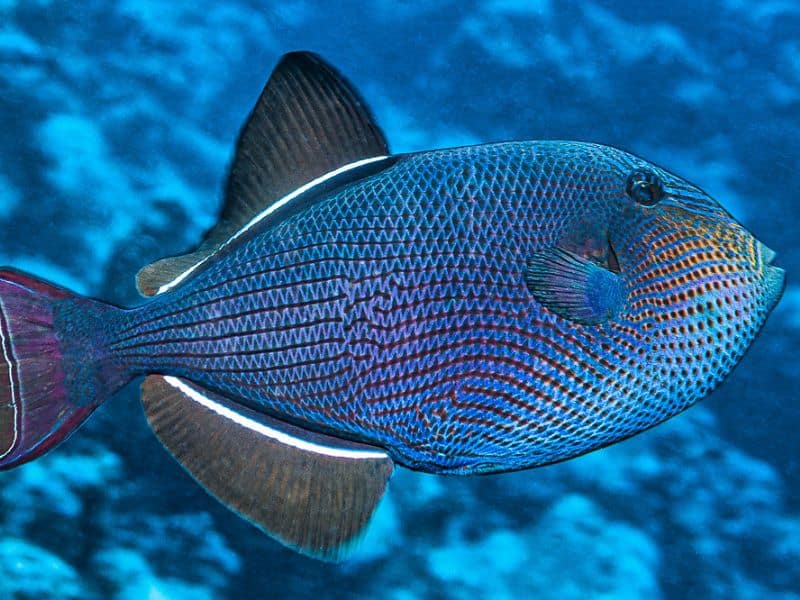
Triggerfish species are among the most spectacular fish you’ll ever encounter underwater. Impossible colors. Bizarre shapes. A surprisingly bold personality. They’re one of the stars of the reef, and divers absolutely love them.

But heads up: there are more than 40 species of triggerfish spread across the world’s oceans. Knowing which one you’re looking at isn’t always easy. That’s where the fun begins.

What exactly is a triggerfish? How many species exist? Why do they fascinate divers so much? This guide gives you clear, detailed, and entertaining answers, for everyone who loves marine life.

Triggerfish Species - especies de pez ballesta

1. What Is a Triggerfish?

Let’s start from the beginning.

Triggerfish belong to the family Balistidae. They are bony reef fish found in tropical and subtropical oceans worldwide. There are roughly 40 recognized species, and each one has something special going for it.

Here’s what makes a triggerfish unmistakable:

  • Oval body, laterally compressed, as if someone had squeezed them slightly from the sides. Their silhouette resembles a diamond or rhombus.
  • Covered in tough, rhombus-shaped scales that work like flexible armor against predators.
  • Small but powerful mouth packed with strong teeth perfectly designed for crushing hard prey.
  • Three dorsal spines. The first is large and locks upright when the fish feels threatened, the famous “trigger.”
  • Two eyes that move independently. Yes, seriously. It’s as strange and as cool as it sounds.
  • A unique swimming style. Instead of using the tail fin for gentle propulsion, triggerfish ripple their dorsal and anal fins in a synchronized wave. This lets them hover, reverse, and maneuver with incredible precision. The tail is saved for explosive bursts of speed when escaping danger.

Their scientific name comes from the family Balistidae, derived from the Latin ballista, a Roman war catapult. Fitting, really: these fish are tough, territorial, and afraid of nothing.

You’ll find them on coral reefs, rocky bottoms, sandy flats, and even in open water. They live in the Atlantic, Indian Ocean, and Pacific. Basically, if there’s a warm tropical sea, there’s probably a triggerfish somewhere in it.

Quick answer: What is a triggerfish? Triggerfish are reef fish in the family Balistidae, found in tropical and subtropical oceans worldwide. They’re recognized by their oval compressed body, tough skin, powerful teeth, and a locking spine called the “trigger.” More than 40 species exist globally.


The Famous Trigger Mechanism

Evolution gave the Balistidae family an ingenious built-in security system. The first dorsal fin has been reduced to just three spines:

  • The first spine is extremely thick, long, and strong.
  • The second spine is smaller and acts as a mechanical latch.

When threatened, the fish finds a narrow crevice in the reef, wedges itself in, and raises the first spine. The second spine slides forward and locks it completely in place. No predator, however powerful, can pull it out. The only way to lower the big spine is to press the second spine backward, working literally like a trigger. That’s exactly where the English name comes from. Even the Italian name, pesce balestra, references the ancient crossbow, which also used a trigger mechanism to release the string. It’s one of the most elegant survival designs on the reef.


2. Triggerfish Species List: How Many Are There?

Short answer: a lot.

There are currently more than 40 recognized species of triggerfish in the family Balistidae, distributed across the world’s major ocean regions:

  • Indo-Pacific: the epicenter. More than 20 species, some of the most colorful on the planet. Giants like the Titan and jewels like the Clown Triggerfish call this region home.
  • Caribbean and Western Atlantic: a smaller list, but strikingly beautiful.
  • Eastern Pacific: a handful of species, including the Redtail Triggerfish.
  • Mediterranean: occasional sightings of migratory species.

Triggerfish play a key role in marine ecosystems by controlling populations of benthic invertebrates. Here are the most well-known species worldwide:

Species Scientific Name Range
Queen Triggerfish Balistes vetula Atlantic
Titan Triggerfish Balistoides viridescens Indo-Pacific
Picasso Triggerfish Rhinecanthus aculeatus Indo-Pacific
Undulate Triggerfish Balistapus undulatus Indo-Pacific
Ocean Triggerfish Canthidermis sufflamen Tropical Atlantic
Gray Triggerfish Balistes capriscus Atlantic, Mediterranean
Black Durgon Melichthys niger Circumtropical
Redtoothed Triggerfish Odonus niger Indo-Pacific
Crosshatch Triggerfish Xanthichthys mento Indo-Pacific, E. Pacific
Sargassum Triggerfish Xanthichthys ringens Atlantic

No need to memorize them all. We’ll focus on the species divers actually encounter, especially in the Caribbean.

Quick answer: How many triggerfish species exist? More than 40 recognized species exist in the family Balistidae. They’re found in tropical and subtropical oceans worldwide, with the greatest diversity in the Indo-Pacific. In the Caribbean, divers typically encounter 5 to 6 species.


3. Caribbean Triggerfish Species: Your Complete Diving Guide

Now for the section that really matters to Caribbean divers.

If you’re diving in Mexico, the Dominican Republic, the Bahamas, or anywhere in the Caribbean Sea, these are the triggerfish you’re going to meet. Five species you need to know, broken down one by one.

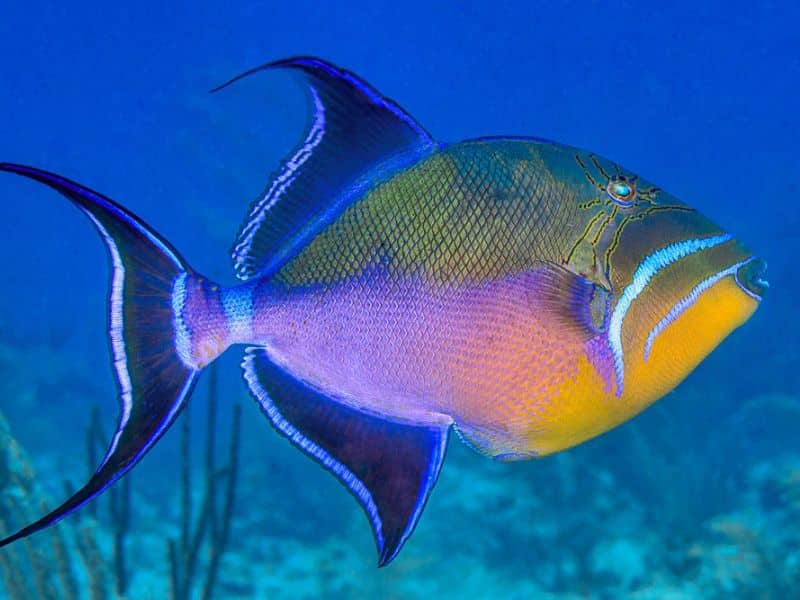
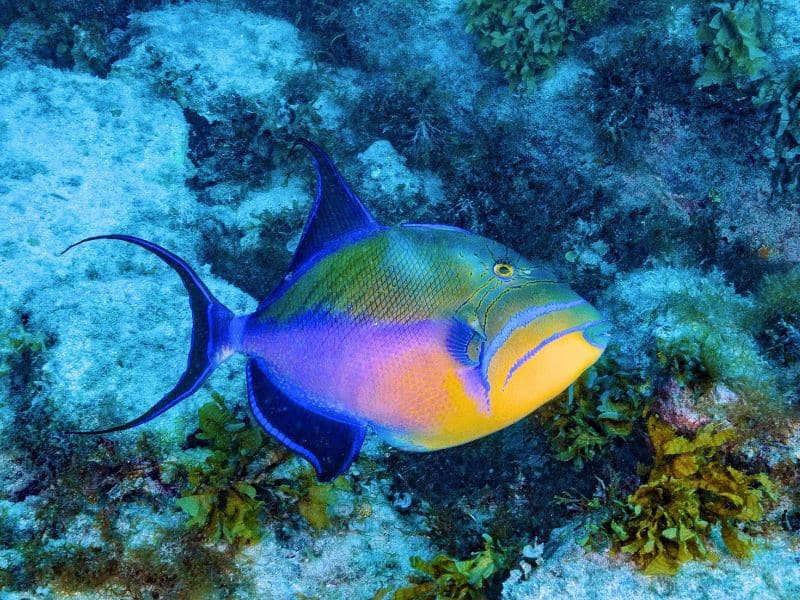
1. Queen Triggerfish (Balistes vetula)

• Appearance: One of the most regal fish on the reef. Features extremely long caudal filaments and vivid coloring, golds, purples, greens, and intense blues. Two electric-blue lines cross its snout like a flashy mustache.

• Size: Commonly 10–16 inches; can reach up to 24 inches.

• Habitat: Coral reefs and rocky areas, 10–165 feet / 3-50 meters deep.

• Sighting frequency: Very common. You’ll see them on almost every Caribbean reef dive.

• ID difficulty: Easy. Those iridescent facial lines are unmistakable.

• Behavior: Curious and bold. Will often approach divers. Can become territorial during nesting season (summer months), give nesting females space.

• Fun fact: Females guard their eggs with fierce aggression. Don’t get too close.

2. Ocean Triggerfish (Canthidermis sufflamen)

• Appearance: Dull grayish-brown overall. The clearest ID mark is a large black circular spot right at the base of the pectoral fin. Often seen cruising mid-water near sargassum weed lines.

• Size: Typically, 12–20 inches; maximum reported length around 26 inches, up to about 13 lbs.

• Habitat: Open water and reef drop-offs. Commonly seen on drift dives.

• Sighting frequency: Moderate. Usually spotted patrolling deep reef walls.

• ID difficulty: Medium. Can be confused with the Gray Triggerfish, but that large black pectoral spot is a dead giveaway.

• Behavior: Calm and inquisitive. Less aggressive than the Queen.

Triggerfish Species- Ocean Triggerfish (Canthidermis sufflamen)

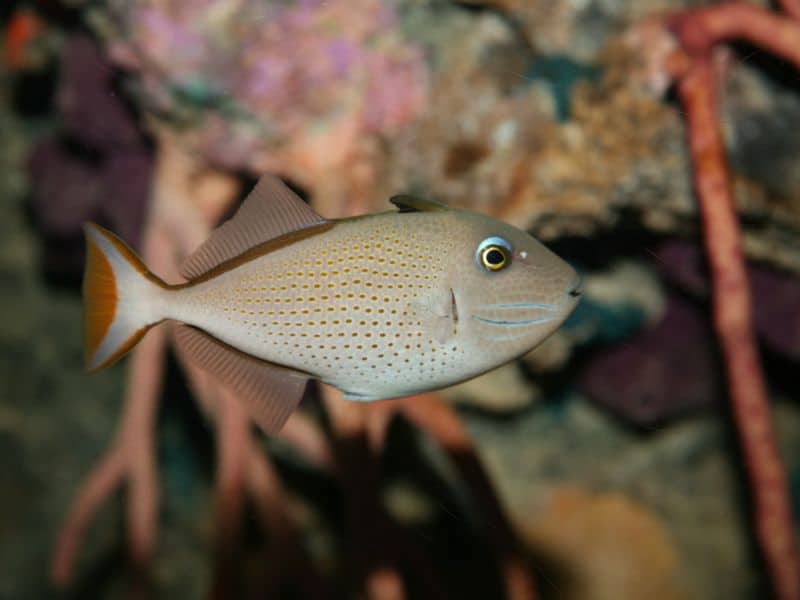
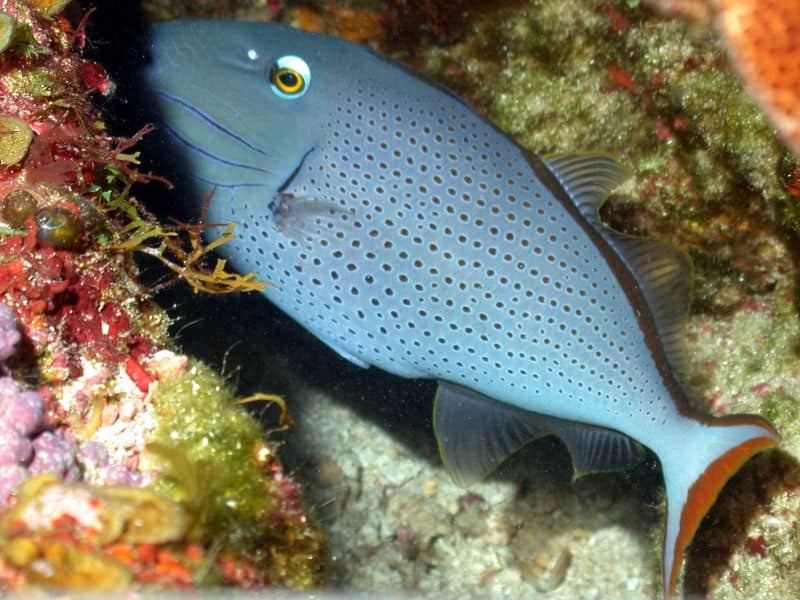
3. Sargassum Triggerfish (Xanthichthys ringens)

  • Appearance: A smaller triggerfish, light brown to grayish, with rows of dark spots running lengthwise along the body and three deep-blue grooves on its cheeks.
  • Size: Up to 10 inches.
  • Habitat: Pelagic zones near sargassum lines and reef edges.
  • Sighting frequency: Less common. You need to be in the right spot at the right moment.
  • ID difficulty: Medium. Look for those three horizontal grooves on the cheek, the definitive clue.
  • Behavior: Active and fast-moving. Often found in small groups.
Triggerfish Species-Sargassum Triggerfish (Xanthichthys ringens)

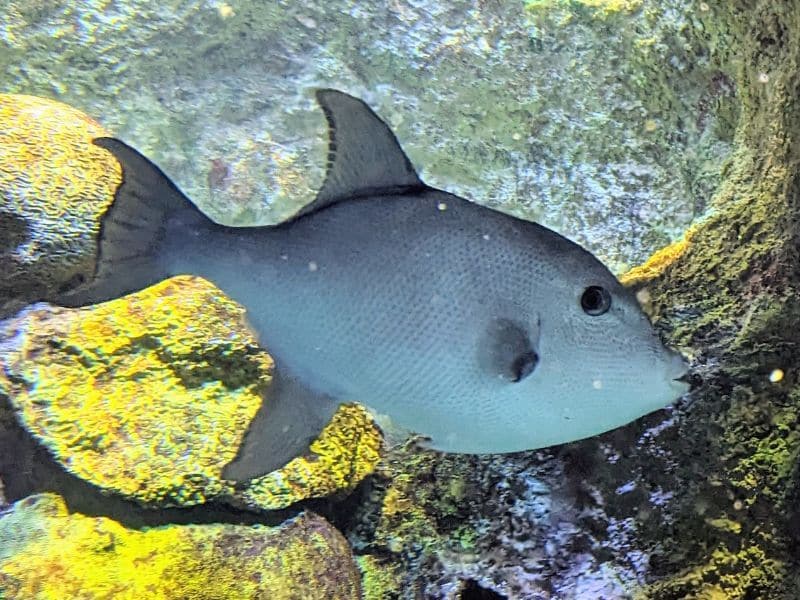
4. Gray Triggerfish (Balistes capriscus)

  • Appearance: A compressed body in pale olive-gray to grayish-brown, with small blue spots on the dorsal fin.
  • Size: Up to 24 inches.
  • Habitat: Coral reefs, rocky areas, and sandy bottoms, 3 –330 feet / 0,9 – 100 meters deep.
  • Sighting frequency: Common throughout the Caribbean and North Atlantic.
  • ID difficulty: Medium. Its muted coloring and ability to shift tones slightly make it tricky to spot at first.
  • Behavior: Curious and sociable. Often seen foraging near the bottom.
Triggerfish Species- Gray Triggerfish (Balistes capriscus)

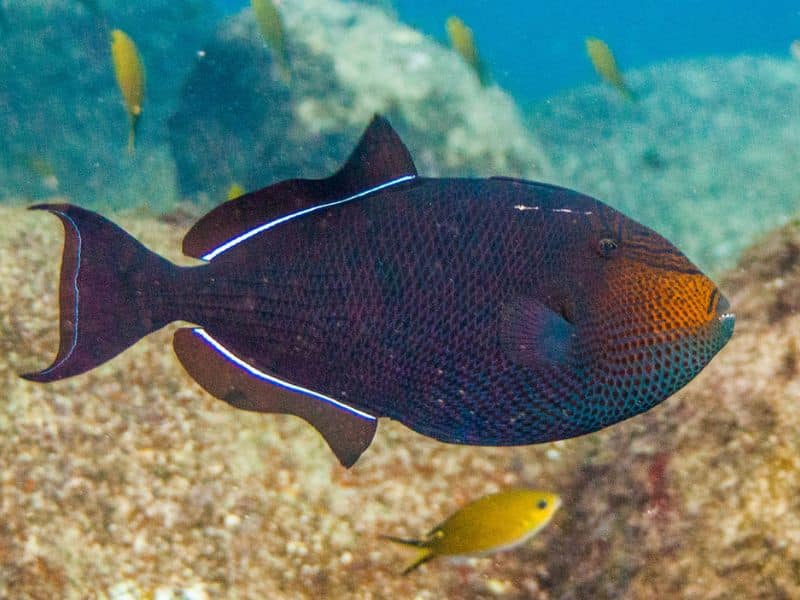
5. Black Durgon (Melichthys niger)

  • Appearance: An oval-shaped fish that looks completely black underwater, but flashes green and purple highlights under direct light. Bright neon-blue lines run along the bases of the dorsal and anal fins.
  • Size: Up to 14 inches.
  • Habitat: Reef drop-offs and outer reef walls, 3–200 feet / 0,9 – 60 meters deep.
  • Sighting frequency: Extremely high. One of the easiest triggerfish to find in the Caribbean.
  • ID difficulty: Very easy. Almost entirely black body with those blue-white lines at the fin bases.

Behavior: Calm and filter-feeding. Unlike most triggerfish, the Black Durgon poses no threat to divers whatsoever.

Triggerfish Species-Black Durgon (Melichthys niger)

Pro tip: Want to see all 5 Caribbean species in a single trip? Dive Cozumel. Its reefs hold exceptional triggerfish populations, especially Queen Triggerfish and Black Durgon.


Quick Visual ID Table

Species Colors Max Size Key ID Feature Depth Range Frequency
Queen Triggerfish Blue, green, yellow, purple 24 in Iridescent facial lines 10–165 ft ★★★★★
Ocean Triggerfish Gray-brown 26 in Black spot at pectoral fin 30–300 ft ★★★☆☆
Gray Triggerfish Olive-gray, mottled 24 in Three rows of dorsal spots 3–330 ft ★★★★☆
Black Durgon Intense black 14 in Blue-white lines at fin bases 3–200 ft ★★★★★
Sargassum Triggerfish Brown with pale spots 10 in Three horizontal cheek grooves Surface–130 ft ★★☆☆☆


General underwater ID rules:

  • Look at the face first. Many species have unique patterns around the eyes and mouth.
  • Check the tail. Shape and color vary significantly between species.
  • Note the size. The Titan is unmistakable. The Sargassum is tiny.
  • Distinguish lines vs. spots vs. solid color. That alone narrows it down fast.

4. How to Photograph Triggerfish

Attention, underwater pixel hunters! Photographing a triggerfish is one of the most fun and challenging experiences on the reef. These aren’t timid fish that bolt at the first bubble, they have attitude. If you want that epic shot to show off on your socials, you need a solid strategy.

Follow these pro photographer tips to nail your triggerfish shots:

  • Don’t approach head-on. Going straight at them is the worst mistake you can make. You’ll only see their tail disappearing at full speed. Move in from the side, slowly, without locking eyes with them directly.
  • Buddha-level patience before you click. Find a solid neutral buoyancy position and stay completely still for 3–5 minutes. Let the fish adjust to your presence. Their natural curiosity will kick in and they’ll come check out your lens.
  • Keep the light at your back. Position yourself so the Caribbean sun is behind you. This makes light punch straight through the water and brings out the Queen’s electric-blue lines or the Black Durgon’s velvet-black texture, and prevents you from casting your own shadow on the fish.
  • Freeze the action with shutter speed. Their dorsal and anal fin rippling is constant. Use a high shutter speed (minimum 1/250 sec) to freeze their rapid movement and get razor-sharp focus.
  • Pick a clean background. Try to eliminate visual clutter behind the fish. A clean blue-water background or clear coral wall will make their geometric outlines pop in your shots.
  • Always shoot RAW. Water absorbs reds and yellows fast. Shooting RAW preserves all the sensor data so you can recover those vibrant golds and purples in post-processing.
  • Set your strobes right. Position your strobes wide, slightly behind your housing, angled slightly outward. This evenly lights the fish’s flat body without creating hot spots on its shiny scales and minimizes backscatter from suspended particles.
  • Nesting season? Safety first. If the fish is showing stress signals or guarding a nest, keep your camera housing or fins between you and it, they work as a great protective shield. And please, never point a selfie stick at them.


5. Are Triggerfish Aggressive?

Let’s be clear: some of them can be.

Quick answer: Are triggerfish aggressive? Some triggerfish species can be aggressive, especially during nesting season when they’re defending nests on the seafloor. The Titan Triggerfish and Undulate Triggerfish are the most notorious for this behavior and have been known to charge and bite divers who enter their territory. Other species are generally curious but harmless.

Triggerfish aren’t inherently dangerous. But they are highly territorial, especially during nesting season (typically April through September). And when a triggerfish decides you’re a threat, it doesn’t back down.

The Geometry of Defensive Territory

Their defensive territory forms an inverted cone extending upward from the nest toward the surface. The key rule: never swim upward when you feel threatened, you’re moving straight into the center of their defense zone. Always swim horizontally or downward to exit the cone. Once you’re out of range, the fish loses interest.


*****************************************


\             Alert Zone              / <- Watch out! The territory gets wider as you go up!

\               inside                /      Divers should swim to the side, never upward!

\         the cone            /

\                             /

\                          /

\                     /

\               /

\          /         <- Triggerfish protecting its eggs.

____________________________________

Triggerfish Species (4) especies de pez ballesta

6. Protocol for Diving with Triggerfish

Triggerfish are fascinating reef inhabitants. But during breeding season, their protective instincts make them seriously territorial.

  1. Identification and Prevention
  • Watch for nest-guarding behavior: If you see a triggerfish swimming in circles or moving erratically near the seafloor, it’s likely protecting a nest.
  • The Inverted Cone Rule: Their defensive territory extends upward from the nest in an inverted cone shape. If threatened, never swim up, you’ll be heading straight into the core of their defense zone.
  1. Safety Protocol (If You Feel Threatened)
  • Stay calm and keep oriented. Don’t panic or wave your arms. Keep the fish in your line of sight at all times.
  • Escape direction: Always swim horizontally or downward, away from the nest. By moving out from the center of the cone, the fish will disengage.
  • Use your gear as a shield. If the fish gets too close, hold your fins or camera between you and it. This creates a physical barrier without harming the animal.
  1. Ethical and Ecological Protocol
  • Respect their space. The best way to avoid conflict is to maintain a safe distance, at least 30 feet / 9 meters if you detect defensive behavior.
  • Passive observation. Don’t chase, feed, or try to attract any fish. Responsible diving means being a silent observer, not a main character in their world.
  • Buoyancy control. Maintain neutral buoyancy to avoid damaging coral or stirring up sediment. A diver in control of their position is both safer and far less disruptive to local wildlife.
  • Spread the word. If you see another diver getting too close to a nest, let them know, calmly. Protecting the ecosystem is a shared responsibility.

Important note: A triggerfish’s defensive behavior is completely natural. Never strike or provoke the animal. A calm, strategic retreat is always the most professional and respectful response, for the safety of both of you.


7. Frequently Asked Questions

What is the scientific name of triggerfish? Triggerfish belong to the family Balistidae. Each species has its own scientific name: for example, the Queen Triggerfish is Balistes vetula and the Titan Triggerfish is Balistoides viridescens.

What is the largest triggerfish species? The Titan Triggerfish (Balistoides viridescens) is the biggest, reaching up to 30 inches. It lives in the Indo-Pacific and is well known for its territorial behavior during breeding season.

Which triggerfish species live in the Caribbean? The main Caribbean species are: Queen Triggerfish, Ocean Triggerfish, Gray Triggerfish, Black Durgon, and Sargassum Triggerfish.

Are triggerfish dangerous to divers? Most are not. However, the Titan Triggerfish and Undulate Triggerfish can be aggressive during nesting season and may charge or bite. The Caribbean Queen Triggerfish can also get defensive near its nest. Always observe from a respectful distance.

Can triggerfish bite? Yes, and it hurts. Triggerfish have fused, powerful teeth designed for crushing sea urchins and crustaceans. A bite from a Titan Triggerfish is no joke. Keep your distance during nesting season.

What do triggerfish eat? Sea urchins, crabs, mollusks, worms, small fish, and zooplankton. They use their powerful teeth to break open hard-shelled prey.

Are triggerfish reef fish? Yes. Most species are closely tied to coral reefs, rocky bottoms, and sandy reef flats. Some species, like the Ocean Triggerfish, are also found in open water.

Why do triggerfish have spines? The first dorsal spine is large and can be locked upright by the smaller second spine, the “trigger.” When threatened, they wedge into a crevice and lock the spine, making themselves nearly impossible to remove. It’s one of nature’s most elegant defense mechanisms.

Triggerfish Species (5) especies de pez ballesta

8. Where Can Divers See Caribbean Triggerfish?

Ready to dive with triggerfish? Here are your go-to destinations.

The Caribbean is home to some of the best triggerfish diving in the world. These are the spots where your chances are highest:

Cozumel, Mexico

  • Best for: Queen Triggerfish, Ocean Triggerfish, Black Durgon
  • The famous drift dives over the Palancar reef system offer exceptional triggerfish encounters year-round.
  • Cozumel’s Queen Triggerfish are particularly bold, they’ll often swim right up to divers to investigate.

Playa del Carmen, Mexico

  • Best for: Queen Triggerfish, Gray Triggerfish
  • Shallow reefs and nearby cenote diving around Playa del Carmen produce regular triggerfish sightings.
  • A great option for newer divers looking for their first triggerfish encounter.

Bayahibe, Dominican Republic

  • Best for: Queen Triggerfish, Black Durgon, Ocean Triggerfish
  • Bayahibe has incredibly healthy reefs with excellent triggerfish populations.
  • Dive sites like La Caleta and Catalina Island are especially productive.

Punta Cana, Dominican Republic

  • Best for: Queen Triggerfish, Gray Triggerfish, Black Durgon
  • Punta Cana’s reefs offer calm conditions and consistent triggerfish sightings.
  • Great for underwater photography: the light is outstanding and the fish are very accessible.


Triggerfish species are truly one of the most rewarding groups of reef fish you’ll ever encounter underwater. They have personality. They have style. And once you can tell a Queen from a Black Durgon, every single dive gets a little more exciting.

Reach out, let’s plan a trip, and get you in the water. The species of triggerfish aren’t going to ID themselves.

Happy diving!

CONTACT US FOR
PERSONALIZED ASSISTANCE

Ready to improve your dive skills?
Need more information about the next certification level?

WE ARE HERE TO HELP

contact

    I consent to receiving commercial communications and promotions from Dressel Divers.