
Quick answer: A symbiotic relationship in the ocean is a close, long-term interaction between two different marine species. Marine biologists classify these partnerships into three types: mutualism (both species benefit, like clownfish and sea anemones), commensalism (one species benefits while the other is unaffected, like remoras riding on whale sharks), and parasitism (one species benefits at the other’s expense, like sea lice on fish). These relationships are essential to ocean ecosystems, especially nutrient-poor tropical coral reefs, where recycling energy between species is often the difference between survival and collapse.

Scuba Diving Apparel: Much More Than Scuba Clothing
26/08/2026
Glowing Sea Creatures: 20+ Shining Marine Animals
09/09/2026Table of Contents
- What Is a Symbiotic Relationship in the Ocean?
- Why Are Symbiotic Relationships in the Ocean So Important?
- The Three Main Types of Marine Symbiosis
- Examples of Symbiotic Relationships in the Ocean
- Marine Symbiosis by Region: Tropical, Atlantic, and Arctic Waters
- How Divers Can Observe Marine Symbiosis Responsibly
- FAQs
1. What Is a Symbiotic Relationship in the Ocean?
Imagine trying to survive underwater. You need food. You need protection. You need somewhere to live. Now imagine another species has exactly what you need, and you have something valuable to offer in return. That’s where marine symbiosis begins.
A symbiotic relationship in the ocean is a close, long-term relationship between two different marine species, in which at least one species depends on the other for survival-critical resources such as food, shelter, cleaning, protection, transportation, or reproduction. Unlike fish that simply school together for safety, true marine symbiosis is durable, it becomes a permanent part of both species’ life cycles.
These partnerships aren’t rare. They’re everywhere, from colorful coral reefs to the icy Arctic Ocean, and they help marine life survive in places where resources are scarce. By studying these relationships, marine scientists and scuba divers gain a clearer picture of how interspecies cooperation shapes entire aquatic ecosystems.
2. Why Are Symbiotic Relationships in the Ocean So Important?
The ocean isn’t as nutrient-rich as most people assume, especially in the tropics. Most coral reefs grow in nutrient-poor water, yet they support thousands of species. The answer is teamwork: nature has evolved ways to recycle energy between species instead of losing it to the open ocean.
Marine symbiosis helps ecosystems by:
- Turning sunlight into food through microscopic algae
- Building coral reefs that function as underwater cities
- Removing parasites from fish at dedicated cleaning stations
- Creating safe homes for small, vulnerable species
- Recycling nutrients instead of losing them to open water
- Increasing biodiversity across entire ecosystems
Think of a coral reef as a giant apartment building: every symbiotic partnership adds another floor, another room, another family. Without symbiosis, the building collapses.
HOW DOES THIS ENERGY FLOW WORK?
Here’s a simplified version.
☀️ Sunlight
↓
Microscopic algae (Zooxanthellae)
↓
Produce sugars and oxygen
↓
Feed coral polyps
↓
Corals build limestone reefs
↓
Reefs become homes for thousands of species
↓
Cleaning stations + shelters + biodiversity
↓
Healthy marine ecosystems
3. The Three Main Types of Marine Symbiosis
Not all underwater partnerships work the same way. Some are true win-win deals, some are one-sided, and some are downright parasitic. Every symbiotic relationship in the ocean falls into one of three categories: mutualism, commensalism, and parasitism.
- Mutualism (+/+)
In mutualism, both species benefit, sometimes neither could survive without the other. Marine biologists divide mutualism into two subtypes:
- Obligate mutualism: the partners depend on each other completely. If separated, one or both may die. The classic example is corals and their microscopic algae (zooxanthellae).
- Facultative mutualism: life together is beneficial but not essential. Each species can survive independently if it has to.
Mutualistic partnerships typically solve one of three survival problems: finding food, staying safe from predators, or staying clean and disease-free. Many of the most famous symbiotic relationships in the tropical ocean are mutualistic, and they’re a major reason coral reefs are among the richest ecosystems on Earth.
- Commensalism (+/0)
Commensalism is a free ride: one species benefit, through transportation, shelter, leftover food, or protection, while the other is essentially unaffected. Marine biologists recognize two common forms:
- Phoresy: one animal uses another purely as transportation, like a hitchhiker.
- Epibiosis: one organism lives permanently attached to another, such as barnacles growing on a whale.
Commensal relationships aren’t always static. Small, incremental costs or benefits can slowly shift a commensal relationship toward mutualism, or even parasitism, over evolutionary time.
- Parasitism (+/-)
In parasitism, one species (the parasite) benefits while the other (the host) pays the price, often through lost blood, tissue, nutrients, or body fluids, or by having its body used for shelter or reproduction. Parasitism symbiotic relationships in the ocean can look purely harmful at first glance, but they play a real ecological role: parasites help regulate host population sizes, prevent any single species from dominating a reef, drive the evolution of stronger immune systems in their hosts, and provide a food source for cleaner fish and shrimp.
Marine Symbiosis at a Glance
| Type | Who Benefits? | Main Advantage | Classic Example |
| Mutualism | Both species | Food, protection, cleaning | Clownfish + Sea anemone |
| Commensalism | One species | Shelter or transportation | Remora + Whale shark |
| Parasitism | Parasite only | Nutrients and energy | Sea lice + Fish |

4. Examples of Symbiotic Relationships in the Ocean
If you want to understand symbiotic relationships in the ocean, nothing beats seeing them in action. Below are 15 examples every diver and ocean lover should know, organized by type of symbiosis.
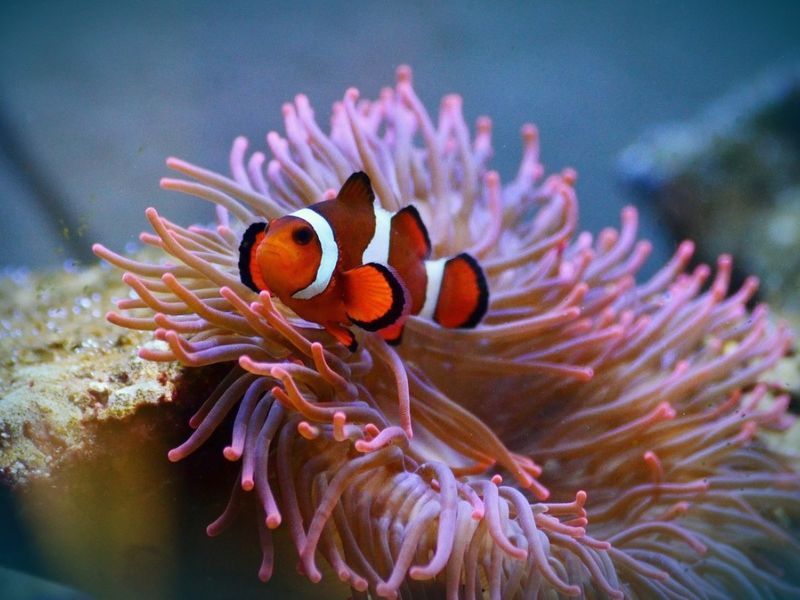
- Clownfish + Sea Anemone
Type: Mutualism. The clownfish and sea anemone form one of the most famous mutualistic relationships in the ocean: the anemone’s venomous tentacles protect the clownfish (thanks to a mucus coating that prevents stings), while the clownfish chases off anemone-eating butterflyfish, keeps water circulating, and fertilizes the anemone with nutrient-rich waste.
- Why it works: Clownfish get protection; anemones get food, oxygen, and defense.
- Where to see it: Indo-Pacific coral reefs, 1–15 m (3–50 ft)
- Spotting difficulty: Easy
- Diver tip: Watch the anemone carefully, clownfish rarely stray far from their host.
- Cleaner Shrimp + Moray Eel
Type: Mutualism. Cleaner shrimp run underwater “dental clinics”: the moray eel opens its mouth wide and the shrimp walks inside to remove parasites, dead skin, and leftover food, gaining an easy meal while the eel stays healthier.
- Where to see it: Caribbean, Tropical Atlantic, and Indo-Pacific reefs, 5–30 m (16–100 ft)
- Spotting difficulty: Easy to Moderate
- Diver tip: Look for long white antennae waving from dark crevices, that usually signals an open cleaning station.
- Goby + Pistol Shrimp
Type: Mutualism. The pistol shrimp is a skilled burrow-builder with poor eyesight, while the goby has sharp vision but can’t dig; the shrimp builds and maintains a shared burrow while the goby stands guard, keeping an antenna on the goby at all times to sense danger.
- Where to see it: Sandy patches beside Indo-Pacific coral reefs, 3–25 m (10–82 ft)
- Spotting difficulty: Moderate
- Diver tip: Hover quietly over sandy patches and look for a still goby beside a small sand mound, a pistol shrimp is almost always underneath.
- Coral Polyp + Zooxanthellae
Type: Mutualism (obligate). Coral polyps host millions of microscopic algae called zooxanthellae inside their tissue; the algae photosynthesize sunlight and share up to 90% of that energy with the coral, while the coral supplies shelter, carbon dioxide, nitrogen, and phosphorus. Without this partnership, most tropical coral reefs could not exist, making it arguably the most important symbiotic relationship in the tropical ocean.
- Where to see it: Tropical reefs worldwide, 1–30 m (3–100 ft)
- Spotting difficulty: Easy
- Diver tip: A coral’s vibrant browns, greens, blues, and purples come largely from the algae living inside it.
- Emperor Shrimp + Sea Cucumber (or Nudibranch)
Type: Commensalism. The emperor shrimp rides on sea cucumbers or large nudibranchs, using them as free transportation to food-rich areas while barely affecting its host.
- Where to see it: Indo-Pacific reefs, 5–30 m (16–100 ft)
- Spotting difficulty: Hard
- Diver tip: Examine large sea cucumbers and colorful nudibranchs closely, the emperor shrimp is tiny but unforgettable once spotted.
- Hermit Crab + Sea Anemone
Type: Mutualism. Some hermit crabs place sea anemones directly onto their portable shells: the crab gains a powerful defense against predators, while the anemone gets transportation and a steadier supply of food scraps than it would find sitting still.
- Where to see it: Temperate and tropical oceans worldwide, 5–40 m (16–130 ft)
- Spotting difficulty: Moderate
- Diver tip: Look for what appears to be a moving shell with tiny “flowers” on top.
- Decorator Crab + Sponges
Type: Commensalism. Decorator crabs use hook-like hairs on their shells to attach living sponges and algae to their bodies for camouflage, while the sponge gains mobility and access to fresh water flow and food.
- Where to see it: Tropical Atlantic and Indo-Pacific reefs, 3–25 m (10–82 ft)
- Spotting difficulty: Hard
- Diver tip: If a piece of “sponge” suddenly starts walking, you’ve found a decorator crab.
- Manta Ray + Cleaner Wrasse
Type: Mutualism. Manta rays visit reef cleaning stations, hovering motionless with mouths open while cleaner wrasses remove parasites, dead skin, and debris from their bodies, mouths, and gills.
- Where to see it: Tropical channels, seamounts, and outer reefs, 5–30 m (16–100 ft)
- Spotting difficulty: Moderate
- Diver tip: Stay still and keep your distance, calm divers see longer manta visits.
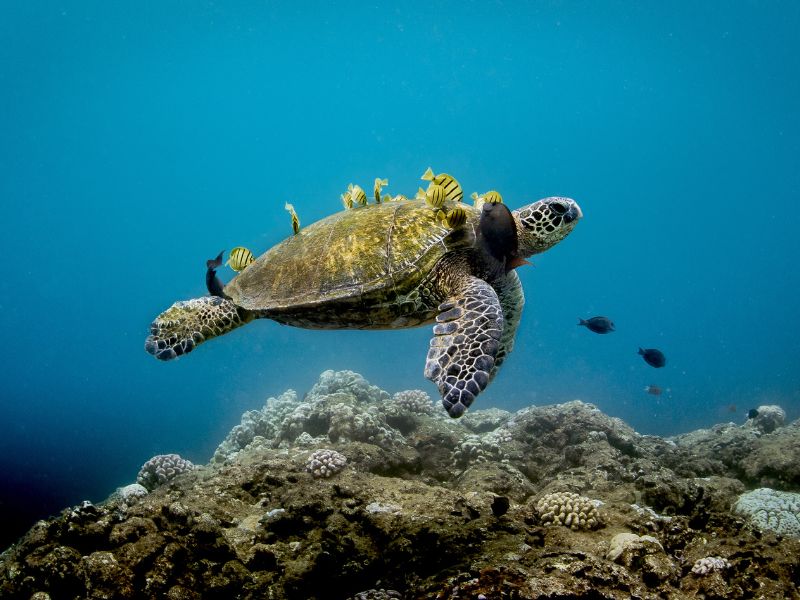
- Sea Turtle + Cleaner Fish
Type: Mutualism. Sea turtles rest on coral heads while cleaner fish remove algae and parasites from their skin, shell, neck, and flippers.
- Where to see it: Tropical reefs worldwide, especially the Caribbean, 3–20 m (10–65 ft)
- Spotting difficulty: Easy
- Diver tip: Look for a turtle resting still with small fish gathered around it is usually being cleaned, not sleeping.
- Spotted Cleaner Shrimp + Reef Fish
Type: Mutualism. The spotted cleaner shrimp (Periclimenes yucatanicus) sets up cleaning stations inside sea anemones in the Caribbean, removing parasites and dead skin from fish that stay still to be cleaned, including inside their mouths.
- Where to see it: Caribbean coral reefs, including Cozumel, Playa del Carmen, and the Dominican Republic, 3–25 m (10–82 ft)
- Spotting difficulty: Easy
- Diver tip: Look inside large sea anemones for gently waving white antennae, a sure sign of a cleaner shrimp.
- Pederson Cleaner Shrimp + Sea Turtle
Type: Mutualism. Pederson cleaner shrimp and cleaner gobies service sea turtles at Caribbean cleaning stations, removing parasites and algae from the turtle’s skin and inspecting its mouth.
- Where to see it: Caribbean reefs with resident green turtle populations, 2–20 m (6–65 ft)
- Spotting difficulty: Easy
- Diver tip: A turtle holding unusually still while tiny fish or shrimp crawl over it is participating in one of the ocean’s oldest cleaning partnerships.
- Giant Barrel Sponge + Brittle Star
Type: Commensalism. Brittle stars perch on giant barrel sponges and extend their arms to catch microscopic food carried by the thousands of liters of water the sponge filters daily, without helping or harming the sponge.
- Where to see it: Caribbean reef walls, 10–35 m (33–115 ft)
- Spotting difficulty: Easy
- Diver tip: Check the rim of large barrel sponges, brittle star arms often blend perfectly with the sponge’s texture.
- Christmas Tree Worm + Coral
Type: Commensalism. Christmas tree worms spend their entire lives inside tunnels they build within living coral, filtering plankton from the water while barely affecting the coral itself.
- Where to see it: Caribbean coral reefs, especially Cozumel, the Riviera Maya, Jamaica, and the Dominican Republic, 2–30 m (6–100 ft)
- Spotting difficulty: Easy
- Diver tip: Approach slowly, the colorful worm crowns retract into the coral in under a second if disturbed.
- Arrow Crab + Corkscrew Anemone
Type: Commensalism. The long-legged arrow crab hides among corkscrew anemone tentacles for protection, leaving periodically to hunt small worms and crustaceans, with little to no effect on the anemone.
- Where to see it: Caribbean reefs and rocky bottoms, 5–30 m (16–100 ft)
- Spotting difficulty: Moderate
- Diver tip: Search around large anemones, the crab’s extremely long legs usually give it away first.
- Tongue-Eating Louse + Snapper
Type: Parasitism. As a juvenile, the tongue-eating louse enters a fish through its gills, attaches to the tongue, and feeds on its blood supply until the tongue withers, at which point the parasite itself functionally replaces the tongue, and the fish continues eating with the parasite in place.
- Where to see it: Tropical Atlantic and Caribbean waters, 2–60 m (6–200 ft)
- Spotting difficulty: Hard
- Diver tip: Macro photographers sometimes find them by accident inside the mouths of snappers and grunts.

5. Marine Symbiosis by Region: Tropical, Atlantic, and Arctic Waters
Where you dive changes what you see!
Tropical Reefs & The Caribbean
Warm water, bright sun, and high competition create thousands of alliances!
Spotting symbiotic relationships in the tropical ocean is a highlight of every dive trip.
Want to see these firsthand?
Check out 3 symbiotic relationships in the tropical ocean at top Dressel Divers destinations:
- Riviera Maya and Cozumel, Mexico: Deep wall dives at Palancar Reef feature giant barrel sponges packed with brittle stars, plus moray eels sharing crevices with cleaner shrimp.
Mine while, in the Riviera Maya you can dive shallow reefs to swim alongside sea turtles getting shell cleanings from surgeonfish.
- Punta Cana and Bayahibe in the Dominican Republic: Explore coral nurseries and wreck sites like the Astron where watchman gobies guard pistol shrimp burrows.
- Montego Bay, Jamaica: Wall dives like Airport Wall host busy cleaner wrasse stations servicing passing fish.
Arctic & Cold-Water Partnerships
Cold waters have fewer species, but incredible partnerships!
Looking at symbiotic relationships in the arctic ocean shows how life survives extreme cold.
For example, juvenile Arctic cod swim safely inside the stinging tentacles of giant Lion’s Mane Jellyfish for protection.
Meanwhile, investigating symbiotic relationships in the Atlantic Ocean reveals cold-water sea anemones sheltering tiny crustaceans along rocky reefs!
6. How Divers Can Observe Marine Symbiosis Responsibly
Want to be an awesome eco-diver? Follow these rules:
- Master your buoyancy: Stay off the sand so you do not crush goby-shrimp burrows!
- Respect cleaning stations: Keep a distance of 2 to 3 meters so big fish do not get scared away.
- Look, don’t touch: Never poke anemones or touch sea turtles.
- Be patient: Freeze your movements, relax, and let the marine behavior unfold.
- Mind your flashes: Avoid shooting continuous macro strobes into small animal eyes!

7. Frequently Asked Questions
What are symbiotic relationships in the ocean?
A symbiotic relationship in the ocean is a long-term interaction between two different marine species. These interactions are categorized into three primary types: mutualism (where both species benefit), commensalism (where one benefits without affecting the other), and parasitism (where one benefits while harvesting energy from the host).
What is the best example of mutualism in the ocean?
The relationship between coral polyps and microscopic zooxanthellae algae is the most ecologically important example of mutualism. The coral provides the algae with a protected environment and carbon dioxide, while the algae supply the coral with essential nutrients through photosynthesis.
Can scuba divers see symbiotic relationships underwater?
Yes, divers frequently observe symbiotic relationships on tropical coral reefs. Common encounters include visiting cleaning stations to watch cleaner fish service larger predators, spotting clownfish nestling inside protective anemones, or observing tiny gobies standing guard outside shrimp burrows.
Is parasitism always harmful to ocean ecosystems?
While parasitism harms individual host organisms, it plays an essential role in broader ecosystem balance. Parasites help regulate fish population densities, prevent dominant species from overpowering reefs, drive host immune evolution, and provide a key food source for cleaner fish.
What is the difference between mutualism and commensalism in the ocean?
In marine mutualism, both species benefit from the interaction, such as clownfish receiving protection while anemones get vital nutrients. In commensalism, one species benefits while the other remains completely unaffected, like remoras attaching to whale sharks for transport without harming or helping the host.
What is a marine cleaning station and how does it work?
A marine cleaning station is a specific location on a reef where client fish, sea turtles, and sharks gather to have parasites and dead tissue removed by small cleaner species like wrasses or shrimp. This mutualistic service keeps larger animals healthy while feeding the cleaners.
What is the rarest symbiotic relationship divers can see on a reef?
One of the rarest observations is the boxer crab (pom-pom crab) holding tiny sea anemones in its claws. The crab uses the anemones’ stinging tentacles like boxing gloves for self-defense and food capture, while the anemones gain mobility and access to food particles.
What is an example of a parasitic relationship in tropical waters?
A striking tropical example is the tongue-eating louse (Cymothoa exigua). This parasitic crustacean enters a host fish through the gills, attaches to its tongue, cuts off the organ’s blood supply until it detaches, and then acts as the fish’s functional new tongue while feeding on its blood.
Knowing how marine animals interact turns every dive into an underwater treasure hunt!
Instead of just looking at fish, you start watching their real-life behaviors, alliances, and secret partnerships.
Next time you dive with Dressel Divers in Cozumel, Riviera Maya, Punta Cana, or Montego Bay, keep your eyes open!
Who knows what incredible marine team you will discover next?
Sources
CONTACT US FOR
PERSONALIZED ASSISTANCE
Ready to improve your dive skills?
Need more information about the next certification level?
WE ARE HERE TO HELP