7. Who Coined the Term SCUBA Really?
The term SCUBA is widely credited to Dr. Christian James Lambertsen (1917–2011), an American physician, researcher, and pioneer in diving medicine.
While still a medical student at the University of Pennsylvania, Lambertsen designed his first closed-circuit oxygen rebreather. His idea was to remove carbon dioxide from exhaled gas so the diver could breathe it again underwater. The technology was particularly suited to military operations because it produced no bubbles that could reveal the diver’s position.
Lambertsen first presented his invention to the U.S. Navy, which rejected it. The Office of Strategic Services (OSS), the wartime intelligence organization that preceded the CIA, recognized its potential and put the device to use. Lambertsen personally trained OSS combat swimmers and was deployed with them to Burma. He later received the Legion of Merit for his contributions to covert operations.
The device went through several names. It was initially described simply as a breathing apparatus, and later became known as the Lambertsen Amphibious Respiratory Unit, or LARU. In 1952, Lambertsen and a colleague described it as a “Self-Contained Underwater Breathing Apparatus” — giving us the acronym SCUBA.
And here’s the interesting part:
The original SCUBA was a rebreather.
The apparatus behind the original acronym was not the open-circuit scuba equipment most recreational divers use today. Lambertsen’s LARU was a closed-circuit oxygen rebreather. It recycled the diver’s exhaled gas, removed carbon dioxide with a chemical absorbent, and retained usable oxygen. Because the system did not release exhaled gas as bubbles, it was particularly valuable for covert military swimming operations.
So, what about Cousteau and Gagnan?
A few years earlier, in 1943, French naval officer Jacques-Yves Cousteau and engineer Émile Gagnan had developed the system that would become the Aqua-Lung: an open-circuit system using compressed air and a demand regulator. The diver inhales air from the tank through the regulator, then exhales it directly into the water as bubbles.
It was a completely different technology from Lambertsen’s rebreather.
So how did both end up being called SCUBA?
That’s the fascinating part.
Understanding the meaning of the SCUBA acronym requires looking back at Lambertsen’s original invention — a military rebreather. But over time, the word evolved from a specific acronym into a general term for self-contained underwater breathing equipment.
Meanwhile, the Cousteau-Gagnan Aqua-Lung helped establish the form of scuba diving that became familiar to the general public and eventually dominated recreational diving. That is why SCUBA today is commonly associated with open-circuit equipment, even though the device behind the original acronym was a bubble-free rebreather.
In other words:
The word SCUBA began with a rebreather.
The scuba diving we know today was shaped by the Aqua-Lung.
Two inventions. Two different technologies. One word that eventually came to describe both.
8. What Is Scuba Diving?
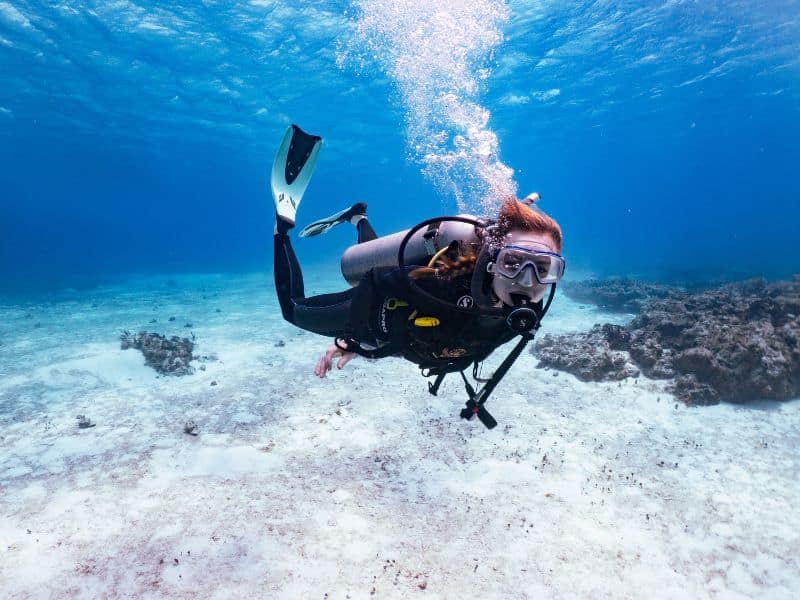
Scuba diving is underwater diving where you carry your own breathing gas, completely independent of the surface.
That independence is the whole point. It’s what lets divers explore reefs, inspect shipwrecks, do scientific research, or just go stare at a turtle for twenty minutes.
A modern scuba equipment setup usually includes:
- Scuba cylinder: A high-pressure tank holding compressed air or nitrox.
- Regulator: Steps high tank pressure down to something your lungs can actually use.
- BCD (buoyancy control device): An inflatable harness that keeps you floating exactly where you want to be.
- SPG and dive computer: Track your remaining air, your depth, and your time.
- Mask, snorkel, and fins: The basics. Vision, surface breathing, and propulsion.
What Is the Difference Between SCUBA and Snorkeling?
Both let you peek at marine life. That’s about where the similarities end.
| Feature |
Scuba Diving |
Snorkeling |
| Breathing gas |
Compressed air, carried in a tank |
Plain old surface air, through a tube |
| Depth |
12–40+ metres (40–130+ ft) |
Surface, with the occasional breath-hold dip |
| Time underwater |
30–60+ minutes per tank |
As long as you can hold your breath |
| Gear |
Tank, regulator, BCD, computer, weights |
Mask, snorkel, fins |
| Training |
Certification required |
Basically none |
Curious about the gentler option first? Check out our snorkeling tours.