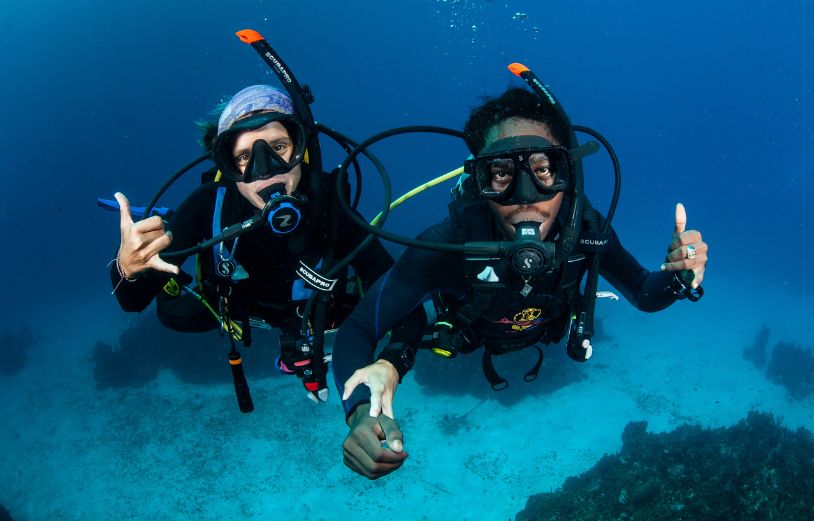

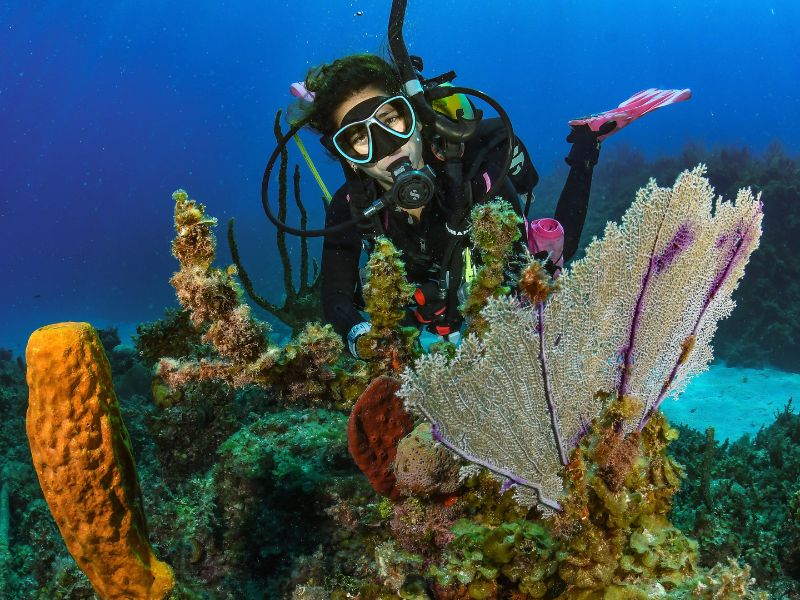
Every sport has its own language, and scuba diving is no exception. Divers love a good abbreviation, a technical term, and a casual nickname, and if you’re new, a dive boat can sound like a secret society. Don’t worry, you don’t need a decoder ring. This guide breaks down the most common scuba slang and diving terminology in plain English, so the next time someone says “nice viz, huh?” you’ll know exactly what they mean.

Meaning of SCUBA Acronym: What Does SCUBA Stand For?
06/10/2026
Scuba Diving Classes: What to Expect, How They Work, and Why They’re Perfect for You
16/10/20261. What Is Scuba Slang? Scuba Slang vs. Scuba Diving Terminology and Vocabulary
2. Common Scuba Diving Terms for Beginners
3. Scuba Equipment Slang and Terminology
4. Scuba Diving Slang for Dives and Dive Sites
5. Scuba Slang for Conditions and What You See Underwater
6. Scuba Slang and Expressions Divers Use
7. Common Scuba Diving Abbreviations
8. Scuba Slang You May Hear on a Dive Boat
9. Scuba Slang Beginners Should Know First
10. Frequently Asked Questions About Scuba Slang

1. What Is Scuba Slang? Scuba Slang vs. Scuba Diving Terminology and Vocabulary
Scuba slang is the informal language, shorthand, abbreviations, and expressions commonly used by scuba divers and dive professionals.
Distinguishing slang from formal technical terminology, abbreviations, and standard descriptive expressions is essential for clear communication underwater and topside:
- Scuba Slang: Informal, colloquial expressions originating in dive culture, such as calling underwater visibility “viz”, referring to a gas cylinder as a “bottle”, or labeling heavy gas consumers as “air hogs”.
- Technical Terminology: Formal terms established by official training organizations like (PADI, SDI, SSI, NAUI), such as “bottom time”, “decompression stop”, and “nitrogen narcosis”.
- Abbreviations: Functional acronyms or initialisms representing gear or training tiers, such as “BCD” (Buoyancy Control Device) or “SPG” (Submersible Pressure Gauge).
- Ordinary Expressions & Techniques: Standard descriptive terms defining physical entries or actions, such as “backroll” or “going diving.”
- Scuba Vocabulary: The overall umbrella term encompassing all spoken words, technical terms, equipment names, and informal expressions used within diving.
- Scuba Lingo: The conversational manner in which active divers mix technical terminology and informal slang during everyday deck conversations, dive briefings, and post-dive logs.
2. Common Scuba Diving Terms for Beginners
Dive Buddy
- Meaning: An assigned diving partner responsible for conducting pre-dive safety checks, monitoring gas supply, and providing assistance in emergencies.
- In practice: Dive leaders pair divers together prior to entering the water to establish mutual safety oversight.
- Example: “Divers must check their dive buddy’s air valve before stepping onto the platform.”
Dive Briefing
- Meaning: An instructional overview delivered by a dive professional prior to entry, detailing site topography, maximum depth, route, and entry techniques.
- In practice: Divers gather on deck to listen to safety parameters, environmental conditions, and group procedures before gearing up.
- Example: “The Divemaster emphasized the strong current during the pre-dive briefing.”
Surface Interval
- Meaning: The elapsed time a diver spends at the surface between consecutive scuba dives to eliminate residual dissolved nitrogen from body tissues.
- In practice: Dive Instructors inform divers of the required rest duration before starting a second dive.
- Example: “A one-hour surface interval is required before starting the second dive.”
Flying After Diving Interval:
- Meaning: DAN’s Flying After Diving workshop recommended at least 12 hours before flying after a single no-decompression dive, and at least 18 hours after multi-day repetitive diving (DAN).
- In practice: Always check your dive computer and your dive center’s current guidance before booking that flight.
- Example: The surface interval between dives isn’t the same as the wait before your flight home.
Dive Site
- Meaning: The specific geographic location, reef structure, or submerged wreck designated for a diving activity.
- In practice: Boat captains navigate directly to the established dive site coordinates before mooring.
- Example: “The vessel is approaching a shallow reef dive site known for clear water.”
Descent
- Meaning: The controlled downward movement of a diver from the water surface to the planned target depth.
- In practice: Divers vent air from their buoyancy device and equalize their ears during the downward transition.
- Example: “Divers should equalize their ears early and often throughout the descent.”
Ascent
- Meaning: The controlled upward movement of a diver toward the surface at a maximum safe speed.
- In practice: Divers monitor depth gauges and maintain a slow rate of upward travel to prevent pressure-related injuries.
- Example: “Maintaining a slow ascent rate allows dissolved gases to vent safely from the bloodstream.”
Bottom Time
- Meaning: The total elapsed time from the beginning of the descent until the start of the direct final ascent to the surface.
- In practice: Divers track bottom time on dive computers to remain within non-decompression safety limits.
- Example: “The computer indicated a total bottom time of 45 minutes at maximum depth.”
Dive Log
- Meaning: A physical notebook or digital record used by divers to document dive details, depth, time, equipment, and environmental conditions.
- In practice: Divers logbook their profile data topside during surface intervals to verify experience for advanced certifications.
- Example: “Logging dives accurately provides proof of experience required for advanced training courses.”

3. Scuba Equipment Slang and Terminology
Tank
- Meaning: A high-pressure metal cylinder containing compressed atmospheric air or enriched nitrox gas mixtures. Informally called a “bottle” in dive slang.
- In practice: Divers verify cylinder pressure on a pressure gauge before securing the tank to their harness.
- Example: “Please swap this empty tank for a full cylinder before the afternoon dive.”
Reg
- Meaning: An informal shortened slang term for regulator, the mechanical system delivering breathable air from the cylinder.
- In practice: Divers purge their reg and test airflow before stepping into the water.
- Example: “Keep your reg in your mouth whenever floating at the surface.”
Regulator
- Meaning: The complete mechanical assembly consisting of a first stage connected to the tank valve and second stages for breathing.
- In practice: The first stage reduces high cylinder pressure to an intermediate level sent through hoses to the second stage mouthpiece.
- Example: “A complete regulator set includes a primary mouthpiece, an alternate air source, and an instrument console.”
BCD
- Meaning: Buoyancy Control Device; an inflatable jacket or back-plate wing used to adjust underwater buoyancy and provide surface flotation.
- In practice: Divers add small amounts of air to the BCD to hover neutrally above coral formations.
- Example: “Inflating the BCD at the surface ensures positive flotation while waiting for boat pickup.”
BC
- Meaning: An abbreviated alternative term for Buoyancy Control Device or Buoyancy Compensator.
- In practice: Dive guides check that the low-pressure inflator hose is firmly connected to the BC.
- Example: “Secure all loose straps on your BC before stepping up to the entry platform.”
SPG
- Meaning: Submersible Pressure Gauge; an instrument hose assembly that displays remaining cylinder air pressure.
- In practice: Divers inspect the SPG display periodically throughout a dive to monitor gas consumption.
- Example: “Check your SPG frequently to ensure you turn the dive with sufficient reserve air.”
Octo / Octopus
- Meaning: Informal terms for the alternate second stage regulator, typically colored bright yellow, used for sharing air with a buddy in emergencies.
- In practice: The octopus is secured within the chest area for rapid deployment during an out-of-air situation.
- Example: “In an emergency, locate and secure your buddy’s octo immediately.”
Weights
- Meaning: Lead weights worn in BC weight pockets or on a waist belt to offset human body and suit buoyancy.
- In practice: Divers perform surface buoyancy checks to confirm they carry sufficient weights to submerge smoothly.
- Example: “Adjusting lead weights correctly allows comfortable hover positioning near the seabed.”
Exposure Protection
- Meaning: Thermal garments designed to insulate the body against water temperatures and guard against marine scrapes.
- In practice: Divers select exposure gear ranging from lycra rashguards (“skins”) to short wetsuits (“shorties”), full suits (“steamers”), or waterproof drysuits.
- Example: “Diving in cold temperate waters requires full exposure protection such as a drysuit.”
Dive Computer
- Meaning: An electronic instrument that continuously tracks depth and time to calculate real-time non-decompression limits.
- In practice: Divers wear a dive computer on their wrist to monitor remaining bottom time and ascent rates.
- Example: “The dive computer provides real-time depth tracking and safe ascent alarms.”
If you want to go deeper (no pun intended), DAN’s reference booklet on decompression sickness has a full chapter on using your dive computer effectively (DAN).
Mask
- Meaning: A watertight glass facepiece covering the eyes and nose, enabling clear vision underwater. Never referred to as “goggles”.
- In practice: The enclosed nose pocket allows divers to exhale into the mask space to equalize internal pressure and clear trapped water.
- Example: “Exhaling gently through the nose clears water from the mask pocket.”
Fins
- Meaning: Flexible rubber or composite foot blades worn to generate movement through water efficiently. Never referred to as “flippers”.
- In practice: Divers use controlled fin techniques such as flutter or frog kicks to glide without disturbing sediment.
- Example: “Wearing properly fitted fins improves underwater maneuverability while saving energy.”
Wetsuit
- Meaning: A neoprene garment that traps a thin layer of water against the skin, warmed by body heat to maintain thermal insulation.
- In practice: Wetsuit neoprene compresses under water pressure at depth, slightly decreasing suit buoyancy during deep descents.
- Example: “A 3mm wetsuit provides comfortable insulation during tropical ocean dives.”
4. Scuba Diving Slang for Dives and Dive Sites
Two-Tank Dive
- Meaning: A single boat trip itinerary that includes two separate dives conducted at different sites or times.
- In practice: Charter operators organize two-tank dives separated by an onboard surface interval.
- Example: “Morning boat charters typically schedule a two-tank dive departing at 8:00 AM.”
Shore Dive
- Meaning: A dive entered directly from a coastline, beach, or pier without using a motorized vessel.
- In practice: Divers walk into shallow surf before donning fins and swimming out to deeper reef structures.
- Example: “Shore dives offer easy access for shallow marine life exploration.”
Boat Dive
- Meaning: A dive conducted by taking a vessel offshore to reach deeper or isolated underwater locations.
- In practice: Divers assemble gear on bench racks before executing stride entries off the vessel stern.
- Example: “Boat dives provide direct access to distant offshore reefs and deep drop-offs.”
Drift Dive
- Meaning: A diving technique where divers allow prevailing water currents to move them along a reef while the vessel follows topside.
- In practice: Divers maintain neutral buoyancy and float effortlessly with the current without fighting water flow.
- Example: “Drift diving over coral walls feels like flying through the water.”
Wall Dive
- Meaning: A dive along a vertical underwater cliff face that drops steeply into deep open water.
- In practice: Divers monitor their depth gauge continuously, as wall sites often extend far below recreational limits.
- Example: “Wall dives offer dramatic views of deep sea fans and pelagic marine life.”
Night Dive
- Meaning: A dive conducted after sunset using hand-held underwater torches to observe nocturnal species.
- In practice: Divers use dive lights and tank signal markers to navigate and maintain buddy contact in the dark.
- Example: “Night dives reveal active hunting octopuses and bioluminescent plankton.”
Deep Dive
- Meaning: In recreational diving, any dive extending deeper than 60 feet (18 meters) down to a maximum limit of 130 feet (40 meters).
- In practice: Deep dives require close air management because gas consumption increases with higher surrounding pressure.
- Example: “Advanced Open Water certifications qualify divers to conduct deep dives down to 100 feet.”
Reef Dive
- Meaning: A dive focused on exploring natural coral reef ecosystems and associated marine species.
- In practice: Divers maintain horizontal positioning to observe marine life without contacting delicate coral colonies.
- Example: “Tropical reef dives host vibrant fish communities and sea turtles.”
Wreck Dive
- Meaning: A dive centered on exploring submerged shipwrecks, sunken aircraft, or artificial structures.
- In practice: Divers swim along external structures or acquire specialist training to penetrate interior corridors safely.
- Example: “The wreck dive featured an intact vessel resting on a sandy seabed at 80 feet.”
Liveaboard
- Meaning: A dedicated dive vessel providing guest sleeping quarters, allowing divers to reside onboard for days to reach remote dive sites.
- In practice: Liveaboard trips allow divers to complete four to five dives per day directly from the vessel deck.
- Example: “Booking a liveaboard excursion grants access to pristine ocean reefs far off the coast.”
Dive Site
- Meaning: The specific designated underwater location chosen for a diving excursion.
- In practice: Divemasters evaluate local water conditions before selecting the optimal dive site for the group.
- Example: “This dive site is famous for crystal-clear water and schooling reef fish.”

5. Scuba Slang for Conditions and What You See Underwater
Viz / Visibility
- Meaning: Informal slang for visibility, measuring horizontal underwater transparency distance in feet or meters.
- In practice: Divers describe exceptionally clear water as having “great viz”.
- Example: “The Divemaster reported over 80 feet of viz at the outer drop-off.”
Current
- Meaning: Continuous directional water flow caused by tides, winds, or oceanic circulation systems.
- In practice: Divers streamline their equipment to swim efficiently when encountering moderate currents.
- Example: “Swimming into a strong current drains cylinder air rapidly.”
Surge
- Meaning: Horizontal back-and-forth water displacement caused by surface wave swells passing over shallow underwater areas.
- In practice: Divers relax body muscles and glide with the surge motion rather than spending energy fighting it.
- Example: “Shallow reef formations often experience noticeable surge during ocean swells.”
Thermocline
- Meaning: A distinct, sharp boundary layer in the water column separating warmer upper water from significantly colder water below.
- In practice: Divers feel an immediate, distinct drop in water temperature when descending through a thermocline.
- Example: “Passing through the thermocline at 45 feet made the ocean water noticeably colder.”
Bottom
- Meaning: The solid ocean seabed, sand floor, or reef structure underlying a water body.
- In practice: Divers maintain neutral buoyancy above the bottom to avoid kicking up silt or damaging marine habitats.
- Example: “Hovering three feet off the sandy bottom preserves clear water visibility.”
Blue Water
- Meaning: Deep, clear ocean water where the seabed is not visible and no structural landmarks exist nearby.
- In practice: Blue water diving requires constant monitoring of depth gauges to maintain proper spatial positioning.
- Example: “Descending into blue water demands strict attention to dive computer depth displays.”
Green Water
- Meaning: Coastal water with lower visibility, tinted green due to suspended sediment or plankton blooms.
- In practice: Green water indicates plankton-rich environments that frequently attract large filter-feeding marine species.
- Example: “Plankton blooms resulted in green water, but brought feeding manta rays into the bay.”
Marine Life
- Meaning: The living organisms, fish, corals, and marine animals inhabiting underwater environments.
- In practice: Divers observe marine life quietly without touching or harassing animals.
- Example: “Protecting pristine marine life relies on good buoyancy control from every diver.”
Critter
- Meaning: Informal dive slang for small marine creatures, macro invertebrates, or well-camouflaged animals.
- In practice: Dive guides point out tiny critters hidden inside reef crevices to underwater photographers.
- Example: “The guide located a camouflaged critter nestled inside a coral pocket.”
6. Scuba Slang and Expressions Divers Use
Let’s Get Wet
- Meaning: An enthusiastic informal dive deck phrase meaning it is time to put on gear and enter the water. A cheerful way of saying it’s time to get in the water. SDI even builds its learning path around it: Get Smart (eLearning), Get Wet (pool training), and Go Diving (open water) (SDI).
- In practice: Captains and dive guides use this phrase to signal that the boat is on position and ready for entries.
- Example: “Gear checks are complete, so let’s get wet!”
Giant Stride
- Meaning: A standard boat water entry technique where a diver steps outward from a stable platform into the water with gear inflated.
- In practice: The diver holds their mask and regulator firmly against their face while stepping out with one large stride.
- Example: “Step out far off the stern using a giant stride to clear the boat platform.”
Backroll
- Meaning: A water entry method executed from small boats (such as RIBs or pangas) where divers sit on the gunwale and roll backward into the water.
- In practice: Divers secure their mask, hold chest gear, and fall backward together on the captain’s count.
- Example: “Small boat entries utilize the backroll technique to drop divers smoothly over shallow reefs.”
Negative Entry
- Meaning: An advanced water entry technique where divers empty all air from their BCD before jumping, sinking directly beneath the surface without floating topside.
- In practice: Employed in strong surface currents so the dive group stays together while descending straight to target depth.
- Example: “Executing a negative entry allowed the group to submerge instantly and avoid surface drift.”
Hot Dive
- Meaning: Slang for an immediate water entry performed quickly upon boat arrival due to fast surface currents or choppy seas.
- In practice: Divers sit fully geared with masks in place, ready to enter the moment the captain gives the command.
- Example: “The skipper called for a hot dive entry to capitalize on a brief pause in surface waves.”
Blow Your Bubbles
- Meaning: A foundational dive safety instruction reminding divers to exhale continuously whenever a regulator mouthpiece is out of the mouth underwater.
- In practice: Continuous exhaling prevents lung over-expansion injuries caused by expanding air during upward movements.
- Example: “Always remember the fundamental diving rule: never hold your breath and always blow your bubbles.”
Out of Air
- Meaning: An emergency condition where a diver’s air cylinder supply becomes completely exhausted underwater.
- In practice: Communicated underwater using the standardized hand signal of drawing a hand flat across the throat.
- Example: “Signaling out of air prompts an immediate response from a buddy to share an alternate air source.”
Turn the Dive
- Meaning: The designated point in a dive profile when a group stops moving away and begins heading back toward the boat anchor line or shore exit.
- In practice: Initiated as soon as any diver reaches a pre-planned turn pressure on their pressure gauge.
- Example: “The group reached 1000 PSI on their SPGs and turned the dive toward the boat mooring.”
Safety Stop
- Meaning: A precautionary 3-minute pause conducted at a depth of 15 feet (5 meters) during the final ascent.
- In practice: Allows nitrogen dissolved in body tissues to off-gas safely before surfacing.
- Example: “Hovering comfortably at 15 feet for three minutes completes a standard safety stop.”
The Bends
- Meaning: A nickname for decompression sickness.
- In practice: It’s why we ascend slowly, so we don’t get “bent”
- Example: If something feels off after a dive, DAN’s advice is simple: don’t shrug it off. Tell your dive supervisor and your buddy, because denial can complicate even a mild injury, and DAN says it’s available if you have symptoms after a dive.

7. Common Scuba Diving Abbreviations
| Abbreviation | Full Name / Meaning | What It Refers To |
| BCD | Buoyancy Control Device | Inflatable buoyancy jacket or wing |
| SPG | Submersible Pressure Gauge | Instrument showing remaining cylinder air pressure |
| SMB | Surface Marker Buoy | Inflatable signaling tube deployed to mark diver location topside |
| DSD | Discover Scuba Diving | Introductory resort diving experience for uncertified beginners |
| OW | Open Water Diver | Baseline autonomous diver certification tier |
| DM | Divemaster | Certified professional dive guide and instructional assistant |
| SI | Surface Interval | Time spent resting topside between consecutive dives |
| NDL | No Decompression Limit | Maximum allowable dive time at a specific depth without decompression stops |
| DV | Demand Valve | Second-stage regulator mouthpiece assembly delivering air on inhalation |
| DAN | Divers Alert Network | Global non-profit organization providing dive safety research and insurance |
8. Scuba Slang You May Hear on a Dive Boat
Listening to boat operations reveals how dive vernacular functions in real-world scenarios. When stepping onto a vessel deck, divers hear structured instructions and casual phrases designed to coordinate team preparation.
A standard dive trip follows a predictable verbal flow:
- Pre-Entry Call: “Check your gear” — Signals divers to conduct preliminary gear inspections and confirm tank pressure.
- Safety Protocol: “Buddy check” — Directs paired divers to systematically review each other’s equipment using the standard BWRAF procedure.
- Trip Overview: “We are doing a two-tank dive” — Informs the group that the itinerary includes two separate site visits separated by a rest period.
- Site Briefing: “Watch the current at depth” — Warns divers about localized water movement along the planned underwater route.
- Water Entry: “Giant stride on my mark” — Directs divers to step far off the deck platform once the captain clears the water.
- Intermission: “Enjoy your surface interval” — Announces the mandatory rest period topside between dives to eliminate residual nitrogen.
The buddy check procedure relies on the BWRAF mnemonic device to ensure comprehensive safety coverage:
- B (BCD): Testing power inflator and manual deflator mechanisms.
- W (Weights): Confirming weight belts or integrated weight pockets are securely locked.
- R (Releases): Inspecting all chest straps, shoulder buckles, and tank band latches.
- A (Air): Breathing through the primary regulator while observing the SPG needle to confirm the tank valve is fully open.
- F (Final Check): Conducting a final head-to-toe visual check for loose hoses or missing fins before stepping to the entry door.
9. Scuba Slang Beginners Should Know First
When beginning scuba training, learning a select set of core terms prevents feeling overwhelmed by technical jargon. Beginners can focus on this essential baseline list:
- Buddy: Assigned safety partner.
- Dive Briefing: Safety orientation before entering.
- BCD: Inflatable buoyancy vest.
- Regulator (Reg): Breathing mouthpiece assembly.
- SPG: Pressure gauge displaying cylinder air supply.
- Surface Interval: Rest period between dives.
- Bottom Time: Total time spent underwater.
- Dive Site: Geographic target location for the dive.
- Descent / Ascent: Vertical entry down and upward return.
- Safety Stop: Precautionary 3-minute pause at 15 feet.
- Viz: Measurement of underwater clarity.
- Two-Tank Dive: Standard boat trip with two scheduled dives.

10. Frequently Asked Questions About Scuba Slang
What does scuba slang mean?
Scuba slang is the informal language, shorthand, and colloquial expressions used by divers to describe equipment, ocean conditions, and dive activities.
What is scuba lingo?
Scuba lingo refers to the everyday conversational blend of technical terminology and informal slang spoken on dive boats and in dive shops.
What is scuba terminology?
Scuba terminology includes the formal technical terms established by dive training organizations to define equipment functions, physical principles, and safety procedures.
What is the most common scuba slang?
Commonly heard slang terms include “viz” (visibility), “reg” (regulator), “bottle” (scuba cylinder), “air hog” (diver who uses gas quickly), and “critter” (small marine life).
What does “two-tank dive” mean?
A “two-tank dive” is a dive charter itinerary that includes two separate dives conducted at different locations or times using two separate cylinders.
What does “reg” mean in scuba diving?
“Reg” is a widely used shortened slang term for regulator, the device that reduces cylinder air pressure and supplies breathable gas.
What does “buddy” mean in scuba diving?
A “buddy” is an assigned diving partner who accompanies a diver to assist with safety checks, monitoring, and emergency support.
What does “bottom time” mean?
“Bottom time” is the total duration spent underwater from the start of the descent until the start of the direct final ascent.
What does “surface interval” mean?
A “surface interval” is the mandatory rest time spent out of the water between dives to off-gas accumulated nitrogen from body tissues.
What does “viz” mean in scuba diving?
“Viz” is shorthand for visibility, representing the distance a diver can see clearly through the water horizontally.
Ready to Put Your New Scuba Vocabulary to Use?
Now you can chat about regs, viz, and surface intervals like a pro. The only thing left is to get in the water. Explore scuba diving with Dressel Divers across the Caribbean.
CONTACT US FOR
PERSONALIZED ASSISTANCE
Ready to improve your dive skills?
Need more information about the next certification level?
WE ARE HERE TO HELP