protect coral reefs (3)
How to Protect Coral Reefs: 12+1 Proven Tips
14/05/2026
best snorkeling from shore in the caribbean (3) snorkel en el Caribe
Best Snorkeling in the Caribbean (2026): Top Islands, Beaches & Tours
18/05/2026
Show all

Underwater Habitats for Humans: Is It Really Possible to Live Beneath the Sea?

Underwater habitat (5) Hábitats submarinos para humanos

When we talk about underwater habitats for humans, your first reaction is probably: wait, can people actually live under the sea? It’s hard. Really hard. But yes. There are brave souls who do it.

Imagine waking up every morning with an ocean view. Not looking out at the blue surface stretching to the horizon, but literally from inside the ocean. No sunrise, no birds, no traffic noise. Just the hum of life-support systems, corals for a garden, and if you’re lucky, a goliath grouper staring at you through the porthole like the nosiest neighbor you’ve ever had.

These are underwater habitats for humans, or aquanauts, the astronauts of the ocean floor. Built by humans, for humans. And yes, it’s as extreme, as fascinating, and as technically brutal as it sounds.

Underwater habitat (12) Hábitats submarinos para humanos

1. What Exactly Is an Underwater Habitat?

First things first, let’s clear something up because people confuse this constantly: an underwater habitat is not the same thing as a submarine, and it’s not an underwater hotel either.

An underwater human habitat is a structure where people live for at least 24 consecutive hours, sleeping, eating, working, at the same pressure as the surrounding water. That’s the key: ambient pressure.

Here’s the thing. We all know that at depth, the human body saturates with gases. Well, underwater habitats allow aquanauts to work for hours or even days without needing to ascend and descend repeatedly, and without going through decompression every single time.

A submarine, by contrast, always maintains an internal atmosphere of 1 ATA regardless of depth. You can stay submerged for months, but physiologically speaking, you’re still a surface creature. You can’t just step out for a stroll on the seafloor.

And an underwater hotel like Jules’ Undersea Lodge is technically a habitat, it operates at ambient pressure, but it sits at shallow depth and its purpose is purely recreational.

Feature Underwater Habitat Submarine Underwater Hotel
Internal pressure Ambient (matches depth) Constant 1 ATM Ambient (shallow)
Primary purpose Research / saturation diving Defense / exploration Tourism
Water access Moon pool (open basin) Pressure hatch Moon pool or vertical shaft
Decompression Required at end of stay Not needed Required at end of stay


2. The History: How We Started Living Beneath the Sea

It all starts with Dr. George F. Bond, a U.S. Navy physician and the father of saturation diving. Between 1957 and 1963, he proved something that changed everything: after roughly 24 to 36 hours, human body tissues become fully saturated with the gases in the breathing mixture. Once saturated, it doesn’t matter whether you stay down for two days or two months, the decompression time doesn’t increase.

That meant an aquanaut could live at depth and work 8 or 9 hours a day. Bond called it the “Man-in-the-Sea” program and dreamed of underwater civilizations farming the ocean floor to feed a growing world.

Conshelf: Cousteau’s Starfish Houses

While the U.S. Navy pursued its military-industrial approach, the legendary French explorer Jacques-Yves Cousteau was chasing a more romantic vision. In 1962, he launched Conshelf I, the world’s first inhabited underwater habitat, at 10 meters / 33ft depth off the coast of Marseille. Two aquanauts lived there for one week.

In 1963, Conshelf II arrived in the Red Sea: a genuine “underwater village” with a starfish-shaped main structure (the Starfish House), a kitchen, laboratory, and even a garage for the SP-350 diving saucer. Five aquanauts lived there for a full month.

The most ambitious step was Conshelf III in 1965: six people for three weeks at 100 meters / 328 ft depth off the French coast, proving that humans could perform complex manual work, including maintaining a simulated oil well, at depths previously considered impossible for sustained habitation. Cousteau documented it all on film, creating the myth of homo aquaticus.

SEALAB: Because the Cold War Wasn’t Just a Space Race

Meanwhile, the U.S. Navy was deploying the SEALAB program.

SEALAB I went down to 59 meters off Bermuda in 1964. SEALAB II (1965), placed at 62 meters / 205 feet in the cold Pacific waters off La Jolla, California, famously included astronaut Scott Carpenter, making him the first person to hold both the title of astronaut and aquanaut. They also experimented with a bottlenose dolphin named Tuffy, trained to deliver mail and tools between the surface and the habitat. Yes, seriously.

SEALAB III (1969) was planned for 185 meters/ 607 feet, but ended in tragedy: aquanaut Berry L. Cannon died during an emergency repair. The program was cancelled. That same year, humans walked on the Moon, and the Navy redirected its resources toward remotely operated vehicles.

Underwater habitat (7) Hábitats submarinos para humanos

3. The Downsides of Living in an Underwater Habitat

Living in an underwater habitat is a constant negotiation with physics and human biology.

Pressure and Its Effects

Absolute pressure at depth follows a simple rule: every 10 meters adds roughly 1 bar. At 66 feet (about 20 meters), you’re at 3 ATA. The body feels it everywhere: fluid balance, circulation, even the simple act of breathing.

The Nitrogen Problem (and Why You Breathe Helium)

At mid-to-deep depths, the nitrogen in the breathing mixture causes narcosis, the famous “rapture of the deep,” a state of intoxication that impairs judgment and coordination.

The solution is heliox, a mixture of helium and oxygen. Helium is inert and has no narcotic effects… but it conducts heat at a ferocious rate, so the interior of a helium-filled habitat must be kept at around 30°C to prevent hypothermia. Amusing side effect: helium changes the acoustics of your voice and you end up sounding like a cartoon character. Electronic voice descramblers had to be developed just to communicate.

High-Pressure Nervous Syndrome (HPNS)

Beyond 150 meters/ 492 feet, HPNS emerges: tremors, myoclonic jerking, dizziness, and cognitive impairment caused by hydrostatic pressure acting directly on cell membranes. To mitigate it, compression must be carried out extremely slowly, in stages.

Decompression: The Pressure Prison

Once saturated, an aquanaut cannot ascend in an emergency. Doing so would cause dissolved gases in the blood and tissues to form bubbles, potentially resulting in fatal decompression sickness, the bends.

Decompression from saturation is a process that can last several days, at tightly controlled ascent rates. That turns the habitat into not just a temporary home, but a pressure trap you simply cannot run away from.


4. How an Underwater Habitat Is Built

Almost every modern habitat relies on a Life Support Buoy (LSB) anchored at the surface and connected to the seafloor by an umbilical carrying compressed air, oxygen, fresh water, electricity, and fiber optic cables. Generators and compressors run continuously.

The most striking feature is the moon pool: an opening at the bottom of the habitat that stays open to the ocean. Water doesn’t rush in because the internal air pressure holds it back, like an inverted cup in a sink. Aquanauts simply gear up and step into the water, no airlocks or hatches required. It’s the most elegant access point in modern engineering.

A typical scientific habitat like Aquarius Reef Base has three compartments:

  • Wet porch: moon pool, dive gear storage, hot-water shower.
  • Entry lock: transition zone for sensitive equipment.
  • Main compartment: bunks, galley, workstations, bathrooms, and acrylic viewports.
Underwater habitat - Hábitats submarinos para humanos

5. Active Underwater Habitats

Aquarius Reef Base: The Only Operational Underwater Lab in the World

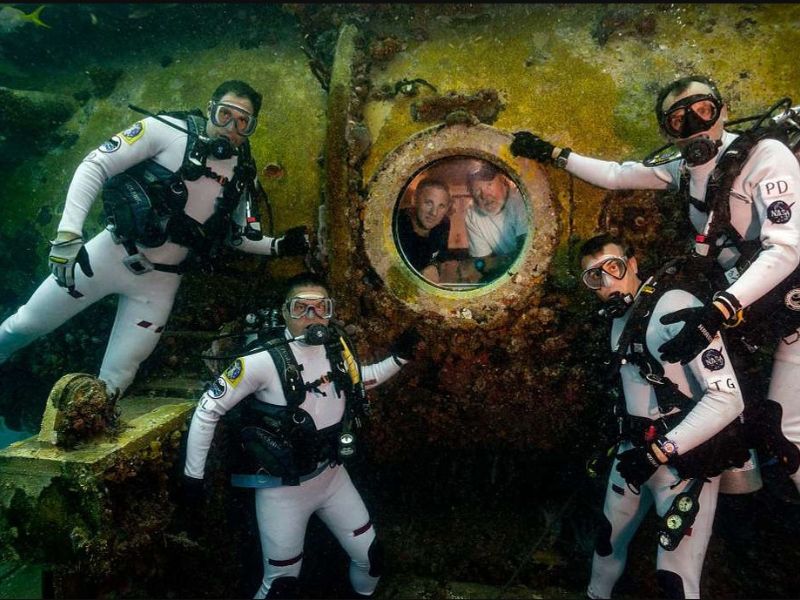
About 8.7 km / 5.4 miles off Key Largo, Florida, sitting at 19 meters/ 62 feet depth at the base of a coral reef, is Aquarius Reef Base, the only active underwater research laboratory on the planet. Owned by NOAA and operated by Florida International University (FIU), it has been the epicenter of undersea science for decades.

NASA NEEMO: Training Astronauts on the Ocean Floor

Since 2001, NASA has used Aquarius for its NEEMO program (NASA Extreme Environment Mission Operations). Why? Because the underwater environment, hostile, isolated, life-support-dependent, and with adjustable gravity, is the best Earth-based analog for space that exists.

Astronauts simulate EVAs on the seafloor with weights adjusted to mimic the gravity of the Moon or Mars. Communication delays are introduced to replicate the lag with Mars. Team dynamics under extreme pressure are studied. It’s literally training for space… inside the sea.

Mission 31: The Cousteau Legacy

In 2014, Fabien Cousteau spent 31 consecutive days in Aquarius to honor the 50th anniversary of Conshelf II, one of his grandfather’s underwater habitats. The results were extraordinary: he and his team estimated they collected the equivalent of two years’ worth of surface-diving data in a single month.

They studied reef health, goliath grouper behavior, and the impact of pollutants on deep-sea sponges. Cousteau described a “cognitive shift” that happens after three days in the habitat: you start feeling like part of the ocean ecosystem, and the surface begins to feel hostile.


6. Life Inside an Underwater Habitat

Cooking underwater is, literally, applied science.

First rule: no open flames. In a hyperbaric environment, a fire could be catastrophic. Everything is prepared in microwaves or on electric hotplates.

Second quirk: the boiling point of water rises with pressure. At sea level it boils at 100°C / 212°F. At 7 atmospheres of pressure, it doesn’t boil until 165°C / 329°F. That means in a deep habitat, boiling water can reach temperatures where the Maillard reaction occurs, the chemical process that browns food and develops flavor; something physically impossible in a pot at sea level. The water essentially “fries” meat from the inside out. Fascinating in theory, though most shallow missions like NEEMO run primarily on freeze-dried food and care packages delivered by support divers.

The Sensory Experience of Living Underwater

Submersion transforms every one of your senses.

Sound: water conducts sound four times faster than air, making it difficult to locate where a noise is coming from. Low-frequency vibrations, the thrum of boat hulls, the crackling of millions of snapping shrimp, are felt directly in the chest. Cousteau described Aquarius as a surprisingly loud place.

Sight: red light disappears within the first few meters, followed by oranges and yellows. The world turns blue-green. Refraction makes objects appear 25% larger and closer than they actually are.

Smell and taste: high pressure and humidity cause the nasal passages to swell slightly, dulling the sense of smell. Cousteau confirmed that during Mission 31, very pungent cheese could still cut through, but the most assaulting smell was rather less gourmet: wetsuits soaked in weeks of use.

Psychological wellbeing: many aquanauts describe a state of “Blue Mind”, deep relaxation, attentional restoration, relief from gravitational stress on the joints thanks to buoyancy. But the strain of ICE (Isolated, Confined, and Extreme) environments is real: physiological markers show decreased heart and respiratory rates and increased parasympathetic tone, in other words, a more physically relaxed state, alongside reduced cerebral blood flow velocity. Dr. Joseph Dituri’s 100-day Project Neptune mission revealed that the spine compresses slightly under constant ambient pressure: the body literally “shrinks” by a couple of centimeters.


Underwater habitat (9) Hábitats submarinos para humanos

7. The Future: PROTEUS and the Next Generation of Underwater Habitats

Interest in underwater habitats is surging, driven by both scientific exploration and the urgent need to understand and respond to climate change.

PROTEUS™: The International Space Station of the Ocean

Designed by Fabien Cousteau and architect Yves Béhar, PROTEUS™ is the most ambitious proposal yet: 370 square meters / 4,000 square feet of modular structure at 60 meters / 197 feet depth off Curaçao, housing 12 to 18 researchers. It will include onsite laboratories for DNA sequencing, a dock large enough for internal submersibles, and a hydroponic garden. It plans to harness Ocean Thermal Energy Conversion (OTEC), exploiting the temperature difference between surface and deep water, to be fully energy self-sufficient.

DEEP Vanguard and the Sentinel System

The ocean engineering company DEEP unveiled Vanguard in late 2025: the first purpose-built underwater habitat since Aquarius. Scheduled for deployment at Tennessee Reef in May 2026, it will house four crew members at a depth of 14 meters, and is on track to become the first underwater habitat to receive certification from DNV, the leading international maritime standards authority. This paves the way for the Sentinel system: a modular habitat capable of supporting six people at 200 meters / 656 feet depth for 28 days at a time.

Project Depth Crea Status (2026)
Aquarius Reef Base 19 m/ 62 ft 6 people Operational
Vanguard (DEEP) 14–18 m / 46–59 ft 4 people Commissioning (May 2026)
PROTEUS™ 60 m / 197 ft 12–18 people Finalizing location
Sentinel (DEEP) 200 m / 656 ft 6+ (modular) In development


8. Why Underwater Habitats Matter More Than Ever

The ocean covers 71% of the planet. We have explored it less thoroughly than the surface of the Moon. And as climate change acidifies the water, bleaches coral reefs, and disrupts entire food chains, having scientists living in the sea, not just visiting for a few hours, is an enormous advantage.

Underwater habitats make possible:

  • Continuous, 24-hour real-time observation of ecosystems.
  • Detection of resilient corals and “climate refugia” where life persists despite warming.
  • Pharmaceutical research with marine organisms of tremendous biomedical potential.
  • Space analog training: everything we learn about life in ICE environments underwater translates directly to Moon and Mars missions.

Cousteau’s old stations in the Red Sea are now thriving artificial reefs. The ocean floor gives back what you put into it.

Underwater habitat (11) Hábitats submarinos para humanos

9. Frequently Asked Questions (FAQ) About Underwater Habitats


What Is the World Record for Living Underwater?

The current world record for living in an ambient-pressure underwater habitat is 120 days, achieved by German engineer Rudiger Koch in January 2025 inside the SeaPod habitat off the coast of Panama. This milestone surpassed the previous 100-day record set by Joseph Dituri in 2023.

What Is the Aquarius Reef Base and Why Is It Important?

Aquarius Reef Base is currently the world’s only operational underwater research laboratory. Located about 62 feet (19 meters) below the surface inside the Florida Keys National Marine Sanctuary, it is used by NASA for the NEEMO missions and by marine scientists to study coral reefs and simulate the isolation conditions of space missions.

How Do Aquanauts Breathe Inside These Structures?

In shallow underwater habitats, aquanauts breathe compressed air. In deeper missions, gas mixtures such as Heliox (helium and oxygen) are used to prevent nitrogen narcosis. Air is typically supplied through an umbilical line connected to a surface support buoy equipped with compressors and power generators.

What Psychological Effects Does Living in Isolated Underwater Habitats Produce?

Aquanauts live in environments classified as ICE environments: Isolated, Confined, and Extreme. These conditions can lead to stress, social monotony, sleep-cycle disruption, and psychological fatigue caused by prolonged coexistence in cramped spaces.

However, many aquanauts also report experiencing the “Blue Mind” effect, a meditative, calming mental state induced by immersion and the rhythmic sound of water.

How Is Wastewater Managed in Underwater Habitats Without Polluting the Environment?

Modern underwater habitats use biological treatment systems in which microorganisms digest organic waste inside aerated tanks, converting it into relatively harmless byproducts such as water and carbon dioxide.

What Is the Estimated Cost of Building and Operating These Structures?

Building underwater is extraordinarily expensive, often costing up to ten times more than a comparable land-based construction project. The PROTEUS project, for example, has an estimated construction budget of $60 million, plus an additional $75 million required to cover operating costs during its first three years.

What Impact Do Habitat Lights and Noise Have on Local Marine Life?

Noise pollution from generators and life-support systems can raise cortisol levels in fish, damage their hearing, and alter feeding and defensive behaviors. Artificial light at night (ALAN) from habitat windows may also disorient coral larvae and sea turtles while disrupting the vertical migration patterns of zooplankton.


In Summary

Underwater habitats for humans are neither science fiction nor a billionaire’s vanity project. They are real laboratories where physics, biology, and engineering negotiate every single second.

The deepest operational underwater habitat right now, Aquarius, reaches only 19 meters / 62 feet. The next great leap is Sentinel’s 200 meters / 656 feet, planned for 2027. But the direction is clear: the oceanic continent, that 70% of Earth still largely unknown, is being reclaimed, meter by meter, by the aquanauts of the 21st century and their remarkable underwater habitats.

CONTACT US FOR
PERSONALIZED ASSISTANCE

Ready to improve your dive skills?
Need more information about the next certification level?

WE ARE HERE TO HELP

contact

    I consent to receiving commercial communications and promotions from Dressel Divers.