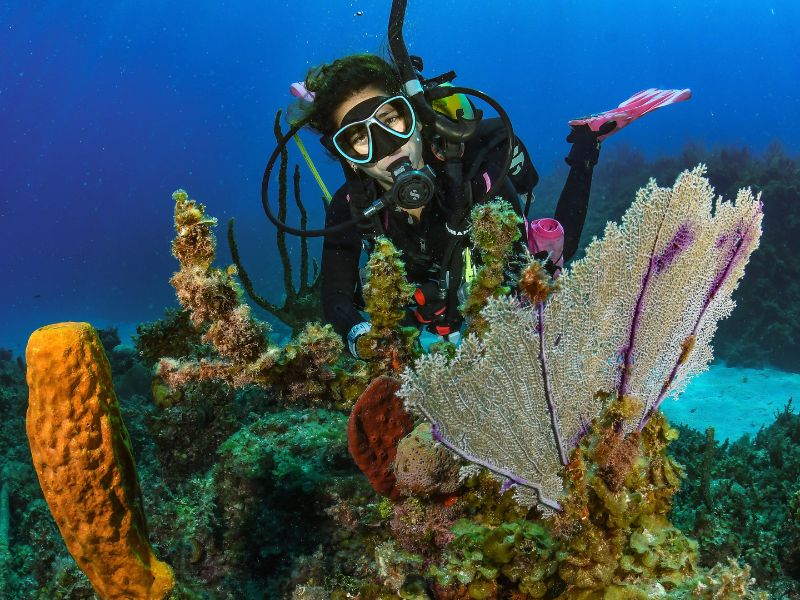
7. What’s Included in Scuba Diving Classes?
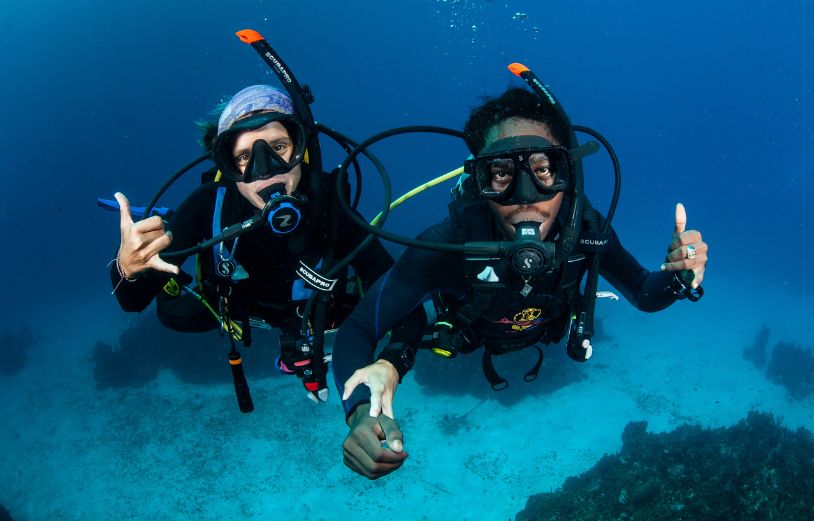
Scuba diving classes for the Open Water certification include, with Dressel Divers:
- Complete equipment rental — mask, snorkel, fins, BCD, regulator with alternate air source, pressure gauge, tank with filtered compressed air, and weight belt. You show up; we gear you up.
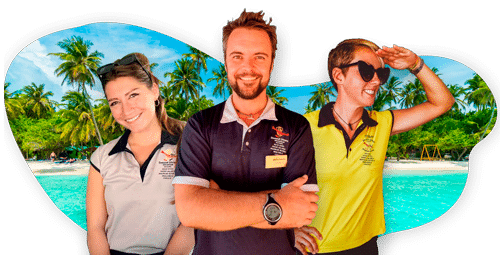
- Certified instructors — a professional with an active teaching license.
- Theory materials — either an e-learning app you complete before you arrive, or in-person scuba diving classes at the dive center.
- 5 confined water sessions — practical pool or protected bay sessions.
- Open water dives — 4 boat dives.
- Student academic record
- Registration
- Digital certification card
- Certification photo
8. How Long Does a Scuba Diving Class Last?
It depends.
- Try Dive: 2 to 4 hours total. Morning activity, beach in the afternoon. Done.
- Open Water Certification: 3 to 4 days across different sessions. BUT — if you complete the theory and exams online at home before your trip, you arrive on Day 1 and go straight into pool and ocean practice. Maximum dive time, minimum classroom time.
The e-learning option is great for travelers. Most people finish the theory in 6–8 hours from home. Then your vacation starts from the very first dive — not the first page of the manual.
9. Scuba Diving Classes for Every Level: From Open Water to Instructor
You’ve done your first scuba diving class. Or maybe you’ve been certified for years and want to go further.
Either way — scuba diving classes don’t end at the beginner level.
There’s a complete progression. From your first breath underwater to teaching others how to do it. Each level of scuba diving classes builds on the last, and each one unlocks a completely new world of diving.
Here’s the full map:
The complete scuba diving class progression
| Level |
Who It’s For |
Duration |
What You Unlock |
| Try Dive / Discover Scuba |
Absolute beginners, no certification |
2–4 hours |
A supervised ocean dive to 40 ft (12 m) |
| Open Water Diver |
First certification |
3–4 days |
Independent diving to 60 ft (18 m) with a certified buddy |
| Specialty Courses |
Any certified diver |
1–2 days each |
Nitrox, wrecks, caves, photography, night diving… |
| Advanced Open Water |
Certified OW divers (10+ dives recommended) |
2–3 days |
Diving to 100 ft (30 m) + specialty skills |
| Rescue Diver |
Advanced OW + Emergency First Response |
3–4 days |
Self-rescue + assisting other divers in distress |
| Divemaster |
Rescue Divers with 40+ logged dives |
Varies (weeks to months) |
Guide certified divers, assist instructors, professional status |
| Instructor (IDC + IE) |
Divemasters with 100+ dives |
Varies (10–14 days + exam) |
Teach all scuba diving classes independently |
Advanced Open Water Diver You’re certified. You’ve done a few dives. And now you want more.
The Advanced Open Water course is the most popular next step after beginner scuba diving classes. It’s not about proving you’re an “advanced” diver — it’s about becoming a safer, more versatile one.
Rescue Diver Ask any experienced diver which scuba diving class made the biggest difference.
Almost all of them say the same thing: Rescue Diver.
It’s about becoming a self-sufficient, calm, and aware diver who can handle any situation. The Rescue Diver course is considered the most transformative level of all recreational scuba diving classes. The skills you learn go far beyond diving — situational awareness, composure under pressure, emergency response. Genuinely life-changing.
Scuba Diving Specialties Not every diver wants to follow the same path. Specialty scuba diving classes let you focus on whatever excites you most about the underwater world.
Each specialty typically lasts 2 days and includes 2 to 4 dives. You can stack as many as you like. Earn 5 and you unlock the Master Scuba Diver title — the highest recreational certification that exists.
Most popular scuba diving specialty courses
| Specialty Course |
What You Learn |
Ideal For |
| Nitrox (Enriched Air) |
Diving with higher-oxygen mixes (32–36%) for longer bottom times and shorter surface intervals |
Divers who want more time on the reef during multi-dive days |
| Deep Diving |
Scuba diving to 130 ft (40 m), decompression theory, gas management, deep dive planning |
Those who want to explore walls, wrecks, and deeper reefs |
| Wreck Diving |
Navigation around and penetration of sunken ships, with safety protocols for overhead environments |
History lovers and underwater explorers |
| Night Diving |
Flashlight techniques, nighttime communication, returning to the boat in the dark |
Anyone who wants to see the reef completely transformed after sunset |
| Underwater Photography |
Buoyancy for photography, composition, lighting, gear care, how to get stunning shots without damaging the reef |
Divers who want to share what they see with the surface world |
| Drift Diving |
Reading currents, using them to glide effortlessly along reefs, signaling surface support boats |
Intermediate divers in high-current destinations (Cozumel, Riviera Mayam, Red Sea, Indonesia) |
| Perfect Buoyancy |
Mastering trim, breath control, and effortless neutral buoyancy — the skill that separates good divers from great ones |
Any diver who wants to improve, regardless of level |
| Cave/Cavern Diving |
Overhead environment protocols, guideline placement, gas management in no-open-water environments |
Advanced divers drawn to cenotes, lava tubes, and cave systems |
| Sidemount |
Carrying tanks at your sides instead of on your back — for tighter spaces and redundant gas systems |
Technical divers and those exploring overhead environments |
| Fish Identification |
Recognizing species by family, behavior, and habitat — turning every dive into a biology lesson |
Nature lovers and ecologically aware divers |
Divemaster This is where recreational scuba diving classes end and professional ones begin.
The Divemaster course is the first professional level in recreational diving. It’s not just a certification — it’s a mindset shift. You go from being a diver to someone who leads, manages, and guides others.
Dive Instructor After completing the IDC and passing the Instructor Examination (IE), you’re qualified to teach all recreational scuba diving classes independently — from try dives to Divemaster training.