reef-diving-principal - buceo en arrecife
Reef Diving: The Definitive Guide
15/04/2026
Show all

Honeycomb Cowfish: The Square-Head Fish Ultimate Guide

Honeycomb Cowfish (1) pez vaca hexagonal

Box-shaped body. Hexagonal skin. Two tiny horns. The honeycomb cowfish is one of the ocean’s weirdest creatures and one of the most rewarding to spot while diving.

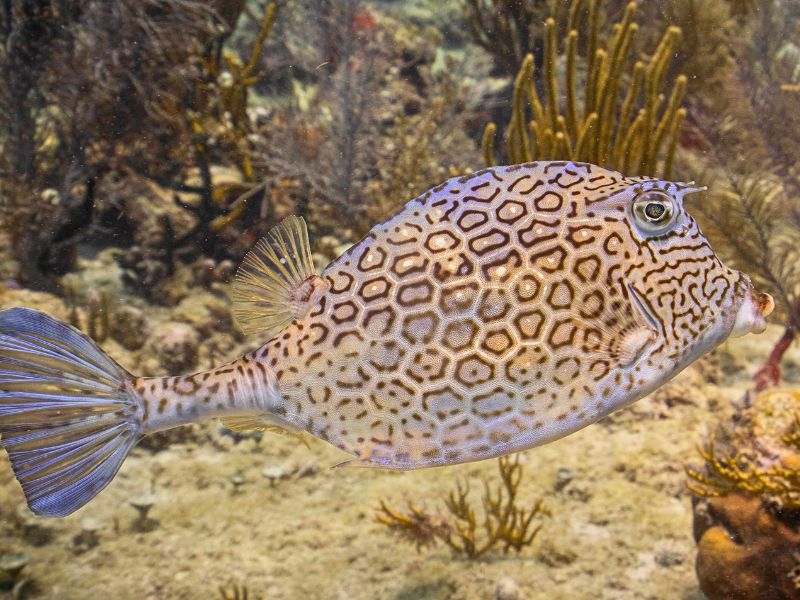
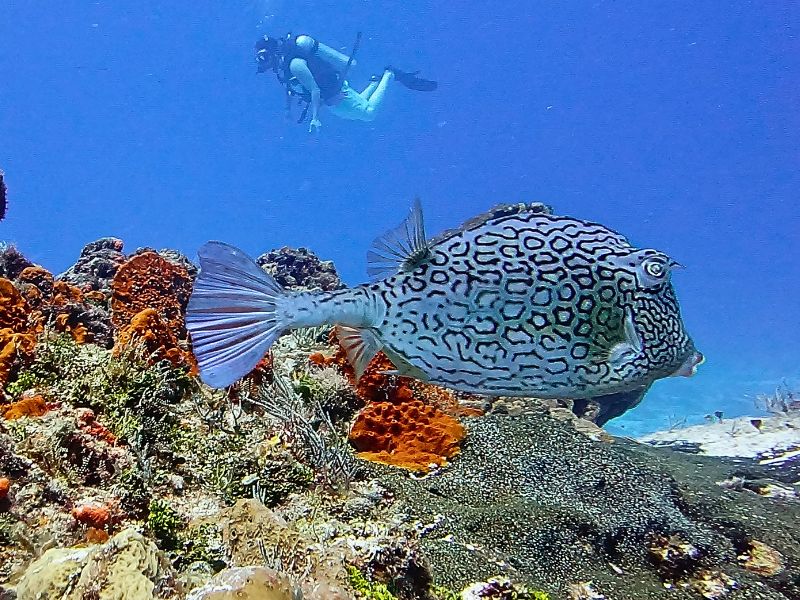
Among all the creatures that look like they were designed by an 80s special effects team, one stands out for its near-perfect geometry. I’m talking about the honeycomb cowfish (Acanthostracion polygonius). This is a fish that decided curves were overrated and went full “cube.” If you’ve ever dived in the Caribbean and saw what looked like a floating shoe box with horns, congrats: you met the reef’s most charismatic square head fish.

In this guide, we’re breaking down everything about this incredible cowfish fish. Whether you’re a marine biology nerd or a diver hunting for your next great shot, get ready. We are jumping into the world of the honeycomb cowfish.

1. What Is the Hexagonal Cowfish?

To understand the hexagonal cowfish, you first need to understand its family tree. This is not just any fish. It is a distinguished member of the order Tetraodontiformes. Yes, the same group that includes pufferfish and triggerfish. But while pufferfish inflate themselves to scare predators, the cowfish has taken a different approach: building an external bunker.

Here is the full classification for those who want the technical details:

Taxonomic classification Detail
Kingdom Animalia
Phylum Chordata
Class Actinopterygii
Order Tetraodontiformes
Family Ostraciidae
Genus Acanthostracion
Species A. polygonius

The common name “Honeycomb Cowfish” comes from two very obvious features:

  • The honeycomb pattern — hexagonal markings all over its body that look exactly like a beehive.
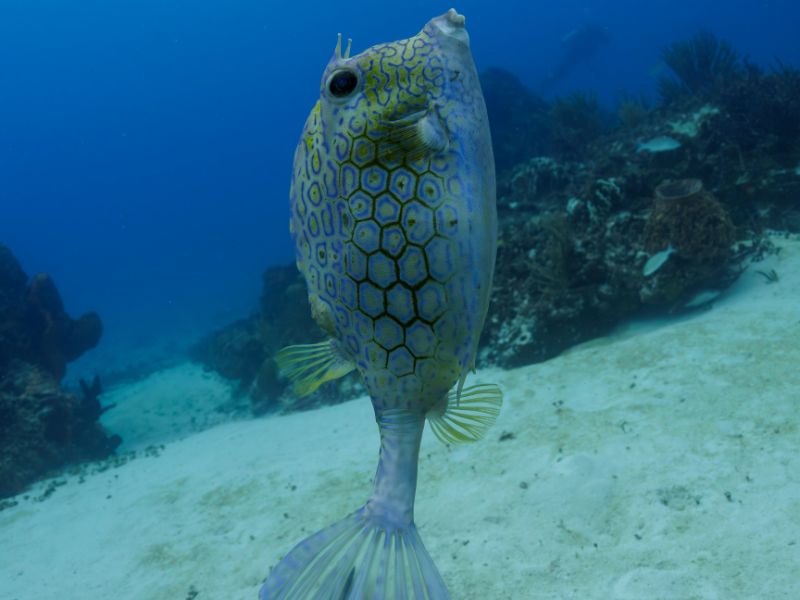
  • The two small horns above its eyes — vaguely reminiscent of a sea cow.


2. Why Is the Hexagonal Cowfish Cube-Shaped?

Even if you’re not a diver, you probably know that a square shape is not the most hydrodynamic form in the ocean. So why did evolution decide to give this fish a box-shaped head and body?

The answer is a fascinating mix of passive defense and very unusual fluid dynamics.

Its most defining feature is its shell. It’s not just tough skin — it’s an armor made of fused hexagonal plates. These plates, called scutes, form a rigid box that protects all its internal organs.

In other words, it’s a floating box with eyes, a mouth, fins, and two little horns.

Any predator trying to bite a honeycomb cowfish ends up facing something with the consistency of stone.

If you look closely, it’s not actually a perfect cube — it’s more triangular in profile, with a wide flat base and a sharp ridge along the top. This makes it extremely difficult to swallow. It’s the “fish that looks like a triangle” nobody wants on the menu.


2.1. A Shape That Doesn’t Boost Speed — But Improves Stability

At first glance, it looks like a terrible design: no flexibility, slow movement, no quick escape potential… or is there more to it?

For years, engineers assumed the cowfish’s box-like shape was bad for swimming. But recent studies in fluid dynamics have revealed something surprising: its armor actually helps stabilize it in the water.

As water flows over the sharp edges of its body (the “corners” of the box), it creates small vortices that act like natural stabilizers. These help the fish maintain a straight trajectory even in strong currents with minimal effort.

  • Ostraciiform propulsion: Since it cannot flex its body, it swims by oscillating only its pectoral, dorsal, and anal fins like small paddles.
  • The rudder: The tail is the only flexible part and is mainly used for quick turns or bursts of speed when startled.
  • Roll stability: The body’s keels reduce rolling, allowing it to “hover” over coral with drone-like precision.


2.2. The Honeycomb Pattern of The Hexagonal Cowfish

The skin pattern is not just decorative. It is a high-level disruptive camouflage system. In the complex light-and-shadow environment of a coral reef, the hexagonal pattern breaks up the fish’s outline, making it difficult for predators to determine where the body begins and ends.

Essentially, it is a high-tech bone-based camouflage suit.

Combined with toxic skin secretions, its rigid body forms part of a complete defense package.

Honeycomb Cowfish (3) pez vaca hexagonal

3. Types Of Cowfish: A Species Guide

The hexagonal cowfish is just one player in this unusual family. Knowing the different types of cowfish is essential for proper underwater identification.

Spiny cowfish (Lactoria fornasini)

Indo-Pacific species. Distinct spines along the back. Brown with white spots. More angular than honeycomb species.

Blue cowfish (Ostracion cyanurus)

Striking blue and yellow markings. Found in the Red Sea and Indo-Pacific. One of the most photogenic species in the family.

Scrawled cowfish (Acanthostracion quadricornis)

Atlantic species. Four horns instead of two. Cream or white body with blue spots. Close relative of the honeycomb cowfish.

Black boxfish (Ostracion meleagris)

Males are dark with white spots and orange accents. Females look completely different.

Longhorn cowfish (Lactoria cornuta)

The most recognizable of all. Its extremely long horns make it unmistakable. Very popular in aquariums.

Yellow boxfish (Ostracion cubicus)

Bright yellow with black spots. Undergoes a dramatic transformation as it matures. A reef favorite in the Indo-Pacific.

Quick identification tip: If you’re diving in the Caribbean or the western Atlantic and you see a boxfish with a hexagonal pattern and short horns, it’s almost certainly the honeycomb cowfish.

The spotted cowfish in the same region has four horns instead. That’s your fastest field distinction.


4. Where Do Cowfish Live?

If you’re planning your next diving holiday and want to tick the hexagonal cowfish off your bucket list, you need to know where to look. This is not a world-traveling fish; it has very specific “neighborhoods.”

The hexagonal cowfish lives mainly in the Western Atlantic. Its range extends from the coasts of New Jersey (although sightings there are rare) and Bermuda, down through the entire Caribbean and the Antilles, all the way to southern Brazil. It is also commonly found throughout the Gulf of Mexico.

Its ideal home: coral reefs

Where exactly does the cowfish live? Don’t look in the open ocean. These are reef-dwelling fish. They prefer clear, warm waters (between 72°F and 81°F / 22°C and 27°C). Their favorite habitats include:

  • Coral reefs: where they can hide among crevices and overhangs
    • Seagrass beds: especially for juveniles
    • Estuaries: occasionally venturing into areas where rivers meet the sea

In terms of depth, they are typically found within recreational diving limits, between 10 and 80 feet (3 to 25 meters), although some individuals have been recorded at depths of over 260 feet (80 meters).

5. Behavior Of the Honeycomb Cowfish

Diving with a cowfish is like watching a slow-motion film. They’re in no rush about anything. Their behavior is a mix of extreme shyness and absolute confidence in their armor-like body.

Social life of the cowfish

Unlike many reef fish that form large schools, the honeycomb cowfish is mostly solitary. However, they can occasionally form small groups of three: one dominant male and two females. The male is highly territorial and will aggressively chase away other males that try to approach his “harem.”

What’s on the menu?

Their diet is surprisingly varied for a fish with such a small mouth. They are benthic carnivores, meaning they spend most of their time “pecking” at the seafloor. They feed on:

  • Sponges and tunicates (their favorites)
    • Small crustaceans such as shrimp
    • Algae and marine worms

A fascinating detail about their feeding behavior is that they use their mouths like a pressure washer. They blast jets of water into the sand to uncover hidden prey. Watching them “blow” through the seabed is quite a spectacle.


6. Juvenile Honeycomb Cowfish: Why They Look Like a Different Species

Juvenile cowfish are a completely different story. If the adult is a tank, the juvenile is a wind-up toy. The main difference is rigidity. Babies are rounder and far less rigid, making them much more agile swimmers than adults.

Juvenile cowfish also look very different from adults, which often confuses divers:

  • Juveniles are usually much brighter — yellows, oranges, and well-defined patterns
    • The honeycomb hexagonal pattern is less pronounced
    • Body proportions are different — the head looks larger relative to the body
    • They are smaller and stay closer to reef shelters

If you see a small, colorful box-shaped fish hiding in a coral crevice, it’s very likely a juvenile cowfish. It’s worth stopping to observe it for a while.

As they grow, their metabolism changes and they begin depositing more calcium into their bony plates. This makes them more angular and heavier. Essentially, they go from being a bouncy ball to an armored box. They also lose those bright yellow tones and shift to more muted colors that provide better camouflage in the adult reef environment.

Honeycomb Cowfish (5) pez vaca hexagonal

7. How To Find a Honeycomb Cowfish While Diving

If you’re a diver, you know there are fish that come to greet you (like remoras) and fish that play hide-and-seek. The honeycomb cowfish is the undisputed champion of the latter. Here are some expert tips to avoid missing it:

  1. Look in the shadows: They rarely swim in full sunlight. They prefer coral ledges or areas beneath sea fans.
  2. Watch for fin movement: Since their body is rigid, only their small transparent fins move. Sometimes you’ll notice the shimmer of movement before seeing the fish itself.
  3. Don’t chase them: If you swim directly toward them, they’ll dart away instantly. Approach from the side without staring them down—they are very sensitive to eye contact.
  4. Time of day matters: They are diurnal animals. The best time to see them active is mid-morning, when they are actively feeding.


8. Underwater Photography of the Honeycomb Cowfish

Good news for underwater photographers: the honeycomb cowfish is one of the best subjects you’ll find on Atlantic reefs. Slow-moving. Geometric pattern. Visually fascinating.

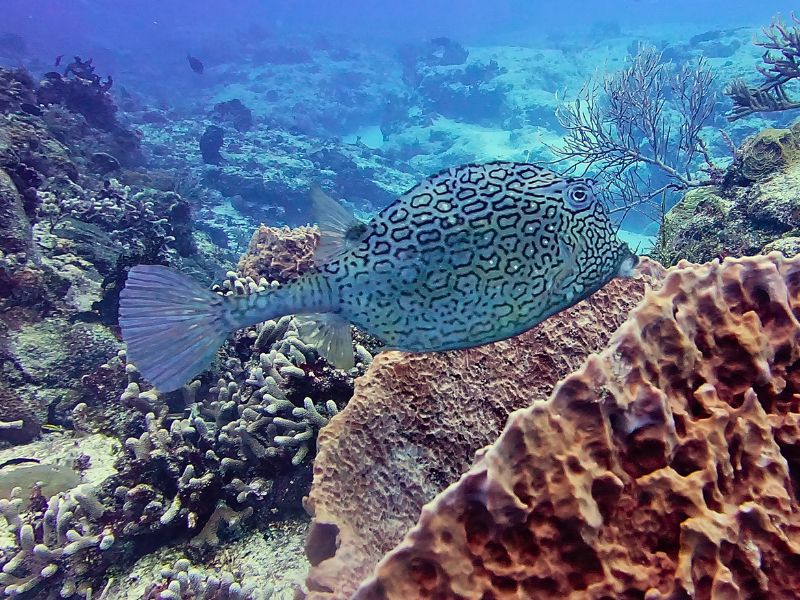
  • Shoot from the side — the lateral angle reveals the full hexagonal pattern. Don’t shoot head-on; you’ll lose all the detail.
    Position yourself at eye level — frame the shot looking directly into its eye. That’s the photo.
    Use a coral or sea fan background — the contrast between the honeycomb pattern and organic coral is visually striking.
    Wait for natural behavior — capture the moment it blows jets of water into the substrate to hunt. Much more interesting than a static portrait.
    Low ISO, well-positioned strobe — the hexagonal pattern needs textured light to really stand out.
    • Be mindful of the background: avoid too much “noise” behind the fish. Clean blue water or an uncluttered coral backdrop will make the pattern pop.
    Patience pays off — hover nearby for 3 to 5 minutes before attempting the shot. (≈ 10–15 feet, ~1–2 meters visibility distance is ideal positioning range depending on conditions)

Pro tip: the two small horns are a fantastic detail in close-up shots. A macro lens at 1–2 inches (3–5 cm) from the head gives you a portrait unlike any other reef fish. Its eyes are large and expressive.

Honeycomb Cowfish (4) pez vaca hexagonal

9. Is the Honeycomb Cowfish Dangerous?

This is the million-dollar question: can such a cute fish hurt you?

Short answer: not you—but yes, other fish.

The honeycomb cowfish has a chemical defense system called pahutoxin (or ostracitoxin). When the fish is highly stressed or attacked, it releases a toxic mucus through its skin. This toxin is lethal to other fish because it damages their gills and red blood cells.

For humans, it is not dangerous to touch (although you should never handle marine life), but it can be dangerous if eaten. In some parts of the Caribbean, it is considered a delicacy, but there are many reported cases of ciguatera poisoning after consumption. Ciguatera is a toxin that accumulates through the food chain and can cause serious neurological symptoms. So, it’s best enjoyed through a camera lens—and not on a plate.


10. Fun Facts About the Honeycomb Cowfish

To finish, here are some bite-sized facts that will make you sound like an expert at your next post-dive debrief:

  • They “grunt”: If a cowfish is removed from the water (which should never be done), it can emit a grunting or snoring-like sound in protest.
  • Bone armor: They literally have two skeleton systems—an internal one for organs and an external armored shell.
  • Sex change: They are thought to start life as females, with some dominant individuals transitioning into males as they mature—common in many reef fish.
  • Sharp eyesight: Despite their slow movement, they have excellent vision to detect predators early.
  • Regenerating horns: If a cowfish loses one of its horns in a fight or bite, it can regrow it within a few months.
Honeycomb Cowfish (9) pez vaca hexagonal

11. The Honeycomb Cowfish FAQS

  1. Can a honeycomb cowfish change color or pattern over time?

Yes, but only slightly. The honeycomb pattern is stable in adults, although stress, lighting conditions, and growth can subtly alter contrast intensity. It does not undergo true color transformation like octopus’ species.

  1. How fast can a honeycomb cowfish swim?

It is a very slow swimmer. Its rigid box-like body limits acceleration and maneuverability, making it dependent on small fin movements rather than speed bursts.

  1. Do honeycomb cowfish have natural predators?

Yes. Despite their chemical defenses, larger predatory reef fish and some sharks may prey on juveniles or weakened individuals. Predation is rare in adults due to toxin release capability.

  1. What happens if a honeycomb cowfish dies or is stressed?

It may release a toxic mucus (ostracitoxin) into the surrounding water. In confined environments (like aquariums), this can be dangerous to other marine life.

  1. Are honeycomb cowfish solitary or social animals?

They are primarily solitary. They may occasionally be observed in loose proximity with other reef fish, but they do not form schools or structured social groups.

  1. How long does a honeycomb cowfish live?

In the wild, lifespan is not precisely documented, but closely related cowfish species can live approximately 5–7 years under natural reef conditions.

  1. Can honeycomb cowfish survive in captivity?

Yes, but they are considered difficult aquarium species due to stress sensitivity and toxin risk. They require large, stable reef systems and careful handling.

  1. How do honeycomb cowfish reproduce?

They are oviparous (egg-laying). Spawning typically occurs in open water, where eggs and larvae become planktonic before settling into reef environments.

  1. What role do honeycomb cowfish play in the reef ecosystem?

They help control small invertebrate populations and contribute to reef biodiversity balance, though they are not major keystone species.

In summary: The hexagonal cowfish is a slow-moving, armored, mildly toxic, and geometrically fascinating animal that looks like it was invented by a cartoonist. It is also one of the most rewarding sightings you can have on a reef. Move slowly along the coral—you’ll recognize it as soon as you see it.

Planning a dive trip to the Caribbean?
Cozumel, Riviera Maya, Bonaire, and Belize offer reef dives where hexagonal cowfish sightings are common. In the first two locations, we take you ourselves. Contact us.

CONTACT US FOR
PERSONALIZED ASSISTANCE

Ready to book a reef diving vacation?
Need more information?

WE ARE HERE TO HELP

contact

    I consent to receiving commercial communications and promotions from Dressel Divers.