
lionfish invasive species
Is The Lionfish Invasive Species A Threat or Just A Change?
05/02/2026
Show all

Southern Stingray: The Queen of the Caribbean Sand

Anyone who has ever submerged their head in the Caribbean Sea knows that it’s almost guaranteed they’ll see a southern stingray.

But the first time you encounter one is, without a doubt, a special moment.

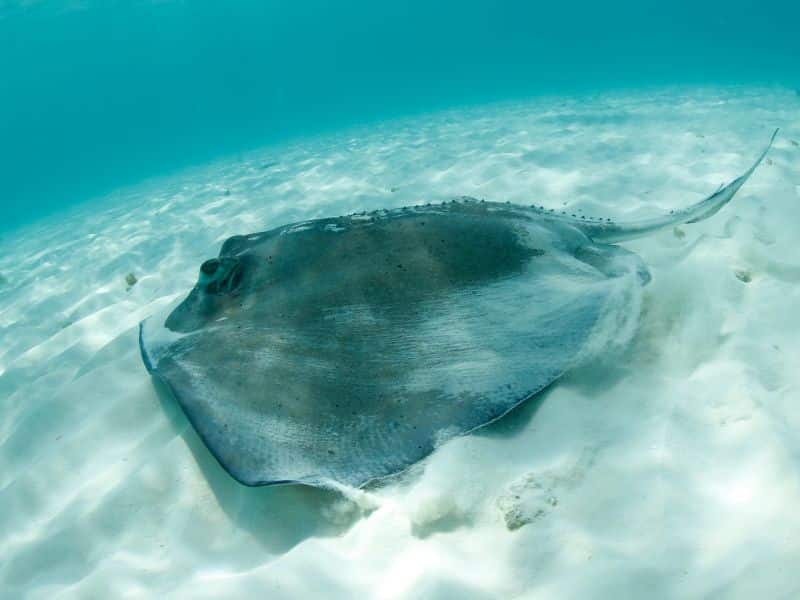
You’re floating in turquoise waters, about 12 meters deep, and suddenly… a geometric shadow moves across the sandy bottom.

The southern stingray isn’t in a hurry, it’s not looking for a fight, and it glides along the seafloor with an elegance that any runway model would envy.

But when it lifts off the bottom with a single flick of its “wings,” it leaves you absolutely speechless.

Exaggerated? Only because when you’re diving, you can’t really open your mouth without losing your regulator. Otherwise, it’s exactly like that.

If you’ve never seen a southern stingray, I’ll tell you: it’s the closest thing to seeing a piece of silk floating over the sand of the seabed.

This creature has spent millions of years perfecting the art of being invisible when it wants to be, and utterly majestic when it deems worthy to reveal itself to you.

The best part?
They’re everywhere in the Caribbean. You just need to know where to look.
southern stingray pictures (2) raya del sur

1. What is a Southern Stingray? (And why you should know its scientific name)

Alright, let’s start with the basics.

The southern stingray has a scientific name that sounds like a Harry Potter spell: Hypanus americanus.
Until 2016, this lady was known as Dasyatis americana. But scientists decided they needed to reorganize the stingray family tree because… well, because they could.

Here’s the interesting part:
It belongs to the family Dasyatidae, the whip-tail stingray group. Yes, that long, flexible appendage at the back isn’t just for show.
It’s part of the class Chondrichthyes.

What does that mean?
It shares an evolutionary wardrobe with sharks and chimaeras: no bones, all cartilage. A flexible skeleton that makes it agile, light, and practically indestructible.

Within this class, stingrays (including our protagonist) belong to the superorder Batoidea: flattened bodies, pectoral fins fused to the head, and that ninja-like ability to glide across the bottom as if it were the most natural thing in the world.


2. Don’t Confuse the Southern Stingray: Key Differences with Other Stingray Species

This is where a lot of people get it wrong.
You see a stingray in the Caribbean and assume it’s a southern stingray. But not always.

The Atlantic stingray (Hypanus sabina), for example, has much rounder edges and a pointier snout. It’s like comparing an SUV to a sports car: both have four wheels, but they’re definitely not the same.

In Mexico, the southern stingray is called the white whipray.
Poetic name, by the way.

And here’s a fact that should matter if you care about conservation:
Populations in Brazil that were long thought to be H. americanus are actually another species: Hypanus berthalutzae.
This limits the true range of the southern Atlantic stingray and makes protecting its habitat even more urgent.

Then we have another common Caribbean species, the yellow stingray. This one is easy to tell apart: it’s much smaller and yellow.

Species Common Name Disc Shape Max Size “Tell-Tale” Feature Typical Habitat
Hypanus americanus Southern Stingray Diamond (angular tips) Large (~2 m) White spot between the eyes Sandy bottoms and seagrass beds (Caribbean)
Hypanus sabina Atlantic Stingray Diamond (long snout) Small (~35 cm) Pointed, upturned snout Coastal waters, estuaries, and freshwater
Hypanus berthalutzae Lutz’s Stingray Diamond Medium (~1 m) Black speckles on back; almost identical to Southern Exclusive to Brazil’s coast
Urobatis jamaicensis Yellow Stingray Round (circular) Small (~35 cm) Yellow mesh pattern and fin on tail Coral reefs and rocky areas
southern stingray pictures (5) raya del sur

3. The Size of the Southern Stingray

Let’s talk size.

Because when you come across an adult female, the word “impressive” doesn’t even come close.

Females can reach up to 2 meters across the disc.
Two. Meters.
That’s bigger than many humans lying flat on the ground.

And the weight isn’t a joke: females of 97 kg have been recorded. Almost a hundred kilos of muscle, cartilage, and pure underwater elegance.

Males, on the other hand, are much more modest. They rarely exceed 0.8 meters in width.

This isn’t by chance. It’s sexual dimorphism, my friend.
Females need to be large to carry and nourish their young for months. Males only need to be agile enough to… well, you know.

The southern stingray’s disc is roughly 1.2 times wider than it is long, with those 135° front angles that give it that signature diamond shape.
If you ever come across one on the seabed, those angles are your number one visual clue.

4. Southern Ray Adaptations: Evolutionary Genius in Action

Evolution is an artist when it wants to be.
And with the southern ray, it truly shined.

Spiracles: The Ultimate Trick for Breathing Under Sand
How does an animal breathe when it spends half its time buried in sediment?
With spiracles.
These openings, located just behind the eyes on the top of the head, act as a secondary air intake. They pump oxygen-rich water directly to the gills, which are on the underside.
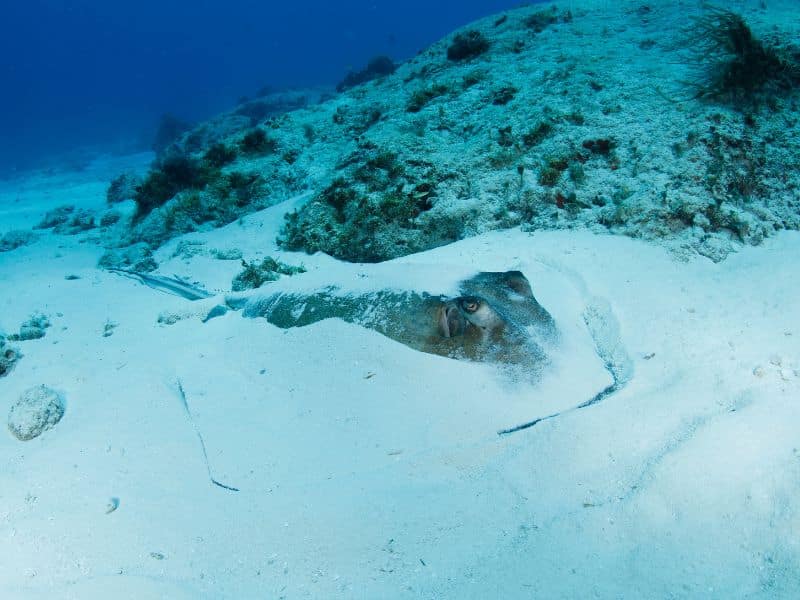
Result: it can be completely covered in sand and keep breathing as if nothing happened.
It’s like having a built-in snorkel.

Hollywood-Level Camouflage
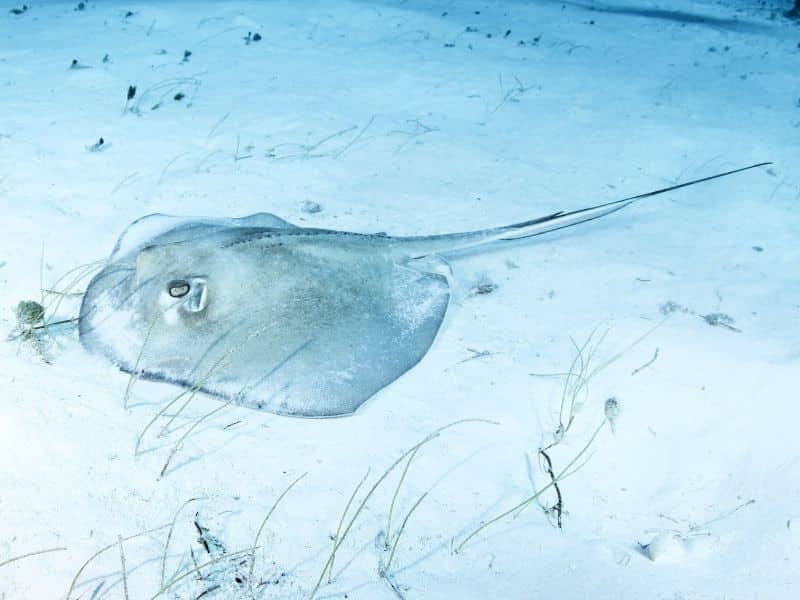
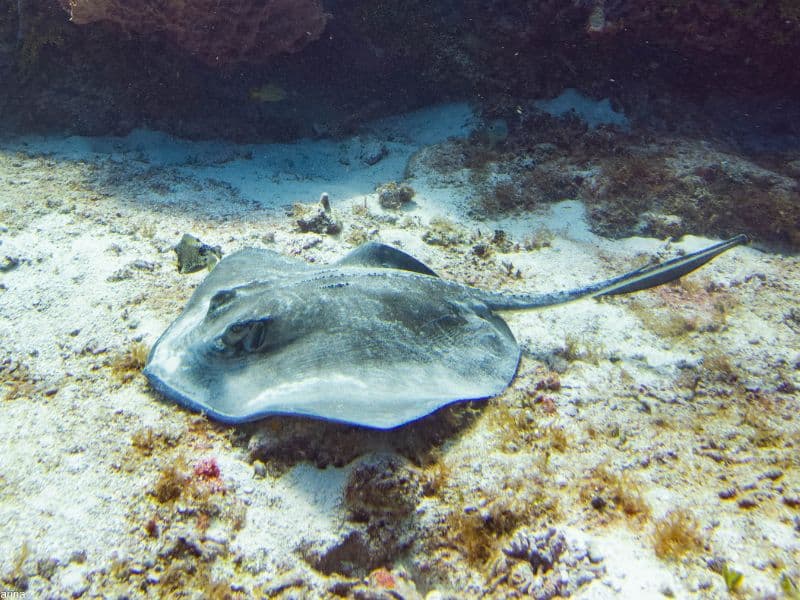
The dorsal coloration ranges from dark gray to olive brown and grayish-green, depending on the environment and age.
When it stays still on the seabed, it’s practically invisible.
Its belly, on the other hand, is creamy white with dark edges. This is called countershading and makes it harder for predators to spot it from below while swimming.

Ampullae of Lorenzini: The Electric Superpower
On the underside of its head are thousands of microscopic pores.
They’re called the Ampullae of Lorenzini.
Their function?
To detect the electric fields generated by the muscle movements of buried prey.
Translation: it can hunt in total darkness and find a shrimp hidden 30 cm under the sand without using its eyes.
Basically, it’s Daredevil, but in ray form.

southern stingray pictures - raya del sur

5. Lifecycle of the Southern Stingray

Its mode of reproduction is viviparity without a placenta, also called aplacental viviparity or ovoviviparity.
In other words, the eggs develop and hatch inside the mother, but there’s no umbilical cord.
At first, the embryo feeds on the yolk sac. When that runs out, the mother produces a protein- and lipid-rich secretion called “uterine milk.”
Yes, uterine milk.
Nature has no limits.
Gestation lasts between 4 and 11 months, depending on water temperature and food availability.
A healthy female gives birth to between 2 and 10 pups, with an average of four per litter.
The pups are born with a wingspan of 17 to 34 cm and already come equipped with a functional stinger.
No helpless babies here.

Maturation of the Southern Stingray: slow growth, late maturity
Males reach sexual maturity when their disc measures about 51 cm, usually at 3 or 4 years old.
Females take longer: they mature at around 75–80 cm, between 5 and 6 years of age.
Estimated lifespan is 15 to 17 years.
Not very long. And that’s why overfishing and habitat degradation are so devastating for this species.


6. Southern Stingray Habitat: Where the Queen of the Sand Lives

The Southern Stingray ranges across the entire Western Atlantic.
From New Jersey (yes, it tolerates temperate waters) down to southern Brazil.
But where it really shines is in the Gulf of Mexico and the Caribbean Sea.

It can go as deep as 100 meters, but it prefers to stay in shallow coastal waters.
Why?
Because that’s where the food is. And the sunlight. And fewer large predators.

Its favorite habitats

  1. Sandy bottoms and sediment plains
    This is where it spends most of its time. Buried. Camouflaged. Waiting.
  2. Seagrass meadows
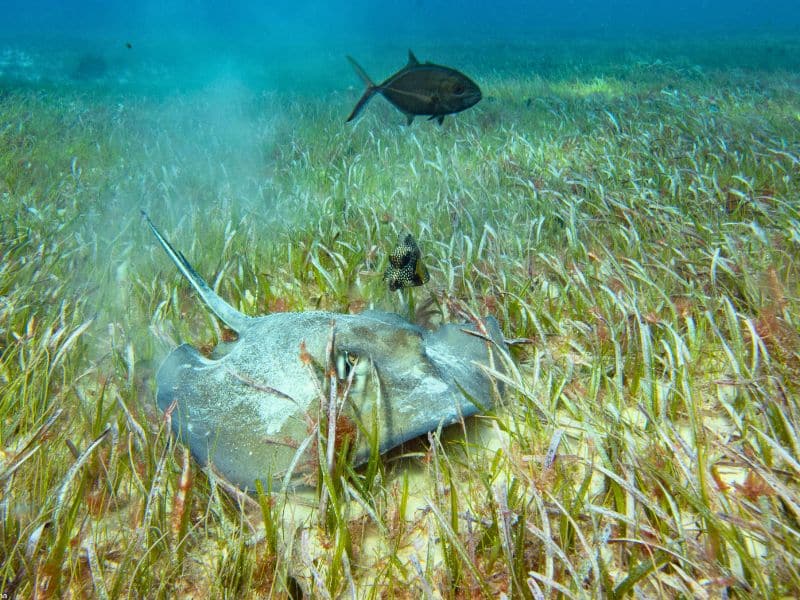
    It uses areas rich in Thalassia testudinum, also called turtle grass, as natural pantries… and as nurseries for its young.
  3. Coral reef edges
    It doesn’t enter massive coral structures (its wingspan prevents it), but it prowls along the edges. It looks for cleaning stations, where cleaner fish like wrasse remove parasites, and, while it’s at it, it hunts invertebrates.
  4. Mangroves and estuaries
    Here you’ll find brackish water, protection from hammerhead sharks, and the perfect shelter for its little ones.

If you’re diving in the Caribbean and there’s sand, chances are you might spot a Southern Stingray.

7. Southern Stingray Diet: What Do the Ladies of the Deep Eat?

The southern stingray is an opportunistic predator.
It spends much of its time searching for food along the seabed.
And its diet is more varied than you might think.

What do southern stingrays eat?
Stomach content studies have found prey from more than 15 different families.

Crustaceans: shrimp, crabs, mantis shrimp. Their favorites.
Bottom-dwelling invertebrates: annelid worms, bivalve mollusks, snails.
Small fish: scorpionfish, surgeonfish, anything that lives buried in the sand.

How it hunts: the art of unearthing prey
The stingray uses two main techniques:

  1. Vigorous flapping
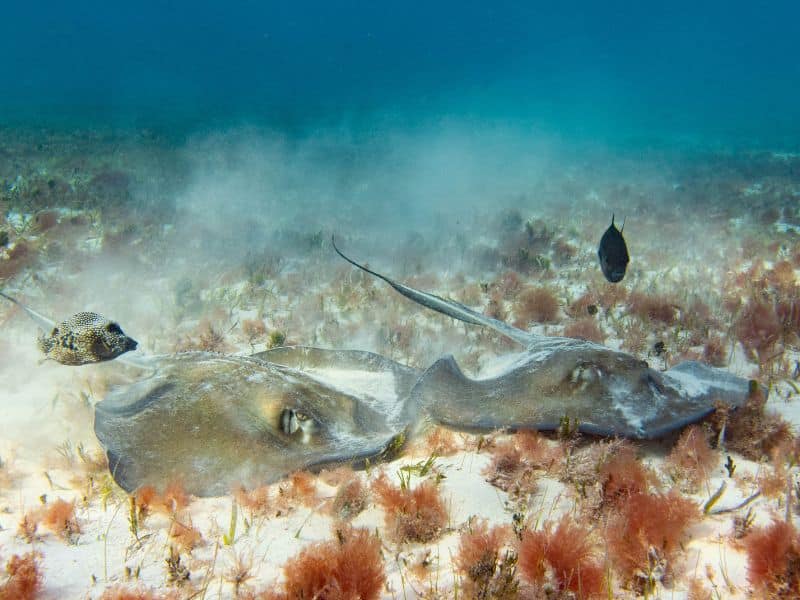
    It beats its pectoral fins against the seabed, creating a current that lifts sediment and exposes hidden organisms.
  2. Water jets
    It blows water through its mouth to “blow away” the sand and reveal prey.

Then, it uses its teeth, arranged in flat, tough plates, to crush shells.
It spits out the calcium fragments and eats the soft parts.
Efficient. Relentless.

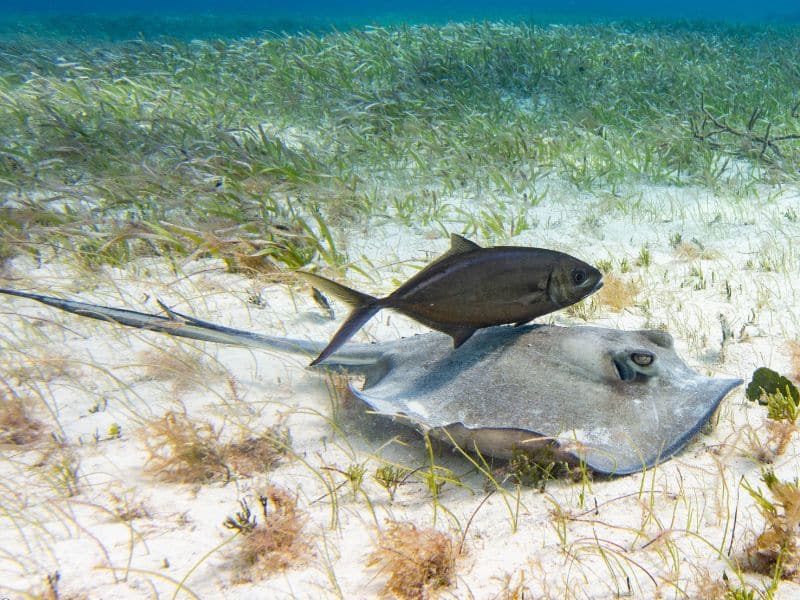
Interestingly, this behavior attracts other species. Snappers, wrasses, even cormorants follow stingrays while they hunt, taking advantage of the leftovers they stir up.


8. Is the Southern Stingray Dangerous? Debunking Myths and Being Clear

Let’s get straight to the point.
The southern stingray has a venomous barb on its tail.
Yes, it can cause harm. So, it’s best to keep your distance and not bother it, just like with any wild animal.

The barb and the venom
It has one or more serrated spines at the base of its tail, covered by a glandular tissue that produces venom.
This venom causes intense pain, swelling, and, in rare cases, allergic reactions.

But here’s the important detail:
The stingray does not use its barb to hunt.
It’s purely defensive.
It only uses it if it feels cornered, stepped on, or threatened.
Leave it alone, and it leaves you alone.

southern stingray pictures (7) raya del sur

9. Curiosities About the Southern Stingray That Will Surprise You

Cleaning Stations: Underwater Spa
Southern stingrays visit specific spots where small fish (like bluehead wrasses or Spanish hogfish) feed on their parasites.
They stay still for up to 26 minutes while the “cleaners” do their job.
It’s interspecies cooperation at its finest.

Circadian Rhythm Reversal
Naturally, they are nocturnal animals.
But in places like Grand Cayman, where tourism feeds them constantly, they have reversed their daily cycle.
Now they are active during the day and rest at night.
Long-term consequences? Nobody knows yet.

“Flat Sharks”
Because of their cartilaginous skeleton and highly developed senses, some biologists colloquially call them “flat sharks.”
Technically not correct, but it sounds awesome.


10. Where to See Southern Stingrays in the Caribbean: Top Destinations

Cozumel: The Drift-Diving Paradise
Visibility over 35 meters.
Sites like Palancar and Santa Rosa are ideal for spotting large stingrays patrolling sandy plains.
Paradise Reef is perfect for night dives, when stingrays are more active.

Riviera Maya: Turtles, Wrecks, and Stingrays
Tortugas Reef combines hawksbill turtles with stingrays resting on the sand.
Mama Viña, near the wreck, attracts large specimens thanks to moderate currents.

Dominican Republic: Bayahibe and Punta Cana
Calm waters, ideal for beginners.
Bayahibe offers relaxed encounters over mixed sand and coral bottoms at less than 12 meters.
Isla Saona and Catalina: sandbanks where stingrays approach with curiosity.

Montego Bay, Jamaica: Protected Biodiversity
Montego Bay Marine Park has revitalized stingray populations.
Sites like The Canyons and Airport Wall are known for large specimens.
Stingray City Jamaica allows controlled interactions, perfect for families.

southern stingray pictures (3) raya del sur

11. Southern Stingray Photography: How to Identify Them Underwater

Quick Visual ID Guide

  1. Disc shape: almost perfect diamond, pointed corners.
  2. No spots: uniform dorsal color (unlike spotted eagle rays).
  3. Position in water: resting directly on the bottom or partially buried.
  4. Tail structure: ventral fin or skin fold well developed below the sting.

Photography Tips

  • Don’t swim directly at them.
  • Move sideways. Maintain perfect neutral buoyancy.
  • Best shots show the eye and spiracle in detail, with the sandy texture covering them.
  • Patience. Gentleness. Respect.


12. FAQ– Southern Stingray

  1. Are southern stingrays dangerous?

Southern stingrays are not aggressive and are generally safe to observe. They only use their venomous spine in self-defense if stepped on or threatened, which makes calm, respectful encounters very safe for divers and snorkelers.

  1. Can you see southern stingrays while snorkeling?

Yes, southern stingrays can often be seen while snorkeling, especially in shallow sandy areas near reefs. They are frequently spotted resting on the bottom or gliding slowly over the sand.

  1. When are southern stingrays most active?

Southern stingrays are usually more active during early morning and late afternoon, when they search for food. During the day, they are often seen resting partially buried in the sand.

  1. How can you recognize a southern stingray underwater?

Southern stingrays have a broad, rounded body, a long whip-like tail, and a uniform brown or gray coloration. Unlike eagle rays, they do not have spots or wing-like fins.

  1. Are southern stingrays found in Southern California?

Southern stingrays are not native to Southern California. While there are many types of stingrays in Southern California, the southern stingray is mainly found in tropical and subtropical Atlantic waters.

  1. Why do southern stingrays bury themselves in the sand?

One of the key southern stingray adaptations is their ability to bury themselves in sand for camouflage and protection. This behavior helps them avoid predators and ambush prey.

  1. Is it ethical to interact with southern stingrays while diving?

Ethical encounters mean observing without touching, chasing, or feeding. Southern stingrays tolerate divers well when approached calmly, allowing natural behavior to be observed.

  1. Are southern stingrays common on recreational dives?

Yes, southern stingrays are one of the most frequently seen rays on recreational dives in the Caribbean, especially on sandy bottoms close to reef structures.

  1. What makes the southern stingray a favorite for underwater photography?

Their calm behavior, predictable resting spots, and preference for shallow, well-lit sandy areas make southern stingrays ideal subjects for underwater photography.

southern stingray pictures (6) raya del sur

13. What It’s Like to Encounter a Southern Stingray While Diving

It’s an experience of deep calm.
No sudden movements. No aggression.
Just functional elegance.

As you approach, it may stay still (trusting its camouflage) or rise with effortless grace.
The movement of its pectoral fins is hypnotic.
It doesn’t flap like a bird (that’s the eagle ray).
It undulates the edges of its disc in a continuous rhythm.

And when it glides into the infinite blue, leaving you behind, you realize you’ve witnessed something special.
Something perfected over millions of years.
Nothing compares to seeing a winged silhouette fade into the blue.
Leaving you hoping to cross paths with the magnificent southern stingray again.

Want to see them? Fill out the form, and we’ll help you plan your diving trip.

CONTACT US FOR
PERSONALIZED ASSISTANCE

Ready to improve your dive skills?
Need more information about the next certification level?

WE ARE HERE TO HELP

contact

    I consent to receiving commercial communications and promotions from Dressel Divers.