

Scuba Diving Newsletter - boletín de buceo
Scuba Diving Newsletter: Stay Inspired, Informed, and Dive Better
18/12/2025
Show all

Scrubbing Diving: or How to Manage the CO₂ Scrubber in Rebreathers

Scrubbing diving is a term that describes an essential process in technical rebreather diving: the removal of carbon dioxide (CO₂) from the closed-circuit breathing system.
There, I’ve told you. You might have just clicked out of curiosity.
This topic is very technical, but extremely interesting.
Moreover, it can open the door to a world you didn’t even know existed. So, stay with us.
If you are a technical diver, you already know that the rebreather’s goal is to maximize breathable gas for extended dives. Proper management of the rebreather’s scrubber improves the device’s performance and keeps the diver safe.
But it’s also important to know how to handle it to protect the environment and comply with waste regulations.

Here’s what we’re going to show you:

Scrubbing diving (6) buceo con depuración

1. What Scrubbing Diving in Rebreathers Is

Let’s start at the beginning.

Where does CO₂ come from and why does it need to be removed?

CO₂ doesn’t appear out of nowhere.

You produce it. By being alive. And even more so if you move.

At rest, a person generates between 0.3 and 0.5 liters of CO₂ per minute.

Moderate activity: 1.5 L/min.

Maximum effort: 4 L/min or more.

Underwater, the same applies.

The body is very clever in one thing: it uses CO₂ as the main signal to decide how much you breathe. It’s not oxygen that drives this. It’s CO₂, because if it accumulates, it poisons you.

When the partial pressure (pCO₂) rises in a rebreather, there’s a problem.

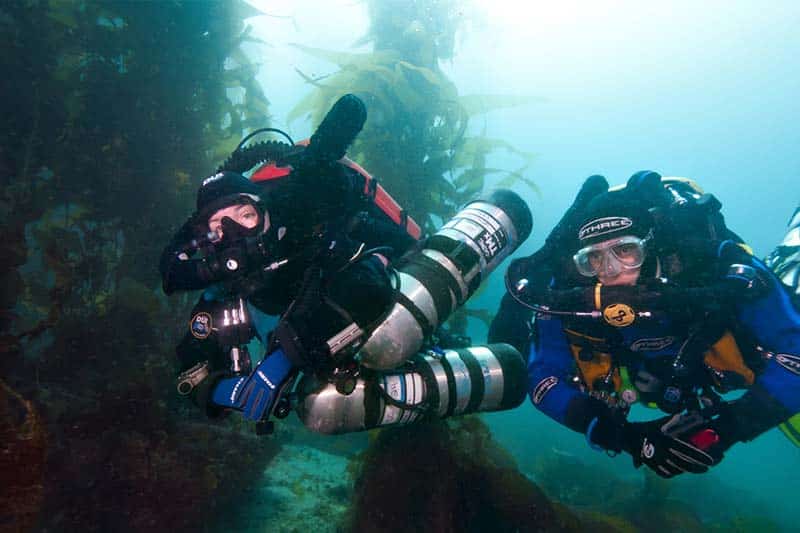
To understand scrubbing diving, we now need to know how a rebreather works.

It is a type of technical diving equipment different from the open-circuit systems used by most recreational divers.

In a rebreather, the gas you exhale is not released into the water like in a conventional tank.

Instead, the gas circulates back through the unit, passing through different components that clean and adjust it before you can inhale it again. This saves gas, reduces bubbles, and extends dive duration, which is especially useful in deep or technical dives.

One of the most important components of this closed circuit is the CO₂ scrubber.

This is where the concept of scrubbing diving comes into play.

Scrubbing diving (2) buceo con depuración

1.1. How the CO₂ Scrubber Works in Rebreathers

The scrubber —or sorb— is one of the key components of the rebreather.
Its function is to remove CO₂ from the gas you exhale.
It does this using small granules or pellets that:

  • trap CO₂,
  • let oxygen pass through,
  • and allow the breathed gas to be reused.

Thanks to this:

  • you consume less gas,
  • you can dive longer,
  • and everything works… until the sorb becomes saturated.

When that happens, it needs to be replaced.
And here begins the problem many prefer not to look at.

1.2. How long it lasts, how long they “say” it lasts… and how long it really lasts

The most commonly used material is soda lime, a mixture of:

  • calcium hydroxide
  • sodium hydroxide

When you breathe:

  1. The CO₂ passes through the canister with the granules.
  2. It reacts with the hydroxide ions, forming bicarbonate.
  3. Then the bicarbonate reacts with calcium hydroxide and becomes calcium carbonate (limestone).

This carbonate remains trapped in the scrubber.
And as long as there is hydroxide available, the process continues working.

After many hours:

  • the sorb saturates,
  • loses effectiveness,
  • and needs to be removed.

Up to this point, everything is normal.

1.3. What happens when the scrubber starts failing

Here comes one of the most important parts.
For much of its life, the scrubber works perfectly.
The pCO₂ stays practically at zero.
But when it starts to fail… it fails fast. Very fast.
A small increase in CO₂ turns, in a matter of minutes, into a large increase. And then into a danger.

Scrubbing diving (3) buceo con depuración

1.4. Factors that drastically change scrubber duration

This is where certainty breaks down.

  1. Workload
    It is the number one factor.
    Breathing 15 L/min is not the same as 75 L/min.
    And no, the scrubber does not wear out five times faster.
    It can wear out ten times faster.
  2. Water temperature
    The absorbent works better when it is warm.
  • At 15 °C it can last 50% longer than at 4 °C.
  • At 30 °C, even longer.
    That is why the standard is tested in cold: to assume the worst-case scenario.
  1. Depth
    More depth = denser gas = colder scrubber.
    Result: less efficiency.
  2. How it is packed
    Same diver, same absorbent, same scrubber…
    and yet: ±10% variation.
  3. Diver’s diet
    Yes, what you eat matters.
  • Fats: less CO₂
  • Carbohydrates: more CO₂
  • Anaerobic effort: much more CO₂
    Total possible variation: ±15%.

1.5. The Typical Mistake in Scrubber Diving: “It Still Works”

It works, until it doesn’t.
A nearly depleted scrubber can seem safe… until you increase the effort slightly.
Then the pCO₂ triples in minutes.
This is not theory. This is what the tests show.

Summary

  • The scrubber doesn’t fail gradually. It fails suddenly.
  • Workload and temperature change everything.
  • The “official” time is a safe minimum, not a goal to stretch.
  • Pushing the scrubber removes the safety margin.

Diving without a margin is a bad idea.

Scrubbing diving (4) buceo con depuración

2. Scrubber Diving and Scrubber Disposal After Use

In any case, at the end of a dive, most of the used scrubber is calcium carbonate, which is not especially dangerous.
The problem is that unreacted sodium hydroxide may remain.
And sodium hydroxide:

  • is corrosive,
  • is toxic to the environment,
  • and is classified as hazardous waste.

This completely changes the rules of the game.
A critical part of scrubber diving is not just using the scrubber, but knowing what to do with the material once it is saturated.
In some places (especially in the United States), many divers throw the used scrubber in regular trash.
The reasoning is usually:
“After all, it’s spent.”
The problem is:

  • it may still contain sodium hydroxide,
  • and in that case, it is neither legal nor responsible to dispose of it as household waste.

Sodium hydroxide must be treated as hazardous waste,
and taken to a special collection point, usually associated with landfills or municipal facilities.

Others do even worse:
“I’ll just throw it in the sea.”
No. And this is not an opinion.
In many countries, dumping any type of waste into water is directly prohibited.
For example, MARPOL regulations forbid dumping trash into water from a vessel:

  • in rivers,
  • lakes,
  • coasts,
  • and even several miles offshore.

It doesn’t matter if “it’s always been done.”
It doesn’t matter if “it’s a small amount.”
The rule is clear.

Best Practices
No need to be paranoid, but do be serious.

  1. Always follow the manufacturer’s instructions for the sorb and the rebreather.
  2. Verify that the disposal method is legal where you are diving.
  3. If there is a possibility that the scrubber contains sodium hydroxide:
    • treat it as hazardous waste,
    • take it to an authorized collection point.
  4. Do not throw it into the sea.
  5. Do not automatically treat it as household waste.

This is not about slogan-driven environmentalism. It’s about doing things correctly.

3. Frequently Asked Questions About Scrubbing Diving

  1. What is Scrubbing Diving?
    Scrubbing Diving is the practice of removing CO₂ from the closed-circuit breathing system in rebreathers. Its goal is to maintain safe CO₂ levels and optimize the use of breathable gas during technical dives.
  2. How does a CO₂ scrubber work in a rebreather?
    The CO₂ scrubber contains chemical granules that react with the exhaled carbon dioxide, transforming it into calcium carbonate and allowing oxygen to be reused. This extends dive duration and reduces gas consumption.
  3. How long does a scrubber last, and what factors affect its performance?
    The actual duration of a scrubber depends on the diver’s workload, water temperature, depth, the way the material is packed, and the diver’s diet. Even if the scrubber appears to “still work,” it can saturate quickly, increasing the risk of elevated pCO₂.
  4. What happens if the scrubber starts to fail during a dive?
    When a scrubber begins to deplete, pCO₂ can rise quickly and dangerously within minutes. This is why it is crucial to respect the official usage times and avoid “pushing” the scrubber.
  5. How should a used scrubber be disposed of?
    A used scrubber may contain sodium hydroxide, a corrosive and hazardous substance. It should never be thrown into the sea or regular trash. It must be treated as hazardous waste and taken to authorized collection points according to local regulations.

Understanding how a CO₂ scrubber works, recognizing when it is depleting, and managing it correctly protects both the diver and the environment. Additionally, complying with hazardous waste disposal regulations ensures responsible and sustainable diving. The key lies in careful planning, constant monitoring, and good practices: never risk your safety or the marine environment by “pushing” the scrubber.

CONTACT US FOR
PERSONALIZED ASSISTANCE

Ready to improve your dive skills?
Need more information about the next certification level?

WE ARE HERE TO HELP

contact

    I consent to receiving commercial communications and promotions from Dressel Divers.