rescue diver course - main
Rescue Diver Course or How to Be a Better Diver
19/02/2026
Show all

Regulator Recovery: How to Get Your Regulator Back While Diving

Regulator recovery: that skill that seems kind of silly… until you actually need it.

We all know that mastering basic underwater skills is what separates a confident, self-sufficient diver from an average one.

And among all the skills you learn when you start diving, regulator recovery techniques rank at the top. Not just on paper, but in real-life situations.

Here’s the good news: if you’ve practiced regulator recovery, you stay calm, reach for your regulator, and get it back in your mouth smoothly.

Losing your regulator isn’t a big deal, and it’s not a real emergency. It’s just an inconvenience, but if you don’t know regulator recovery techniques well, it can feel like one.

That’s why practicing regulator recovery until it becomes automatic, almost without thinking, is what gives you total control over your air supply, without depending on anyone else. That, my friend, is true self-sufficiency.

Don’t remember how, or it’s been a while since you practiced? No worries, we’re about to show you exactly how regulator recovery works.

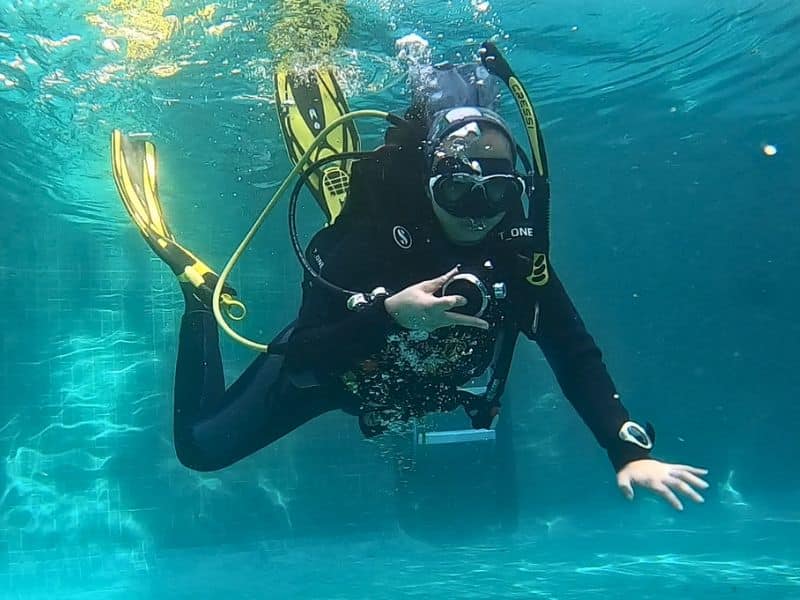
regulator recovery (8) recuperar el regulador cuando buceas

1. What Is Regulator Recovery in Diving?

In recreational diving, regulator recovery is basically the protocol for finding and putting the second stage of your regulator back in your mouth when it has slipped out and is no longer in view.

It sounds simple, but it’s so important that organizations like PADI and SDI include it in the very first pool module of their beginner courses.

And it’s not just for show: the goal isn’t only to recover your gear, but to keep your airway clear while doing it, releasing air continuously to avoid the risk of lung overexpansion.

To understand the technique, you first need to understand how the equipment is set up. The hose of the primary regulator comes out of the right side of the first stage, the part connected to your tank. This means that when the regulator slips, gravity and buoyancy almost always move it behind your right shoulder. Regulator recovery takes advantage of this: instead of blindly “fishing” for it, you perform a calculated search arc that brings it right to your mouth in seconds, even in low visibility.

But the process doesn’t end once you’ve got it in your mouth. At that moment, the second stage will be full of water, so you need to purge it before breathing. You have two options: blow forcefully to clear the water, or press the purge button.

  1. Locate
  2. Recover
  3. Position
  4. Purge

This full sequence defines a properly executed regulator recovery.

And if you don’t find it right away… use your octopus

Every diver carries a redundancy system: the alternate air source, also known as the octopus. So, if your primary regulator isn’t immediately within reach, the right move isn’t to panic or ascend. It’s this:

  1. Grab your octopus, it’s located in the safety triangle on your chest.
  2. Stabilize your breathing, stay calm, take it slow.
  3. Continue your regulator recovery, locate your primary regulator with complete composure.

What could feel like a stressful moment becomes, with the right technique, just a simple exercise in equipment management. Nothing more.


2. Regulator Recovery: What You Need to Know to Stay Calm

Let’s be honest: the first time you truly lose your regulator—not in a drill, but for real—it can feel like the end of the world. But the reality is far less dramatic, and the facts are on your side.

  • You have more time than you think. Even with reduced lung capacity, you can exhale continuously for more than 15 seconds. That’s plenty of time to perform the sweep motion three or four times without rushing.
  • The regulator hasn’t disappeared. It didn’t go anywhere. It’s exactly where it’s supposed to be: hanging behind your right shoulder, waiting for you to retrieve it.
  • Panic is the real enemy, not the situation. The moment you understand that this isn’t an emergency but a routine procedure, your mind stops catastrophizing and your body can focus on executing the technique.
  • Normalization changes everything. The more you practice regulator recovery until it becomes automatic, the less room fear has to take hold.

The key is to strip the moment of all its drama. It’s not a scare—it’s a movement. And a movement, with practice, always works.

Bottom line, losing your regulator:

  • Is not an emergency if you know what you’re doing
  • Your body has enough oxygen reserves to handle the situation calmly
  • Panic—not lack of air—is what complicates things

regulator recovery - recuperar el regulador cuando buceas

3. Preventing Problems Before You Need Regulator Recovery

Why does a regulator get lost? There are several reasons, and each has a simple solution:

Cause What Happens How to Prevent It
Buddy bump A fin or arm hits your hose Maintain proper spacing and situational awareness
Gear snag Hose catches on a BCD buckle or D-ring Hydrodynamic setup and thorough equipment check (Buddy Check)
Emotional reaction Laughing or shouting at marine life Practice breath control when reacting to visual stimuli

By preventing these situations, you reduce the need for regulator recovery, but if it happens, knowing the techniques ensures you stay calm and in control.


4. Regulator Recovery: Step-by-Step Techniques

There are two main methods for regulator recovery. Both are effective, but each works best in different situations depending on how your gear has moved and your own mobility underwater.

  1. The Sweep Method: The “Golden Classic”

This is the technique everyone learns first because, basically, it always works. You use your arm like a radar to snag the hose.

Pro tip: Tilt your body slightly to the right. Gravity will separate the hose from your tank and BCD, leaving it “floating” in the perfect spot.

How to do it:

  1. Touch your right thigh with your hand.
  2. Slide your hand back along the lower part of your tank.
  3. Draw a big outward and forward arc, like giving a giant hug.
  4. Magic! The hose should hook onto your arm. Then slide your left hand along your right arm until you reach the mouthpiece.

Step-by-step regulator recovery from the moment you remove it to putting it back in your mouth:

Action Why (The Secret)
Bubbles Out Exhale a steady stream. Rule of thumb: never stop letting out air.
Tilt Lean a bit to the right. Let gravity work for you.
The Sweep Right arm back, wide arc… snag the hose!
Locate Use your left hand along your right arm to find the mouthpiece.
To Your Mouth Place it carefully, making sure it’s not upside down.
Clear Give a firm blow or press the purge button to remove water.
Relax Take a gentle breath first, just in case there’s a rogue drop.

Extra tip: While your right hand hunts for the lost regulator, keep your left hand near your Octopus (alternate air source). If the sweep fails the first time, don’t panic, grab the Octopus and breathe.

  1. The Reach Method: For “Tricky” Situations

If the sweep fails or the regulator seems stuck behind your neck, it’s time for a more direct approach.

When to use it: If there’s strong current or if you’re vertical and the regulator won’t fall naturally.

The Master Move:

  1. Use your left hand to push the base of the tank upward.
  2. With your right hand, locate the first stage (tank valve).
  3. Trace the hose with your fingers until you reach the second stage. Bam, found it.
  4. Clear it and start breathing.
regulator recovery (7) recuperar el regulador cuando buceas

5. Common Regulator Recovery Mistakes (and How to Avoid Them)

Most mistakes in regulator recovery skills are always the same. The good news? If you know them before you hit the water, you’re already halfway there.

Mistake #1: Searching for the Regulator with Your Left Hand
Your left hand has a lot to do while diving, but regulator recovery isn’t one of its talents.

  • Standard hoses are designed to come out on the right side.
  • Using your left hand will make you fight with your BCD inflator hose or your pressure gauge, and nobody wants that.
  • Memorize it this way: your right side is the “air side.”

Mistake #2: Not Leaning Enough to the Right

  • If you don’t lean, the hose gets pinched between your back and the tank.
  • No amount of sweeping will free it in that position.
  • Lateral tilt is what “releases” the hose and lets your regulator recovery technique work.
  • Exaggerate the movement, more than you think you need.

Mistake #3: Holding Your Breath
Yes, it’s a natural reflex. You lose your regulator and your body says, “Close the valve!” But in diving, holding your breath is rule number one you never, ever break.

  • Holding your air tenses your body, spikes oxygen consumption, and invites panic.
  • Exhaling a steady stream of bubbles protects your lungs from overexpansion if you accidentally ascend.
  • That continuous exhale rhythm keeps you mentally centered, it’s almost like underwater meditation.
  • Bubbles = calm = control. Repeat it like a mantra for smooth regulator recovery every time.

Mistake #4: Putting the Regulator in Upside Down

Sometimes you grab your regulator, bring it to your mouth… and its upside down. Frustrating, but easy to fix, especially if you’ve practiced regulator recovery.

  • Inserting the regulator upside down makes purging harder and can send water straight into your mouth when you try to breathe.
  • Before putting it in your mouth, take half a second to feel where the mouthpiece and purge button are.
  • Instructor tip: take a quick glance downward while holding the regulator. Two seconds of visual confirmation are worth way more than a nasty surprise.


6. Instructor Tips to Master Regulator Recovery Faster Than You Think

Instructors who have spent years watching divers perform this maneuver have tricks that don’t appear in any manual. Here are the best ones:

Tip #1: Practice with neutral buoyancy, not kneeling on the bottom
Kneeling on the sand gives a false sense of security. In a real dive, there’s no bottom to hold onto.

  • Practice regulator recovery while suspended in the water, keeping a horizontal position.
  • Coordinating your arm movement without losing your position is the real skill.
  • Advanced trick: exhale just a bit right before the sweep to sink slightly, this prevents the air in your lungs from pushing you upward while the regulator is out.

Tip #2: Go slow. Really, take it slow
The most common beginner mistake is sweeping too fast and overshooting the hose.

  • A slow, wide, deliberate motion is far more effective than a quick, jittery one.
  • The goal is to feel the hose on your forearm, not to find it by luck.
  • As instructors say: “Slow is smooth, smooth is fast”, and this applies perfectly to regulator recovery underwater.

Tip #3: Visualize before you dive
Close your eyes for a moment and picture the full sequence: lean, thigh, tank, sweep, hose, purge, breathe.

  • This mental prep engrains the muscle memory before your body has to execute it.
  • It reduces reaction time and, more importantly, keeps anxiety in check.

Other Instructor Tricks

Trick Purpose How to Apply
“Tank touch” Ensures your arm goes far enough back Feel the metal of the tank with your thumb during the sweep
Tongue on the roof of your mouth Prevents swallowing water while purging Place the tip of your tongue up when pressing the purge button
Don’t be shy using your alternate air source Reduces stress if the first attempt fails If you don’t find the regulator in 5 seconds, breathe from your alternate and try again
Look over your right shoulder Maintains spatial orientation Helps spot the hose as it appears in the sweep arc
regulator recovery (3) recuperar el regulador cuando buceas

7. Should You Practice Regulator Recovery Regularly?

Short answer: yes, no excuses.

Like any motor skill, if you don’t use it, you lose it. Divers who only get in the water once a year are most at risk of freezing just when they need the skill the most.

  • Diving within the last 6 months → practice occasionally during your safety stop.
  • Diving 6 months–2 years → consider a pool refresher course (30–60 minutes is enough).
  • Diving over 2 years → a full refresher with theory and pool practice is needed. No shortcuts.

For “rusty” divers, centers like Dressel Divers offer refresher courses that aren’t exams or intimidating, just relaxed sessions reviewing the 18 core skills in a pool before heading to open water. Confidence isn’t bought; it’s built hose by hose.

At Dressel Divers, instructors take it seriously, and it shows. They perform slow, clear, exaggerated demonstrations so students understand that regulator recovery isn’t hard; it just needs to be done correctly.

  • Watching a professional perform regulator recovery calmly is the best way to internalize that you can do it too.
  • In introductory dives, regulator recovery is one of the first skills practiced, because feeling in control from minute one changes everything.


8. FAQs About Regulator Recovery

  1. Can beginner divers learn regulator recovery easily?
    Yes! Regulator recovery is taught in all beginner diving courses. With clear, step-by-step instructions and calm, repeated practice, even new divers can master this skill quickly. Visual guides and hands-on drills make regulator recovery much easier to learn.
  2. Does practicing regulator recovery reduce underwater stress?
    Absolutely. Knowing how to perform regulator recovery builds confidence and significantly reduces anxiety underwater. Divers who practice regulator recovery regularly feel safer and enjoy their dives more.
  3. Is regulator recovery the same in all scuba courses?
    While the core technique of regulator recovery is the same, some agencies or advanced courses may teach slight variations. The fundamental steps, locating, retrieving, and securing your regulator, remain consistent across Open Water and Advanced courses.
  4. What happens if I exhale before recovering my regulator?
    No worries. The human body retains enough oxygen in the blood to stay relaxed for 30–40 seconds without inhaling. Simply grab your octopus, take a few calming breaths, and then use your right hand to perform regulator recovery on your primary regulator.
  5. Can the purge button make me swallow water?
    Only if it’s used incorrectly. After performing regulator recovery, the proper technique is to press your tongue against your palate as a shield. When you press the purge button, air pushes water toward the lower exhalation valves. Your first breath after purging should always be gentle and controlled.
  6. Can I use the sweep method for regulator recovery if I’m wearing a drysuit or heavy gear?
    Yes, but you may need to exaggerate the tilt to the right. The extra volume of a drysuit or wing-style BCD can make initial arm contact with the tank harder. In these cases, the reach method for regulator recovery is often preferred by technical divers.
  7. Why does my instructor have me touch my thigh and tank during regulator recovery?
    This is called a “sensory anchor.” By touching fixed points on your body and gear, you ensure your arm covers the full search arc and doesn’t just sweep empty space. It’s the most reliable way to avoid missing the regulator hose during regulator recovery.
  8. What if my regulator gets caught on the tank valve?
    In this case, the sweep method won’t work because the hose can’t move freely. Use the reach method: reach for the first stage with your right hand, locate the primary hose, and gently pull it forward to free it, completing regulator recovery safely.

Regulator recovery isn’t an emergency skill; it’s a confidence skill. So, what are you waiting for? Time to practice your regulator recovery and dive with confidence.

CONTACT US FOR
PERSONALIZED ASSISTANCE

Ready to improve your dive skills?
Need more information about the next certification level?

WE ARE HERE TO HELP

contact

    I consent to receiving commercial communications and promotions from Dressel Divers.