scuba diving ascent rate (1) velocidad de ascenso de buceo
Scuba diving ascent rate: Tips for a Perfect Scuba Ascent
18/02/2026
regulator recovery (5) recuperar el regulador cuando buceas
Regulator Recovery: How to Get Your Regulator Back While Diving
24/02/2026
Show all

Rescue Diver Course or How to Be a Better Diver

rescue diver course - main

The Rescue Diver certification represents one of the most important turning points in a diver’s development.

The Rescue Diver course that turns you into the dive buddy everyone wants
This is the moment when practice stops focusing solely on personal safety and starts incorporating an active responsibility for the safety of the group.

If you’re reading this, you probably already have a few dives under your belt. Maybe you’re already an advanced diver.
And your curiosity is piqued.

But let me tell you something important before you continue: the Rescue Diver course is possibly the biggest mindset shift you will experience underwater.

Until now, diving has been all about you.
About your buoyancy. Your air consumption. Your fins.

That’s fine. That’s how it should be at first.
But Rescue Diver is the bridge. It’s the moment when you stop being a spectator and become a safety asset for the group.

No, you don’t need to be a Navy SEAL.
Nor do you need steel biceps.

What you need is something else: mental management.

In this article, we will break down clearly what it really means to be a Rescue Diver, what you can expect from the course, and how this training opens the doors to the professional world.

If you want to know whether you’re ready to make the leap, keep reading.
I promise you won’t run out of air.

rescue diver course - 2 - curso buceador de rescate

1. What Is a Rescue Diver and Why Does It Mark a Before and After?

There is a phrase you hear often at diving centers:
“Rescue is the course where you really learn to dive.”

Now, it’s not that your Open Water instructor lied to you. It’s that there you learned to dive taking care of yourself.
Here, you learn to take care of others.

A Rescue Diver is, essentially, a problem manager. Someone who has developed a “third eye” underwater.
While others see a beautiful landscape, you notice that your buddy’s eyes are opening wider than usual. Or that something in their diving signals that things aren’t going well.

A Rescue Diver senses stress before anyone else does and has the skill to stay calm and take action.

The difference between a recreational diver and a Rescue Diver isn’t the equipment. It’s the software running inside their head.

This course trains you in three critical areas:

  1. Anticipation: Stop the “cascade of errors” before it becomes a problem.
  2. Control: Know how to intervene with the calm of someone ordering a coffee.
  3. Underwater rescue: Manage an emergency without putting yourself at risk.

Many say it’s the most demanding course. And they are right.
You will finish tired. You will drag people. You will simulate situations that test you.

But I guarantee one thing: the first time you come out of the water after a Rescue Diver session, you will look at the sea with a different respect.
More mature. More confident.


2. The Paradigm Shift: From Autonomous Diver to Rescue Diver

Rescue Diver training is based on a key principle: preventing the so-called cascade of errors.
In diving, incidents are rare and seldom result from a single major mistake, unlike in Hollywood movies.
They are usually the result of small, cumulative factors, or a “cascade of errors.”

  • A slightly leaking inflator.
  • Feeling a bit cold.
  • A buddy drifting too far away.

Now combine all of that, and you have a problem that overwhelms the diver’s capacity.
Rescue Diver training teaches you how to stop that cascade. You learn to recognize early warning signs (that body language that screams “I’m nervous” even when the mouth says “I’m fine”).
You will know how to correct problems before they escalate and make structured decisions under pressure.

Rescue Diver and authority in diving
From the perspective of Experience, Expertise, Authority, and Trustworthiness, Rescue Diver is the level at which a diver begins to be seen as a reference figure. Not because of the certification, but because of their actual ability to maintain control under pressure.

rescue diver course - 5 - curso buceador de rescate

3. Who Is the Rescue Diver Course Really For?

Forget the idea that the rescue diver course is only for those who want to become instructors or for people with a superhero complex.
It is for you if:
• You want to gain confidence and security.
• You aim to be the best diving buddy possible.
• You are an advanced diver who feels something is missing to fully control the situation.
• You genuinely aspire to become a professional and need the Rescue Diver course as a prerequisite.

In short, it is for those who want to go from “diving with someone who knows” to “being the one who knows.”
It is a progressive training, mentally challenging, but perfectly accessible to any diver with the proper foundation.


4. Requirements To Become a Rescue Diver

One of the most searched topics on Google is the requirements for the Rescue Diver course. You can stop searching now. Here they are.

Common prerequisites:
Previous certification: Advanced Open Water Diver or equivalent
First Aid training: CPR and First Aid (EFR or equivalent) within the last 24 months
• Minimum age:
o 12 years for Junior Rescue Diver
o 15 years for standard Rescue Diver

These prerequisites ensure that the student possesses the technical and emotional maturity needed to handle realistic rescue scenarios.

rescue diver course - curso de buceador de rescate

5. Diving Certification… Which Title Should You Earn?

Sometimes the abbreviations drive us crazy. PADI Rescue Diver, SDI, SSI…

At the end of the day, they all meet international standards. But there are nuances:
PADI Rescue Diver: The gold standard. Very focused on realistic simulations. Its final scenarios are famously… “intense.”
SDI Rescue Diver: Very practical, straight to the point, with a modern approach to accident management.
NAUI Rescue Diver: Academic rigor and instructor autonomy.
SSI Stress & Rescue: Strong focus on the stress and rescue dynamic.

Whichever one you choose; a certified rescue diver is respected in any diving center worldwide. It’s a credential that says: “You can dive with confidence with this diver.”


6. What Do You Really Learn in A Rescue Diver Course?

The Rescuer’s “Toolbox”: What You’ll Really Learn in the Course
The heart of the Rescue Diver course is ten practical exercises that turn you into a human Swiss Army knife.

These are the tools you’ll pack in your backpack:
Self-rescue (You first, then others): It may seem selfish, but it’s pure logic. If you can’t manage a cramp on your own or untangle yourself without panicking, you can’t help anyone else. Here, you learn to be your own hero.
Stress recognition: Pure psychology. Identifying unusual behaviors on the surface (like rejecting your gear or staring blankly) and underwater.
Surface management: Learn assistance techniques from the boat or shore. Pure efficiency without unnecessary risks.
The panicked diver: A panicked victim is dangerous; they may try to grab your regulator or pull you under. Here, you learn how to approach, control the situation, and keep yourself safe.
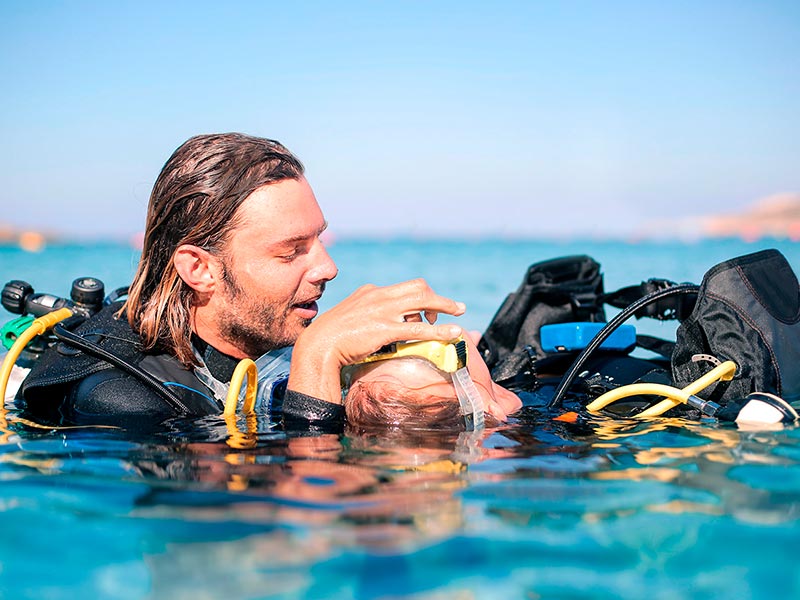
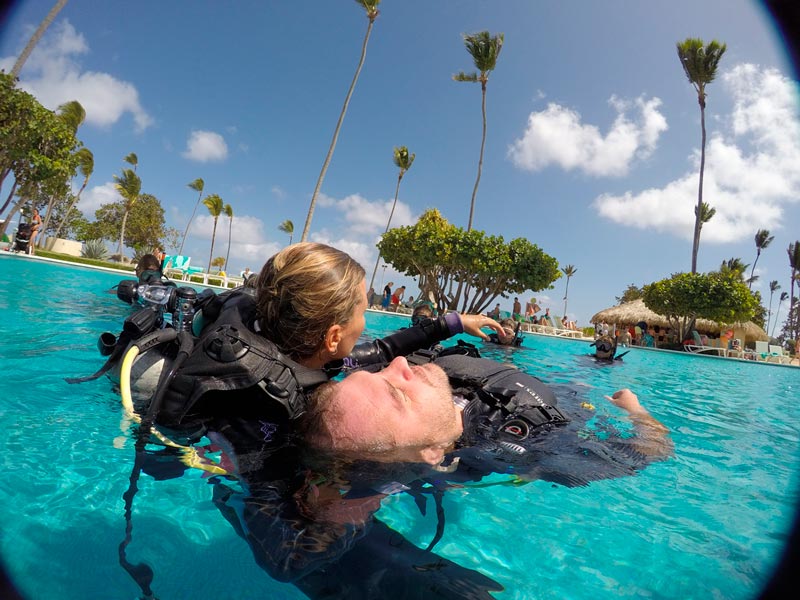
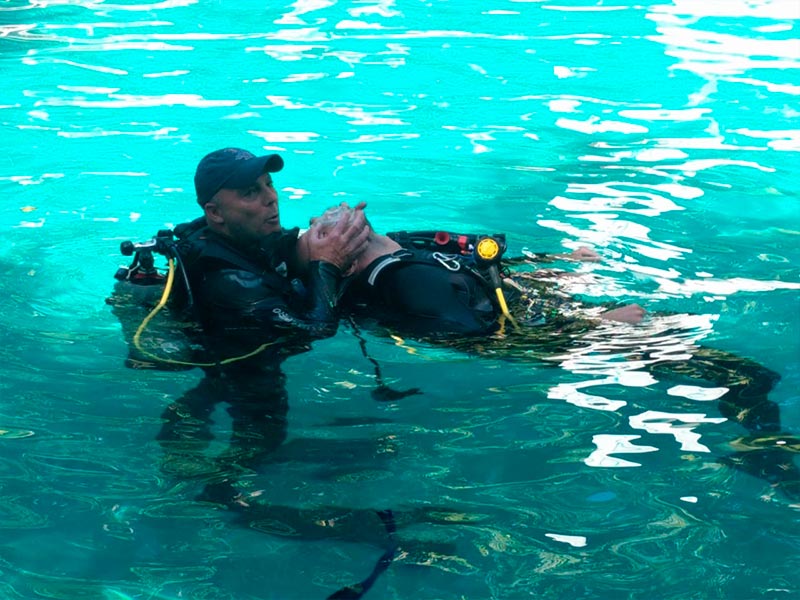
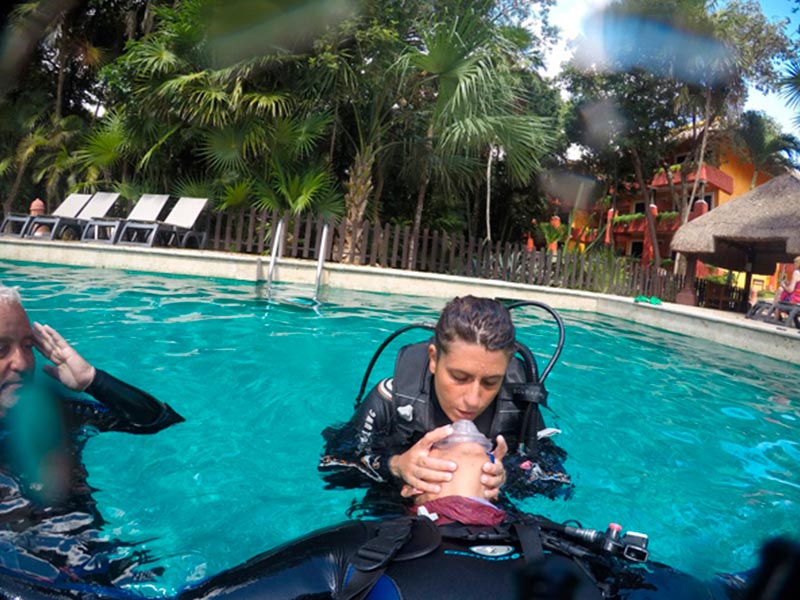
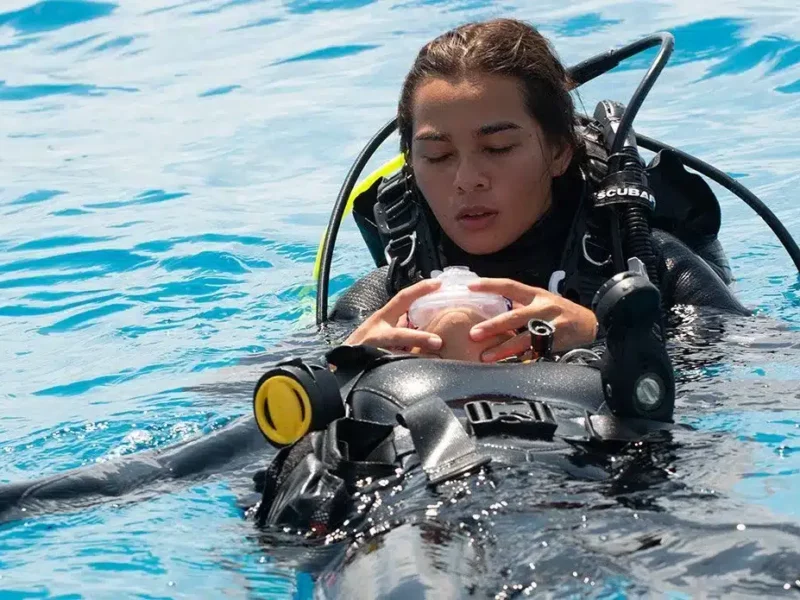
Response to the unconscious diver: This skill separates adults from children. Lifting a victim from the bottom in a controlled manner, protecting their airway, and starting rescue breaths while swimming toward the boat… it’s cinematic. And once you master it, you feel capable of anything.

You don’t just leave with a certification; you leave with a new operating system. One that knows what to do when everyone else freezes.

Additionally, students learn to use specialized equipment such as:
• Pocket mask
• Emergency oxygen administration

These skills make the Rescue Diver a key figure in any diving group.

 Rescue Diver Course focuses on three key parts:

Theoretical knowledge – Dive into the causes of diving accidents, stress, and psychological factors, and get comfortable with emergency management. You’ll also explore hyperbaric injuries, which means you’ll know how to handle any situation like a pro.

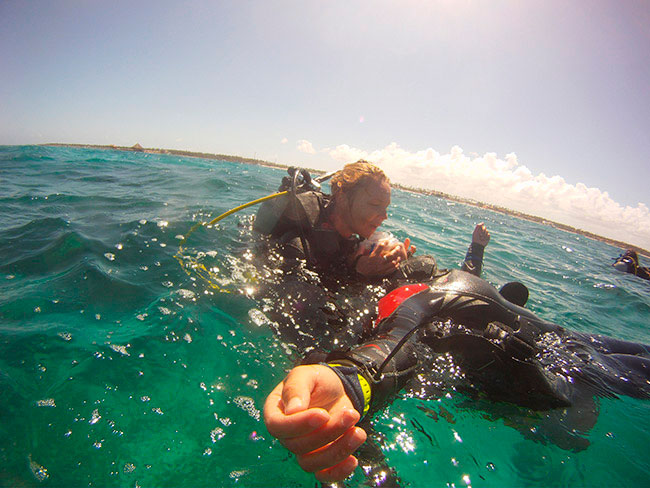
Practical exercises – This is where you’ll get your hands wet! Practice self-rescue, locate and bring unconscious divers to the surface, and execute in-water rescue breathing. You’ll even train on rescuing divers from the surface or bottom, and drag them safely to shore.

Rescue scenarios – In the open water, you’ll practice rescue drills for all types of diving emergencies. Whether it’s locating a lost diver or providing in-water artificial respiration, you’re going to be ready for anything.


padi rescue diver course - 4

7. Is Rescue Diver Difficult?

I’m not going to lie: the course can be physically demanding.
The Rescue Diver training takes you out of your comfort zone. You’ll practice towing people while giving rescue breaths and learn how to manage multiple tasks on the boat in realistic scenarios.

It might be challenging, but interestingly, it’s also the course that makes you laugh the most.

Because the confidence you gain from seeing that you can handle it is addictive.

So no, it’s not difficult because of the technique, it’s demanding because of the commitment.


8. Career Opportunities After Rescue Diver

Closing with a Bang: The Future
After becoming a Rescue Diver, an expert in managing crises, it’s normal to wonder if you can make a living from it. Here’s a snapshot of the job market for a diver with an appetite for more.

The Rescue Diver certification is the gateway. On one side, you have the enthusiastic hobbyist. On the other, the aspiring professional.
If you want to work in the blue, this is the unavoidable toll. No Rescue Diver, no Divemaster—and no Divemaster, no career. Plain and simple.

The Job Market
While the Rescue Diver title gives you authority (and a lot of peace of mind to dive centers when you go as a client), real paychecks start when you cross into the professional side.

Here’s a quick map of what awaits out there:

Professional Role Minimum Required Level Employment Sectors
Dive Guide (Divemaster) Divemaster (+ Rescue) Resorts, liveaboard diving cruises.
Diving Instructor Open Water Instructor Dive schools, luxury vacation centers.
Commercial Diver Commercial Certification Energy, underwater welding, infrastructure.
Public Safety Diver Public Safety Diver Police, firefighters, recovery teams.

Searches for rescue diver jobs, rescue diver career, or rescue diver salary often reflect this transition into the professional world.

Rescue Diver Course by PADI

9. Frequently Asked Questions About the Rescue Diver Course

Here are the most common questions from those looking to take the leap:

  1. How long does the Rescue Diver course last?
    Typically, the course is completed in 2 or 3 intensive days. It includes a theoretical part (which can now be done online), confined water skill sessions, and the famous open water rescue scenarios.
  2. Is the Rescue Diver course physically difficult?
    We won’t lie: it’s demanding. You’ll swim, tow “victims,” and carry equipment. But the training is progressive. You don’t need to be an Olympic athlete—just have normal fitness and a strong desire to learn.
  3. Can I take the course if I don’t want to become a professional?
    Absolutely! In fact, most Rescue Divers are recreational divers who simply want to dive with more confidence and safety. It’s the best life insurance you can wear.
  4. Which certification is better: PADI, SSI, or SDI?
    They all follow international industry standards. The most important factor is not the agency, but the Dive Instructor. Look for a center where you feel comfortable and an instructor who takes safety and scenario realism seriously.
  5. Does my Rescue Diver certification expire?
    Diving certification never expires, but your CPR and First Aid (EFR) training must be updated every 24 months. To be an effective rescuer, you need to have these skills fresh in your mind.


10. Final Conclusion: Is Rescue Diver for You?

Absolutely.

  • You’ll improve as a diver.
    At Dressel Divers, we use systems designed to help you grow as a diver. The Rescue Diver course is no exception. More knowledge, more experience, more dives.
  • You’ll manage yourself better underwater.
    After your Rescue Diver training, you’ll dive with purpose. You’ll have the control that makes all the difference. Less doubt, more decisions.
  • You’ll anticipate problems.
    With your Rescue Diver certification, you’ll develop that radar that detects trouble before it erupts. You’ll know what others won’t even notice.
  • You’ll know how to act when it counts.
    If something happens, no matter how rare, you’ll know what to do. Thanks to your Rescue Diver training, you’ll react without hesitation.
  • You’ll be the ideal dive buddy.
    Everyone wants a Rescue Scuba Diver by their side. The one who’s alert, the one who responds, the one who cares. That’ll be you.
  • You’ll advance professionally.
    Do you want to dive professionally? Start here. The Rescue Diver course is the first step. After that, it’s Divemaster and Instructor. One leads to the next.


If you’ve made it this far, you already know that the Rescue Diver course isn’t just about getting someone out of the water. It’s about staying calm when the world turns chaotic. It’s the best investment you can make in your own safety, the safety of your diving buddies, and especially if you’re aiming for a professional future in the diving industry.

So yes. Get your Rescue Diver certification and become the diver everyone wants by their side.

Write to us, and we’ll tell you how.

CONTACT US FOR
PERSONALIZED ASSISTANCE

Ready to improve your dive skills?
Need more information about the next certification level?

WE ARE HERE TO HELP

contact

    I consent to receiving commercial communications and promotions from Dressel Divers.