master scuba diver (6)
Master Scuba Diver: What This Elite Level Really Means
14/01/2026
Show all

The 10 Biggest Animals in the Sea

I’m going to tell you one thing: if you’ve ever felt like the world is getting too small for you, it’s because you don’t know the biggest animals in the sea.

You haven’t looked beneath the waves, have you?

The ocean is the stage for our planet’s most extreme phenomena. There, evolution has achieved things that would be impossible on land.

If you are looking for information about the biggest animals in the sea, you are entering a domain where scale is measured in dozens of meters or feet and weight in hundreds of tons.

This report is for you, whether you are a wildlife explorer or just curious and looking for precise data about the biggest animals in the sea.

Biggest Animals in the Sea - Los animales más grandes del mar (4)

1. The Biggest Animals in the Sea: Weight or Length?

We are going to meet the biggest animals in the sea, but be careful, because the concept of “the biggest” is a matter of debate.

So, answer me one question: are we talking about weight or length?

While the Blue Whale is the most massive, there are jellyfish that surpass it in linear meters. That is the key to correctly answering what is the biggest animal in the sea.

Here is the raw data for the two biggest animals in the sea. No filters:

Blue Whale vs. Lion’s Mane Jellyfish: Length and Mass Comparison

Species Category Max Length (m) Max Length (ft) Max Weight (kg) Max Weight (lb.) Key Feature
Blue Whale Mammal 33.5 m 109.9 ft 190,000 kg 418,878 lb. The most massive in history.
Lion’s Mane Jellyfish Invertebrate 36.6 m 120.1 ft Variable Variable Extremely long tentacles.

2. The Top 10 Biggest Sea Animals in the World

Let’s dive deep into the protagonists that make up the list of the biggest sea animals in the world.


  1. Blue Whale (Balaenoptera musculus)

It is not just the current king; it is the biggest animal in the sea ever. It surpasses any dinosaur. We are talking about 33.5 meters (109.9 ft) and 190 metric tons (≈418,900 lb.).

Its tongue weighs as much as an elephant and its heart is the size of a car. It is, without a doubt, the perfect example of the biggest animals in the sea. It consumes 4 metric tons of krill per day (≈8,820 lb.) and its 188-decibel (188 dB) calls can be heard hundreds of miles away.


  1. Whale Shark (Rhincodon typus)

This is the biggest sea animal in the world if we only look at fish. It’s a gentle giant. A filter feeder that reaches 18.8 meters (61.7 ft).

Its spots are unique, like fingerprints. They can live for 150 years, making them living legends among the biggest animals in the sea.


  1. Giant Oceanic Manta Ray (Modula biros Tris)

With a wingspan of 9.1 meters (29.9 ft), it is the largest ray in the world. They have the largest brain of any fish and are curious toward divers. They have no stinger, just pure elegance among the biggest animals in the sea.


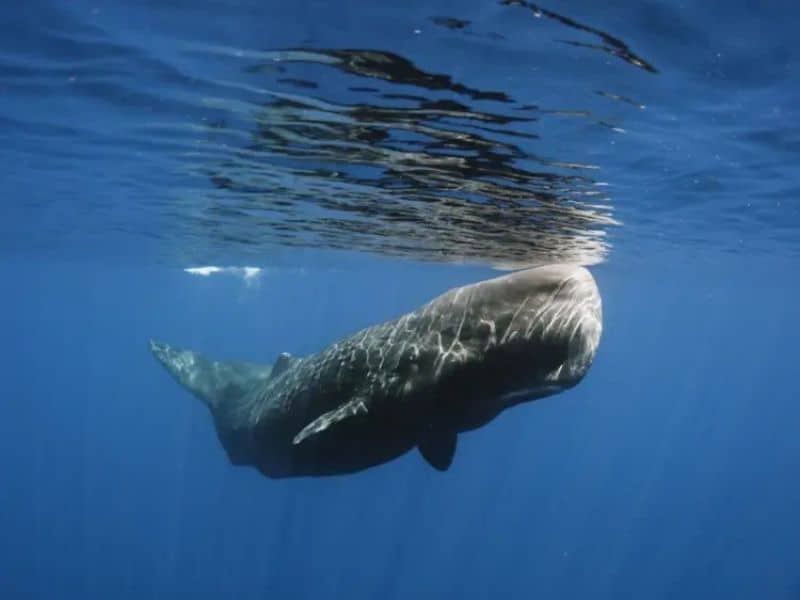
  1. Sperm Whale (Physeter macrocephalus)

The world’s biggest animal in the sea among toothed cetaceans. Famous for its spermaceti organ and for diving down to 3,000 meters (9,840 ft) to battle giant squids.

  • Length: 20.7 meters (67.9 ft)
  • Brain: 9 kg (19.8 lb.)
  • Sound: 230 dB

It is one of the loudest and most fascinating biggest animals in the sea.


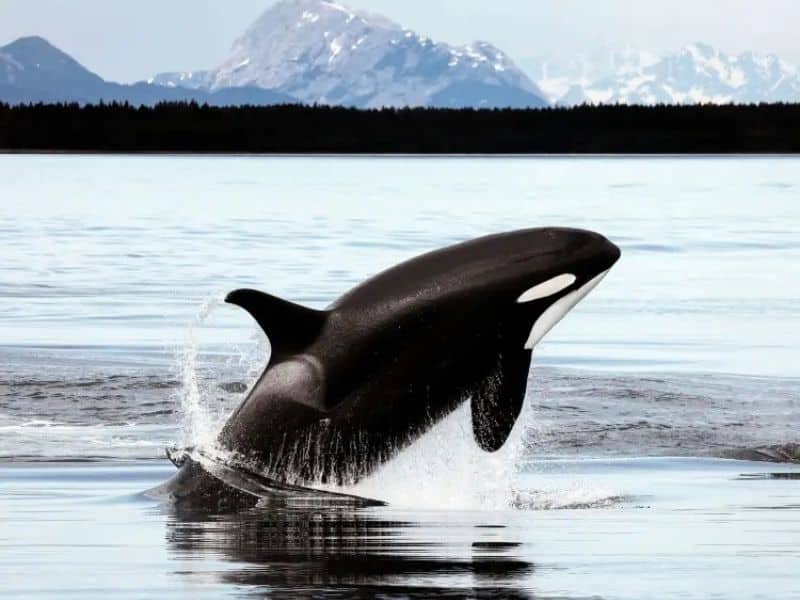
  1. Orca (Orcinus orca)

They are dolphins, but at 9 meters (29.5 ft) and 5 metric tons (≈11,000 lb.). They are apex predators. They have culture, dialects, and hunting strategies passed down from mothers to offspring. A well-deserved spot among the biggest sea animals in the world.

Biggest Animals in the Sea - Los animales más grandes del mar (2) orca
  1. Giant Squid (Architeuthis dux)

The longest invertebrate: 13 meters (42.7 ft). Eyes measuring 30 cm (11.8 in) to see in total darkness. For centuries it was the Kraken; today it is one of the most elusive biggest animals in the sea.


  1. Lion’s Mane Jellyfish (Cyanea capillata)

Pay attention here: its 36.6-meter (120.1 ft) tentacles can exceed the Blue Whale in length. It lives in cold waters and its neurotoxins are potent. A filamentous giant among the biggest animals in the sea.


  1. Reef Manta Ray (Mobula alfredi)

Reaches a 5.5-meter (18.0 ft) wingspan. It is more “homebound” than its oceanic cousin but remains one of the top 10 biggest sea animals in the world. They reproduce very slowly, with only about 7 offspring in a lifetime.


  1. Great White Shark (Carcharodon carcharias)

The largest macropredatory fish. 6.1 meters (20.0 ft) and 2,200 kg (≈4,850 lb). Its 1.8-metric ton bite (≈3,970 lb) is legendary. It is a fundamental pillar when talking about the biggest animals in the sea.


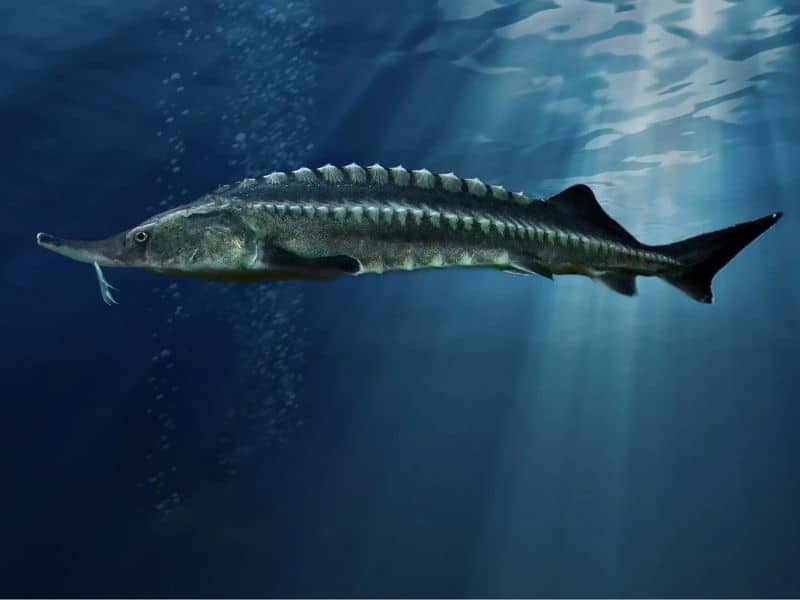
  1. Beluga Sturgeon (Huso huso)

The largest bony fish: 7.2 meters (23.6 ft) and 1,571 kg (≈3,463 lb.). It lives over 100 years but is endangered due to the value of its caviar. A living fossil that closes our list of biggest sea animals in the world.

Biggest Animals in the Sea - Los animales más grandes del mar (9) huso huso

3. Why Are the Biggest Animals in the Sea the Largest in The World?

Look, nature doesn’t do these things on a whim. If the biggest animals in the sea exist, it’s because the design works. It’s not just aesthetics; it’s pure survival.

Here are the main theories on why the big blue is the factory for the biggest animals in the sea and the world:

  • Gravity is Kinder: On land, if you weigh 100 tons, your legs simply say “that’s it” and snap. In the water, buoyancy does the dirty work. The biggest animals in the sea can grow and grow because the ocean supports them like an infinite mattress.
  • Being Big has Perks: If you are one of the biggest animals in the sea, you have fewer enemies. Nobody wants to pick a fight with someone 20 meters long. Plus, being a giant helps you spend less energy proportionally and allows you to travel thousands of miles without getting as tired.
  • The Deep Freeze: It’s freezing at the bottom of the sea and food is scarce. The solution? Abyssal gigantism. Cold temperatures mean a slow metabolism and sometimes growth that never stops, creating some of the strangest biggest animals in the sea we know.
  • A Historical Oxygen Boost: It wasn’t always like this. Some theories suggest that in the Paleozoic Era, oxygen levels were through the roof. This allowed for biggest animals in the sea that today would look like something out of a horror movie.


4. Fun Facts and Records of the Biggest Animals in the Sea

Blue Whale (Balaenoptera musculus)

  • Calf: It drinks about 200 liters of breast milk a day (≈53 US gallons), with 50% fat content. It gains 90 kg per day (≈198 lb.) during its first year, which is equivalent to almost 4 kg per hour (≈8.8 lb. per hour).
  • Heart: So large that a human could swim through its main arteries. During a dive, its heart can beat as few as 2 times per minute to conserve oxygen.
  • Feeding: It consumes 4 metric tons of krill per day (≈8,820 lb.).
  • Tongue: It weighs as much as an elephant. Its mouth could hold a stadium full of people, although its throat is only the size of a dinner plate, as it only eats krill.


Giant Manta Ray (Mobula birostris)

  • Social Behavior: They are known for their curious and playful behavior; they often approach divers and can perform spectacular leaps out of the water.


Whale Shark (Rhincodon typus)

  • Giant Filter Feeder: The whale shark is the largest fish in the world, but it feeds mainly on plankton, small fish, and crustaceans, filtering enormous amounts of water through its gills.
  • Impressive Migrations: It performs very long migrations, sometimes crossing entire oceans in search of food-rich waters.
  • Travel Companions: Often, they can be seen accompanied by cleaner fish, such as remoras, which attach to their skin to feed on parasites.


Sperm Whale (Physeter macrocephalus)

  • Sound: It produces a sound of 230 dB, the most intense of any animal, even surpassing the noise of a space rocket (180 dB). This intensity allows the sperm whale to “see” in the abyss and paralyze prey.
  • Diving Depth: It can descend to 3,000 m (≈9,840 feet).


Orca (Orcinus orca)

  • Behavior: They are apex predators with their own culture and dialects, transmitted from generation to generation.


Giant Squid (Architeuthis dux)

  • Eyes: They have eyes the size of a basketball, measuring 30 cm (11.8 inches), which allows them to detect bioluminescence in the darkness.


Lion’s Mane Jellyfish (Cyanea capillata)

  • Bioluminescence: Although not as well known for bioluminescence as other jellyfish, in the dark it can emit a faint glow that helps attract its prey.
  • Natural Predators: Despite its size and stinging tentacles, the Lion’s Mane Jellyfish is preyed upon by some species of sea turtles and certain fish.
  • Not an Enemy: Despite its imposing appearance, humans have experienced its stings, which, although painful, are usually temporary.


Reef Manta Ray (Mobula alfredi)

  • Reproduction: They reproduce very slowly, with only about 7 offspring throughout their entire life.


Great White Shark (Carcharodon carcharias)

  • Bite: Its bite can reach 1.8 metric tons (≈3,970 lb), making it legendary.


Beluga Sturgeon (Huso huso)

  • Longevity: It lives more than 100 years, but it is in danger due to the value of its caviar.
Biggest Animals in the Sea - Los animales más grandes del mar (6)

5. FAQ: Frequently Asked Questions about the Biggest Animals in the Sea

What is the biggest animal in the sea currently?

Without a doubt, the gold medal for the biggest animal in the sea by mass and volume goes to the Blue Whale. Nothing on the planet compares in weight, reaching 190 tons (418,878 lb).

What is the biggest animal in the sea in terms of length?

Here is the catch. If we stretch animals out like bubblegum, the Lion’s Mane Jellyfish could be the biggest animal in the sea in length, as its tentacles reach 36.6 meters (120 ft), surpassing the 33.5 meters (110 ft) of the Blue Whale.

What animal is the biggest animal in the sea ever?

Historically, the Blue Whale still wins. There is no fossil record of any animal—not even the famous Megalodon or the craziest marine dinosaurs—that has surpassed the mass of a Blue Whale. It is officially the biggest animal in the sea ever.

What is the world’s biggest animal in the sea if we talk about fish?

If we exclude mammals (whales), the world’s biggest animal in the sea is the Whale Shark. Even though it measures 18.8 meters (61.7 ft), it is a gentle giant that only eats plankton.

Where can I see the biggest sea animal in the world in the wild?

To see the Blue Whale, the biggest sea animal in the world, places like Baja California in Mexico or the coasts of Iceland are your best bets.

Are you up for a liveaboard boat trip? It’s more than possible that you’ll also see the other 9 biggest animals in the sea.

Contact us ,and we will help you!

CONTACT US FOR
PERSONALIZED ASSISTANCE

Ready to improve your dive skills?
Need more information about the next certification level?

WE ARE HERE TO HELP

contact

    I consent to receiving commercial communications and promotions from Dressel Divers.